

Key takeaways
- Inspect twice a year: replace expired food, damaged water pouches, dead batteries, dried wipes, and leaking containers.
- Rotate seasonal clothing: a summer kit may be dangerously inadequate during a winter evacuation.
- Keep weight usable: a backpack over about 20–25% of the wearer’s body weight becomes difficult for many people to carry far. Split family supplies between packs.
- Protect electronics: store radios, power banks, and lights in waterproof bags, but do not leave lithium batteries in extreme heat inside a vehicle.
- Practice once: open the packaging, unfold the shelter, test the radio, use the can opener, and confirm everyone knows the meeting place.
- Replace what gets used: a kit is not “finished” after an outage if its batteries, food, or first-aid items were consumed.
The best emergency survival kits are the ones that match your likely emergency: the Ready America 70280 Emergency Kit is a practical low-cost choice for short evacuations, the Uncharted Supply Co. Seventy2 Pro is the most capable compact grab-and-go pack, and a custom kit built around water, shelter, and medication needs is best for families, vehicles, and longer disruptions.
No prepacked kit is a complete solution. Most are strongest in basic first aid, food bars, tools, and light, but weaker in drinking-water capacity, sanitation, warmth, prescription medication, and communication. The figures below describe realistic starting coverage rather than the optimistic “survival days” sometimes printed on packaging.
Our top picks


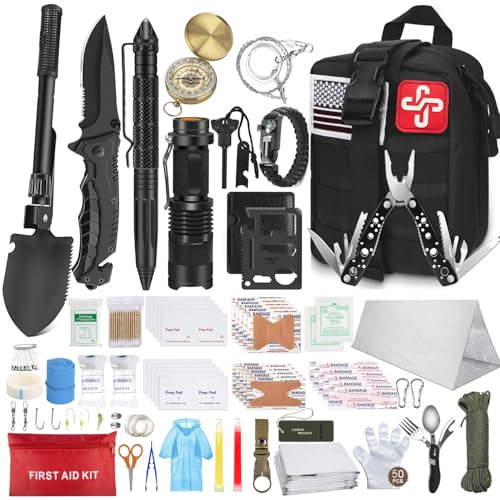
As an Amazon Associate we earn from qualifying purchases at no extra cost to you. Ratings are shown as listed on Amazon.
Best emergency survival kits by situation
| Situation | Best fit | Realistic coverage | Why it wins |
|---|---|---|---|
| Apartment evacuation on a budget | Ready America 70280 Emergency Kit | 1 person, about 1 day of food and water; several days of basic supplies | Low cost, compact, and easy to supplement |
| Prepared grab-and-go backpack | Uncharted Supply Co. Seventy2 Pro | 1 person, roughly 24–72 hours depending on climate and water access | Better organization, tools, shelter, light, and water treatment |
| Family home emergency supply | Modular custom kit | 2–4 people, 3–7 days when stocked correctly | Allows enough water, food, sanitation, medicines, and clothing |
| Vehicle breakdown or roadside evacuation | Vehicle-specific roadside kit plus water and blankets | 1–4 people, one night without resupply | Reflective visibility, warmth, signaling, and vehicle tools matter most |
| Outdoor emergency or remote travel | Backcountry-oriented kit assembled around a first-aid kit, shelter, filter, and beacon | 1–2 people, 24–48 hours beyond planned supplies | Prioritizes weight, navigation, and reliable signaling |
Head-to-head: Ready America versus Seventy2 Pro
The Ready America 70280 is a sensible starter kit for earthquakes, power outages, and evacuation orders when money and storage space are limited. It typically combines emergency food bars, water packets, a first-aid kit, light, a radio or communication tool, masks, gloves, a whistle, and basic sanitation items. Contents can vary by package revision, so check the current box before relying on a specific item.
Its limitation is depth. A small number of water packets is not a household water reserve, and compact food bars provide emergency calories rather than enjoyable or nutritionally varied meals. Treat it as a one-person “leave now” kit, then add a larger water supply, medications, a power bank, warmer clothing, and a better light.
The Seventy2 Pro is a more deliberately organized backpack rather than a simple box of supplies. Its contents have included water-treatment equipment, food, shelter materials, first-aid supplies, a flashlight, fire-starting equipment, gloves, tools, and sanitation items. It is more useful when you may need to walk, spend a night outdoors, or solve several small problems without a household nearby.
It is still not a three-day water and food supply for most adults. Water-treatment gear only helps if you can find a suitable water source, and a compact emergency shelter is not equivalent to a tent and sleeping system in cold or wet weather. Its higher price—commonly in the several-hundred-dollar range—buys organization and capability, not unlimited endurance.
What each essential category should actually cover
Water
Plan around at least 1 gallon per person per day for drinking and basic cooking, with more in heat or strenuous conditions. Many commercial kits contain only a few pouches or treatment tools. A useful household target is 3 gallons per person for a short outage, expanding toward 14 gallons per person for a week. Include sealed water, not just a filter: filters require a source, can clog, and may not remove every contaminant.
Food
Emergency food bars are compact and have long shelf lives, but they are monotonous and usually require extra calories to reach a full day for an active adult. For a three-day household supply, combine shelf-stable meals, nut butter, canned fish or beans, crackers, and high-energy snacks. Add a manual can opener and a way to heat water if the meals require it. Check allergen labels and replace food before its best-by date.
Shelter and warmth
Look for an emergency bivy or sleeping bag, a durable tarp or tube tent, a ground sheet, hand warmers, and spare socks. A reflective blanket is useful for wind and radiant heat but tears more easily than a coated nylon tarp. In cold regions, shelter is a priority equal to food; in hot regions, shade and breathable clothing can prevent heat stress.
First aid
Most commercial first-aid pouches cover minor cuts, dressings, gloves, and simple pain relief. They rarely provide enough material for several people or a serious injury. Add personal prescriptions, spare eyeglasses, medical information, blister care, larger dressings, and any items recommended by a clinician. Do not use an unfamiliar medical device or medication in an emergency without appropriate training or professional guidance.
Lighting and power
A headlamp is more useful than a hand flashlight when carrying water or treating an injury. Aim for one light per person, plus a backup, and store spare batteries in their original packaging. A 10,000 mAh power bank can often recharge a modern phone roughly one to two times after conversion losses, not ten times. Store it charged and inspect it for swelling or heat damage.
Communication and navigation
A whistle, paper contact card, local map, pencil, and battery or hand-crank radio cover different failure modes. Phones may lose service or power, while a radio may provide public alerts without cellular connectivity. In remote terrain, a satellite messenger or personal locator beacon is more appropriate than assuming a phone will work; learn the device before an emergency and maintain its subscription where required.
Sanitation
Sanitation is one of the most overlooked categories. Stock toilet bags or a bucket-liner system, toilet paper, heavy-duty gloves, hand sanitizer, soap, disinfecting wipes, menstrual supplies, trash bags, and sealable bags. One small packet of wipes is not a multi-day sanitation plan for a family.
Decision matrix: buy, supplement, or build
| Your priority | Recommended approach | Minimum upgrade |
|---|---|---|
| Lowest budget and little experience | Ready America-style boxed kit | Add water, headlamps, medications, and a paper contact sheet |
| Very limited apartment storage | One organized backpack per adult | Keep separate water containers under beds or in a closet |
| Family with children or pets | Custom home kit plus individual grab bags | Add age-appropriate food, diapers or pet food, and comfort items |
| Frequent camping or remote travel | Backcountry kit integrated with normal gear | Add navigation, repair supplies, water capacity, and signaling |
| Car-based preparedness | Roadside kit stored in the passenger compartment | Add seasonal clothing, water, traction aid, and a charged power bank |
How to calculate realistic coverage
Suppose a kit contains six 4.2-ounce emergency food bars labeled at 3,600 calories total and four 4.2-ounce water pouches totaling about 0.4 gallons. For one adult, the food may provide roughly one day of reduced activity, but the water supplies less than half a normal day’s drinking requirement. For two people, it is approximately half a day of food and water.
This calculation exposes a common labeling problem: “72-hour kit” may describe the intended emergency window, not 72 hours of complete hydration and normal energy intake. Write the actual food calories, water volume, and number of users on the outside of the container.
Ownership realities and maintenance
- Inspect twice a year: replace expired food, damaged water pouches, dead batteries, dried wipes, and leaking containers.
- Rotate seasonal clothing: a summer kit may be dangerously inadequate during a winter evacuation.
- Keep weight usable: a backpack over about 20–25% of the wearer’s body weight becomes difficult for many people to carry far. Split family supplies between packs.
- Protect electronics: store radios, power banks, and lights in waterproof bags, but do not leave lithium batteries in extreme heat inside a vehicle.
- Practice once: open the packaging, unfold the shelter, test the radio, use the can opener, and confirm everyone knows the meeting place.
- Replace what gets used: a kit is not “finished” after an outage if its batteries, food, or first-aid items were consumed.
Bottom line
Choose a Ready America-style kit when you need an affordable starting point, the Seventy2 Pro when portability and organization justify a higher price, and a custom modular setup when more than one person, more than one day, or extreme weather is involved. The deciding test is simple: count the liters of water, calories, warm sleeping protection, usable light, communication method, and sanitation supplies—not the number printed on the package.





Write Your Review
No reviews yet. Be the first to share your experience!