

Key takeaways
- Best beginner setup: An Iwata Neo CN or Badger Patriot 105 with a regulated, tank-equipped compressor. Both are forgiving, serviceable choices for models, crafts, terrain, and basic artwork.
- Best all-purpose upgrade: The Iwata Eclipse HP-CS, with its 0.35 mm nozzle and 7 ml gravity cup. It handles hobby paints, primers, illustration colors, and moderate coverage without being difficult to clean.
- Best for fine detail: A 0.2–0.3 mm gravity-feed airbrush, such as a detail-oriented Iwata or GSI Creos model, used with well-thinned paint and carefully controlled pressure.
- Best for broad coverage: A 0.5 mm airbrush such as the Badger Patriot 105, or a kit that includes interchangeable 0.5–0.8 mm components. Larger nozzles move thicker paint and cover panels faster.
- Best portable option: A cordless, USB-rechargeable airbrush system for brief craft sessions and touch-ups. It is convenient, but usually lacks the sustained pressure and fine regulation needed for large models or professional work.
The best airbrush kits for most beginners are a gravity-feed, dual-action airbrush paired with a quiet compressor that can deliver 20–30 PSI; pros should choose the nozzle, cup system, hose fittings, and compressor capacity around the materials and surfaces they spray most often.
Our top picks


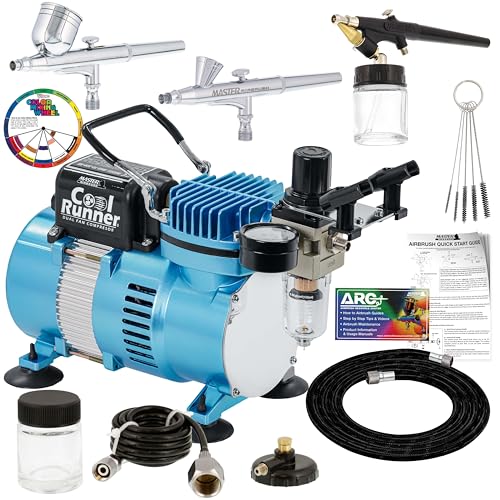
As an Amazon Associate we earn from qualifying purchases at no extra cost to you. Ratings are shown as listed on Amazon.
Quick picks by project
- Best beginner setup: An Iwata Neo CN or Badger Patriot 105 with a regulated, tank-equipped compressor. Both are forgiving, serviceable choices for models, crafts, terrain, and basic artwork.
- Best all-purpose upgrade: The Iwata Eclipse HP-CS, with its 0.35 mm nozzle and 7 ml gravity cup. It handles hobby paints, primers, illustration colors, and moderate coverage without being difficult to clean.
- Best for fine detail: A 0.2–0.3 mm gravity-feed airbrush, such as a detail-oriented Iwata or GSI Creos model, used with well-thinned paint and carefully controlled pressure.
- Best for broad coverage: A 0.5 mm airbrush such as the Badger Patriot 105, or a kit that includes interchangeable 0.5–0.8 mm components. Larger nozzles move thicker paint and cover panels faster.
- Best portable option: A cordless, USB-rechargeable airbrush system for brief craft sessions and touch-ups. It is convenient, but usually lacks the sustained pressure and fine regulation needed for large models or professional work.
What separates a useful kit from a cheap bundle?
A kit is only as capable as its least suitable component. A low-cost package may include an airbrush, compressor, hose, cleaning brush, and paint cups, but the compressor may pulse, the hose may use an unusual fitting, and the nozzle may clog easily. Before comparing accessory counts, check four specifications: operating pressure, nozzle size, connection type, and cleaning access.
| Kit type | Typical nozzle | Useful pressure | Paint cup or reservoir | Best use | Main limitation |
|---|---|---|---|---|---|
| Portable cordless kit | 0.3–0.5 mm | 15–25 PSI | 5–20 ml | Small crafts, makeup-style effects, touch-ups | Short runtime and weak regulation |
| Entry-level tankless compressor kit | 0.3–0.5 mm | 20–35 PSI | 7–22 ml | Models, crafts, occasional painting | More pulsing and heat during long sessions |
| Tank compressor kit | 0.2–0.5 mm | 10–40 PSI | 5–22 ml | Regular hobby use and illustration | Costs more and occupies more space |
| Professional modular setup | 0.15–0.8 mm | 8–60 PSI | 2–50 ml | Detail, priming, murals, automotive work | Separate parts require more setup knowledge |
Nozzle size should follow the paint and surface
0.15–0.2 mm: detail and controlled lines
Small nozzles are appropriate for thin illustration inks, shading, fine camouflage patterns, and miniature details. They demand clean, well-filtered paint. Acrylic paint that is too thick will clog the nozzle, while excessive thinning can cause spidering, poor coverage, or tip drying. These airbrushes are excellent detail tools but inefficient for priming an entire model.
0.3–0.35 mm: the versatile middle ground
A 0.3 or 0.35 mm nozzle is the safest choice for a first serious airbrush. It can spray many hobby acrylics after thinning, produce controlled lines, and cover a 1/24-scale car body or several miniatures without taking all day. The Iwata Neo CN and Iwata Eclipse HP-CS are familiar examples of this general-purpose format.
0.5 mm and larger: coverage and thicker materials
Larger nozzles are better for primers, varnishes, base coats, textile colors, and larger surfaces. The Badger Patriot 105 is commonly selected for this reason. It sacrifices some fine-line control, but it is less fussy when spraying heavier paint. Do not assume a large nozzle makes every paint safe to spray: strain the paint and follow the coating manufacturer’s thinning guidance.
Compressor pressure matters more than advertised maximum PSI
Airbrushes usually work across a broad pressure range, but the useful setting depends on the paint. Start around 15–20 PSI for thin acrylic color, 20–30 PSI for many primers and base coats, and adjust in small increments. A listed maximum of 50 or 60 PSI does not mean the compressor can maintain that pressure while spraying.
A tank-equipped compressor is usually the better investment for regular use. Its reservoir stores compressed air, reducing the pulsing associated with a motor that switches on and off while you spray. A regulator with a moisture trap lets you set pressure at the outlet rather than guessing from the compressor’s maximum rating. For occasional small work, a tankless unit can be adequate; for sessions longer than 20–30 minutes, a tank generally provides steadier output and cooler operation.
Consider air delivery as well as pressure. A compressor producing roughly 0.5–1.0 cubic feet per minute at working pressure is suitable for most single-airbrush hobby applications. Larger spray guns and some textile or automotive jobs require substantially more airflow.
Hose fittings: the overlooked compatibility problem
Many airbrushes use a small 1/8-inch connection, while some Badger airbrushes use a 1/16-inch fitting. A hose can therefore fit the compressor but not the airbrush. Before buying a replacement hose, identify both ends and purchase an adapter when necessary. The adapter should seal firmly without forcing the threads; thread seal tape is used only where the fitting design calls for it, not on every connection.
A braided, flexible hose around 1.8 metres long is a practical default. Shorter hoses take less space, while longer hoses make a floor-mounted compressor easier to use. Avoid sharply bending the hose near the airbrush because repeated flexing can damage the inner tube and create intermittent leaks.
Decision matrix: which setup fits your situation?
| Your situation | Recommended configuration | Why it fits |
|---|---|---|
| First airbrush, small budget, occasional projects | 0.35–0.5 mm gravity airbrush; tankless compressor; 1/8-inch hose or adapter | Low entry cost and enough flexibility for crafts and models |
| Weekly miniature or scale-model painting | 0.3–0.35 mm airbrush; 2–3 litre tank; regulator and moisture trap | Steadier pressure and better control during longer sessions |
| Fine illustration or camouflage | 0.2–0.3 mm gravity airbrush; adjustable regulator; filtered paint | Supports narrow lines without committing to a specialist-only nozzle |
| Priming and broad base coats | 0.5 mm airbrush; 20–35 PSI; larger cup or side-feed reservoir | Moves thicker coatings and reduces passes over large surfaces |
| Limited workspace or travel | Rechargeable portable unit or compact compressor; 0.3–0.5 mm nozzle | Easy storage, but best for short sessions and small surfaces |
Cleaning demands and ownership costs
Cleaning is not an optional accessory feature. After each color, spray the appropriate cleaner through the airbrush until it runs mostly clear, wipe the cup, and remove paint from the nozzle area. At the end of a session, flush more thoroughly and inspect the needle tip. Dried paint on the needle or nozzle is one of the most common causes of sputtering.
For a deeper clean, remove the needle carefully from the rear, then remove the nozzle only when needed. A nozzle wrench, interdental brushes, soft cleaning brushes, and a spray-out pot are useful additions. Do not push a metal tool through a precision nozzle; a tiny change in its shape can permanently affect the spray pattern.
The parts that wear first are usually the needle tip, nozzle, needle packing, and hose seals. Replacement needles and nozzles commonly cost about $10–$40 per part, depending on the brand and precision. A basic cleaning and replacement budget of roughly $20–$60 per year is reasonable for a hobbyist who sprays weekly, excluding paint and thinner.
A simple setup method that prevents most problems
- Install the hose and check for leaks. Run the compressor briefly with the airbrush trigger untouched. Hissing at a joint indicates a fitting or seal problem.
- Set the regulator before adding paint. Begin at about 15–20 PSI, then raise pressure only if the paint refuses to atomize.
- Thin and strain the paint. Use the paint maker’s recommended thinner where possible. Straining removes lumps that can block a 0.2–0.35 mm nozzle.
- Test on scrap material. Check the spray pattern, overspray, and drying time before moving to the finished project.
- Spray in light passes. Several thin coats produce more even coverage than holding the airbrush close and flooding the surface.
- Flush between colors and clean after use. This takes less time than dismantling an airbrush after paint has dried inside it.
How much compressor capacity do you need?
Suppose an airbrush consumes approximately 0.6 cubic feet per minute and your compressor’s tank stores 0.8 gallons. That tank is not a large reserve, so the motor may run frequently during a continuous session. A 2–3 litre tank provides a more useful buffer for hobby spraying, particularly when the compressor has a reliable regulator. The exact runtime varies with pressure, leaks, duty cycle, and the compressor’s actual air-delivery rating, so treat tank size as a comfort and stability feature rather than a guaranteed runtime figure.
Final buying advice
For the widest range of projects, choose a 0.3–0.35 mm gravity-feed airbrush, a quiet compressor with a 2–3 litre tank, a regulator, a moisture trap, and a standard 1/8-inch hose connection. Spend the next part of the budget on cleaning tools and replacement needles rather than a large accessory bundle. Choose a 0.2 mm setup only when fine detail is the priority, and choose 0.5 mm when primers, thick coatings, or broad surfaces matter more than hairline control. That combination of nozzle size, stable pressure, compatible fittings, and manageable cleaning will matter more than the number of items printed on the kit’s packaging.






Write Your Review
No reviews yet. Be the first to share your experience!