

Key takeaways
- Five chicken treats compared: scratch grains, seed and grub blends, a coop cake and a flock block, plus the portion rules that protect your layer feed.
As an Amazon Associate we earn from qualifying purchases.
Chicken treats are the extras scattered, hung or set out on top of a flock’s ordinary ration: scratch grains, seed-and-grub blends, pressed cakes and big flock blocks. They are how keepers tame shy hens, call a scattered flock back to the run, and give confined birds something to do on a long winter day. What they are not is feed. Every product in this roundup is a supplement to a complete layer ration, and the honest starting point for the whole category is that a treat’s job is entertainment and training leverage, while the layer pellets or mash do the nutritional work.
The five picks below cover the four formats that make up this shelf: a vegetable-and-grain blend, a seven-grain scratch, a seed-and-mealworm blend, a small pressed coop cake, and a full-size flock block with grit and shell built in. Each is judged on what its maker publishes — the ingredient panel, the guaranteed analysis where one is printed, and the feeding directions — because in this category the label is where the difference between a reasonable extra and flavoured filler actually shows.
Affiliate Disclosure: This article contains affiliate links. If you buy through a link on this page, the site may earn a commission at no additional cost to you. Products are selected on their published specifications and labelling, and claims are reported as their makers state them.
The rule that governs every treat on this page
Treats are at most about 10 percent of the diet. That figure appears in makers’ own feeding directions — Pecking Order prints it on the bag below — and it exists because of simple arithmetic. A laying hen needs a ration built around roughly 16 percent protein with a substantial calcium level to lay consistently. Treats run far below that: scratch grains are mostly starch, and even a protein-forward blend dilutes the ration once it displaces real feed. Over-treat for a few weeks and the results show up exactly where a keeper least wants them — thinner shells, cracked eggs, fewer eggs, and hens that fill up on corn and skip the feeder. A tablespoon or two per bird per day is the working portion for bagged treats, and it is smaller than most people guess.
Scratch is energy, not nutrition. Cracked corn and whole grains are carbohydrate. The traditional use — a handful scattered in the late afternoon on cold days, so the birds go to roost with a full crop and generate heat digesting it overnight — is a legitimate one, and several makers describe their scratch in exactly those terms. Framed plainly, though, corn is candy: it is the ingredient hens pick out first and the one with the least protein on the panel. Scratch earns its place as a winter-evening ritual and a flock-calling tool, not as a meaningful share of what a hen eats.
Grit and oyster shell are separate, and treats replace neither. Hens have no teeth; whole grains are ground in the gizzard, and that grinding requires insoluble grit, which birds on bare runs may not find for themselves. Calcium is a second, separate need: laying hens need free-choice oyster shell in its own dish, taken as they need it, which is a different system from the calcium blended into layer feed. Two of the picks below carry some oyster shell or granite grit inside the product, and that is a genuine convenience — but a block or blend is eaten at treat rates, not at the rate a laying hen actually consumes shell and grit. Keep both dishes filled regardless of what treats are in the run.
Blocks and cakes are boredom relief first. A pressed block’s second function is occupational. A flock confined by snow, mud or a predator scare pecks at each other when it has nothing else to peck at; a hard block or a hanging cake gives that behaviour a target that lasts days instead of minutes. Makers position their cakes and blocks this way themselves, and it is the most defensible reason to buy the format.
Store treats like the food they are. Seed and grain blends go stale in two quiet ways: feed mites colonise bags kept warm and open, and the oils in sunflower seed and flax turn rancid. Keep treats sealed, dry and off the floor, use the oldest bag first, and throw out anything that smells musty or moves. Check best-by dates and lot codes when a bag arrives, too: poultry treats do get recalled occasionally — Manna Pro, for example, recalled a single lot of a different treat line in 2021 over possible Salmonella contamination, long since closed — and the date code is how a keeper knows a given bag is not part of one.
1. Manna Pro Harvest Delight Poultry Treat, 2.25 lb — the garden blend
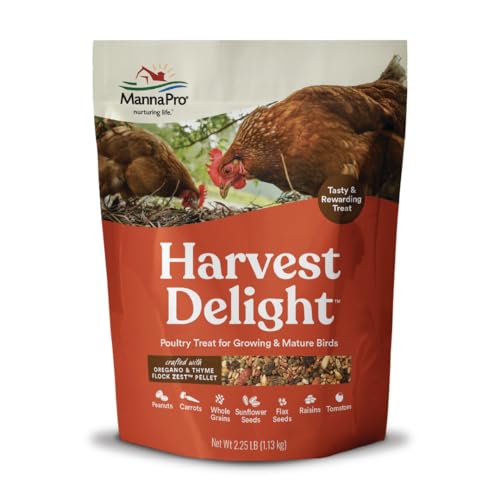
Harvest Delight is the most vegetable-forward bag in this list: wheat, peanuts, corn and millet mixed with raisins, dried tomatoes, dried carrots, popcorn, sunflower kernels and flaxseed, finished with soybean meal, dehydrated alfalfa and the oregano and thyme the maker calls its Flock Zest seasoning. The published protein figure is 14 percent from vegetarian sources, which is high for a scatter blend and reflects the peanut, soybean and seed content rather than any insect protein — keepers who specifically want grubs in the mix should look at the Pecking Order blend or the cake below instead.
The maker’s directions are unusually specific for this shelf: half a tablespoon to two tablespoons per bird per day, which lands squarely inside the 10 percent rule and makes this the easiest pick to portion honestly. It works scattered on the ground to encourage foraging, in a dish, or from the hand for taming. One listing detail worth knowing: the bag is sold as a 2.25 lb bag, matching the maker’s own specification sheet, even though one secondary field on the listing page states a slightly different weight — the 2.25 lb figure is the one the maker publishes.
Specs
- Bag weight: 2.25 lb
- Protein as published: 14 percent crude protein, from vegetarian sources
- Ingredient headline: Wheat, peanuts, corn, millet, raisins, dried tomatoes, dried carrots, popcorn, sunflower kernels, flaxseed, sunflower seeds, safflower seeds, soybean meal, milo, dehydrated alfalfa meal, oregano and thyme
- Feeding rate as published: One half to two tablespoons per bird per day
- Intended use: Scattered, dish-fed or hand-fed treat blend for adult poultry
- UPC: 095668136918
2. Manna Pro 7-Grain Ultimate Chicken Scratch, 10 lb — the winter-evening scratch

This is the scratch pick, and it should be bought as scratch: seven grains — corn, wheat, milo, barley, oats, sunflower seed and millet — with propionic acid as a preservative, in a 10 lb bag sized for a flock rather than a trio of hens. The listing describes the grains as non-GMO, and the mix is a step up from the plain cracked-corn scratch that is the bottom of this shelf, because the barley, oats and sunflower seed widen what the birds are actually picking through. It is still an energy product with no fortification behind it, and the maker’s plainer three-grain scratch sold under a similar name states the category rule outright: scratch is not fortified and should not make up more than about 10 percent of the diet. That warning applies to this bag with equal force.
Used as intended — a modest handful per bird scattered late in the day, more as a flock-calling and roost-filling ritual than as food — a 10 lb bag lasts a small flock a long time, which is the practical argument for the format. Hens still need their grit dish filled to grind whole grains like these, and the scratch does nothing for calcium. Buy it for cold evenings and for training birds to come when called, not as a protein strategy.
Specs
- Bag weight: 10 lb
- Model number: 1000853
- Ingredient headline: Corn, wheat, milo, barley, oats, sunflower seed, millet, propionic acid (preservative)
- Grain count: Seven grains, described on the listing as non-GMO
- Intended use: Scatter scratch, fed as a supplemental energy treat alongside a complete ration
3. Pecking Order Mealworm & Sunflower Treat, 3 lb — the seed-and-grub blend

Pecking Order’s blend leads with sunflower in three forms — black oil sunflower seeds, striped sunflower and sunflower hearts — then cracked corn, flax seed, dried mealworms, peanut pieces and raisins, with calcium carbonate and a vitamin A and D3 supplement folded in. That ingredient order matters: the mealworms are a real component but not the bulk of the bag, which makes this a seed blend with grub content rather than a bag of dried mealworms, and it is priced and portioned accordingly. The added calcium carbonate is a thoughtful touch in a treat aimed at laying hens, though at treat portions it supplements the oyster shell dish rather than replacing it.
The maker’s directions are the category rule stated on the bag itself: offer it in a small feeder or scattered on the ground to promote foraging, and keep treats at no more than 10 percent of a laying hen’s diet. The 3 lb bag is the middle size on this page — enough for regular use in a backyard flock without the storage commitment of the 10 lb scratch bag — and the flax content is one more reason to store it sealed and use it while it is fresh, since flax oil is among the first ingredients in any blend to turn.
Specs
- Bag weight: 3 lb
- Model number: 9328
- Ingredient headline: Black oil sunflower seeds, cracked corn, striped sunflower, sunflower hearts, flax seed, dried mealworms, peanut pieces, raisins, calcium carbonate, vitamin A and D3 supplement
- Feeding guidance as published: Treats should not exceed 10 percent of a laying hen’s diet; feed in a small feeder or scatter on the ground
- Package dimensions: 4 x 10.5 x 11 inches
- UPC: 737539093288
4. Manna Pro Mealworm Medley Cake, 19.5 oz — the coop cake

The Mealworm Medley Cake compresses the blend idea into a single pressed cake: corn, dried mealworms and sunflower seeds bound with soybean meal, hominy feed, feeding oatmeal, dried whey, dehydrated alfalfa meal, linseed meal, brewer’s dried yeast and gelatin. The maker publishes 16 percent protein for the cake, crediting its Calf-Manna supplement component — the highest protein figure among these five picks, delivered in the format that rations itself, since a hard cake gives up its contents a peck at a time instead of being inhaled in one scattering.
That self-rationing is the point of the pick. Set out or hung in the coop, the cake occupies a confined flock on wet or frozen days when scattering treats outdoors is not an option, and a single 19.5 oz cake suits a small flock better than a 25 lb block would. Two label details deserve attention: the maker directs it at adult poultry and advises against feeding it to birds under eight weeks, whose beaks and crops are not ready for its larger particle size, and the formula contains supplemental copper, so it should not be offered to sheep or other copper-sensitive species on mixed homesteads.
Specs
- Cake weight: 19.5 oz, single cake
- Protein as published: 16 percent, with Calf-Manna per the maker
- Manufacturer part number: 1000205
- Ingredient headline: Corn, dried mealworms, sunflower seeds, soybean meal, hominy feed, feeding oatmeal, dried whey, dehydrated alfalfa meal, linseed meal, brewer’s dried yeast, gelatin, vegetable oil
- Age guidance as published: Adult poultry; not recommended for birds under eight weeks
- Intended use: Placed or hung in the coop as a peck-at treat cake and boredom reliever
5. Kalmbach Feeds All Natural Poultry Block, 25 lb — the big run block

Kalmbach’s block is the heavyweight format: 25 lb of whole wheat, shelled and cracked corn, black oil sunflower seed and milo bound with molasses products and lignin sulfonate, and — the detail that separates it from a plain grain block — oyster shell and crushed granite worked into the matrix, alongside calcium carbonate and a set of Lactobacillus fermentation products the maker markets as its LifeGuard blend. Published protein for the block is 9 percent, squarely in flock-block territory: this is an occupation and slow-release extra, not a protein source. The block is pressed hard, a deliberate choice the maker describes as keeping it from falling apart in wet weather, and it is simply set on the ground in the run.
The directions define its role precisely: feed it as a supplement alongside a balanced complete feed, for poultry fourteen weeks and older, and not as a sole ration. The built-in oyster shell and granite are a real convenience — birds pick up some calcium and gizzard grit as they work the block — but the amounts eaten at block pace do not retire the separate grit and shell dishes, and keepers should read the block as topping those systems up, never as substituting for them. For a larger flock or a long confinement stretch, this is the pick that is still there next week; for three hens, the cake above is the proportionate version of the same idea.
Specs
- Block weight: 25 lb
- Protein as published: 9 percent crude protein
- Block dimensions: 9 x 9 x 9 inches
- Ingredient headline: Whole wheat, shelled corn, cracked corn, black oil sunflower seed, milo, molasses products, oyster shell, crushed granite, calcium carbonate, salt, lignin sulfonate, Lactobacillus fermentation products
- Feeding guidance as published: Supplement in conjunction with a balanced complete feed, for poultry 14 weeks and older; not for use as a sole ration
- Intended use: Ground-placed flock block for pecking enrichment
Feeding treats without undoing the layer feed
The discipline that makes all five of these products reasonable is the same: the feeder stays full of layer ration, the grit and oyster shell dishes stay filled in their own containers, and treats stay a measured extra — a tablespoon or two of a bagged blend per bird, a late-day scattering of scratch in cold weather, a cake or block set out for the days the flock cannot range. Introduce any new treat in small amounts, watch that the flock still eats its ration with appetite, and pull back if egg shells thin or lay rate dips, since those are the earliest visible signs that treats have crept past their share.
Store every bag and block dry and sealed, off the floor, oldest stock used first, and discard anything that smells rancid or shows signs of feed mites. Chosen in the format that fits the flock — a blend for hand-taming, scratch for winter evenings, a cake or block for confinement days — and fed inside the 10 percent rule, treats do the jobs they are actually good at: training, taming and keeping hens occupied, while the layer feed quietly does the feeding.
More from Amazon
Programs that pair well with the guide above. Offers and eligibility are set by Amazon and may change.
Free shipping on eligible items, Prime Video and more. Eligible new members can start with a free trial.
Start a Prime free trialA Prime membership for ages 18-24 with a trial period. Eligibility is set by Amazon.
See Prime for Young AdultsAudiobooks and podcasts to listen to on the go. Eligible new members can start with a free trial.
Try Audible freeAd-free music streaming. Eligible new subscribers can start with a free trial.
Try Music Unlimited freeAs an Amazon Associate we earn from qualifying purchases.










Write Your Review
No reviews yet. Be the first to share your experience!