

Key takeaways
- A beach umbrella in a steady onshore breeze behaves like a sail, and the wrong one will cartwheel down the sand with a good chance of hitting someone.
A beach umbrella in a steady onshore breeze behaves like a sail, and the wrong one will cartwheel down the sand with a good chance of hitting someone. That reality shapes this entire category: shoppers looking for an umbrella for windy beaches are not buying shade first, they are buying a way to keep the shade anchored. Anchor design, pole thickness, rib material and a vented canopy all matter more than size, while a bigger canopy catches more wind and puts more strain on every joint.
This guide compares six umbrellas for windy shorelines in 2026, using only details stated in the product titles, such as sand anchors, vent designs, rib materials and the safety standard cited on one listing. No umbrella is wind-proof, and every manufacturer says to close it in strong gusts. Use the listing to confirm canopy diameter, pole diameter and weight, and treat the ideas here as a way to narrow the field rather than a guarantee of how any umbrella behaves in a storm. Some beaches and parks also restrict umbrella size or require anchors, so a quick look at local rules before the trip is a smart step.
Quick Picks
Our top picks


As an Amazon Associate we earn from qualifying purchases at no extra cost to you.
| Product | Best for | Key spec from the title |
|---|---|---|
| LOTTAFUN 6ft Beach Umbrella | Small groups and lighter loads | 6 ft, sand anchor, UV 50+, carry bag |
| AMMSUN 7ft Beach Umbrella | Mid-size shade with tilt | 7 ft, sand anchor, vent, tilt, UPF 50+ |
| AMMSUN 8 Feet Beach Umbrella | Larger families wanting vent and tilt | 8 ft, sand anchor, air vent, tilt, UV 50+ |
| BEACHBUB All-in-One System | Buyers who want a base designed to a stated standard | Ultra base, ASTM F3681-24 cited |
| BEACH DUDES 8FT | Wind-focused construction | 4-point wind mitigation, 8mm fiberglass ribs, marine-grade pole |
| Tommy Bahama ANCHORX 7 ft | Branded option with a wind stability system | 7 ft, sand anchor, wind vents, manual tilt, UPF 50+ |
How to Choose
The anchor matters more than the canopy
Wind pulls an umbrella up and sideways, so the anchor is the first line of defense. Corkscrew-style sand anchors drive deeper into the beach than a plain pointed pole, and they work best when screwed in below the damp layer where the sand packs harder. Weighted bases suit hard-packed ground. The BEACHBUB listing refers to the ASTM F3681-24 beach umbrella safety standard for its base, which is worth reading about on the listing page. Whatever the anchor, bury it deep and angle the umbrella into the wind. Pointing the pole slightly toward the breeze lets gusts push the canopy down rather than lifting it, which is the usual guidance on windy days. Check the anchor again after an hour, because shifting sand and tide moisture can loosen a setup that felt solid at first. Anyone setting up near other families should leave generous space, so a loose umbrella has less chance of reaching a neighbor.
Canopy size, vents and tilt
Larger canopies shade more people but catch more wind. A six or seven foot umbrella gives more margin than an eight-footer in gusty conditions. Vents let air pass through the canopy so it does not act like a solid sail, and a tilt mechanism lets the user angle the canopy toward the sun or the wind. Look for vent design and tilt hardware that feels sturdy on the listing, since a weak joint is where an umbrella usually fails. A tilt lock that clicks firmly into place is worth more than a flashy finish, and a carry bag with a shoulder strap makes the walk across soft sand easier. Folding the canopy with its ties after each use also protects the ribs from snagging.
Ribs, pole and materials
Fiberglass ribs flex under pressure instead of snapping, while thin metal ribs can bend permanently. The BEACH DUDES title cites 8mm fiberglass ribs and a marine-grade pole, which are the kinds of details to look for when wind is the main concern. Rust-resistant hardware matters in salt air. UPF 50+ wording, which appears on several titles, relates to sun protection of the fabric and not to wind performance, so treat it as a separate feature. Darker interior fabrics and fabric weight may influence comfort and glare, but those details usually sit on the listing rather than in the title.
Where budget umbrellas cut corners
Budget umbrellas often use thin poles, plastic tilt joints and shallow anchors. Check the listing for pole diameter and rib material, and avoid buying purely on canopy size. Close the umbrella and lay it down at the first sign of strong gusts, because no design is wind-proof. A good routine is to check the sky and the flags at the lifeguard stand before settling in, and to take the umbrella down when the breeze picks up rather than waiting for it to fail.
The 6 Best Options
LOTTAFUN 6ft Beach Umbrella
LOTTAFUN’s 6-foot umbrella is described as heavy duty and wind resistant, with UV 50+, a sand anchor and a carry bag. It suits small groups and solo beachgoers who prefer a more compact canopy that is easier to hold down.
- A 6-foot canopy offers a smaller sail than larger models.
- Sand anchor and carry bag are stated in the title.
- Trade-off: less shade for a bigger family.
Skip it if a group of four or more needs to sit under one canopy. The listing appears in several variants, so confirm color and size before ordering. Buyers who walk a long way from the car may like the lighter feel, and the carry bag makes it easier to manage along with a chair and a cooler.
AMMSUN 7ft Beach Umbrella
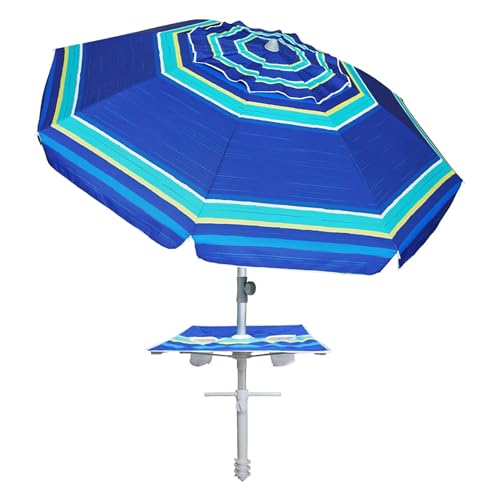
The 7-foot AMMSUN lists a sand anchor, a vent, tilt and UPF 50+ protection, and is described as heavy duty for high wind. A variation of the 7-foot model adds a built-in table tray. It suits couples and small families.
- Vent and tilt are listed in the title.
- Seven feet balances shade and wind exposure.
- Trade-off: the title does not state pole diameter or rib material.
Skip it if an exact fiberglass or marine-grade pole is required. Read the listing for hardware details, and compare how the vent is built, since vents that stay open help air pass through. Parents bringing infants should also think about adding shade from a second source, because an umbrella alone does not give full coverage as the sun moves.
AMMSUN 8 Feet Large Beach Umbrella
The 8-foot AMMSUN lists a sand anchor, an air vent, a tilt function and UV 50+ protection. It is for larger groups who accept a bigger canopy for more shade.
- Larger canopy shelters more people.
- Air vent and tilt are stated.
- Trade-off: bigger canopies catch more wind.
Skip it if the beach is very breezy or if the group is small. Anchoring depth becomes more important at this size, and many users keep an extra weight, such as a filled bag of sand, tied to the pole as a second layer of security. Because the canopy is large, plan to adjust it as the sun moves rather than leaving it fixed all day.
BEACHBUB All-in-One Beach Umbrella System
The BEACHBUB system includes an Ultra base and cites compliance with the ASTM F3681-24 beach umbrella safety standard. It is for buyers who want a base-and-umbrella package built around a stated standard rather than a simple sand anchor.
- The listing names a specific safety standard for the base.
- All-in-one system reduces mix-and-match guesswork.
- Trade-off: the title lacks canopy size and fabric details.
Skip it if a low-cost accessory-style umbrella is all that is needed. Read what the standard covers on the listing before relying on it. A cited standard is a point in favor, but it does not remove the need to watch the weather and close the umbrella when gusts build.
BEACH DUDES 8FT Beach Umbrella
BEACH DUDES lists an 8-foot canopy with an anti-flyaway 4-point wind mitigation system, 8mm fiberglass ribs, a marine-grade pole and an integrated anchor, plus UPF 50+. It is the most construction-focused title here.
- Fiberglass ribs and marine-grade pole are in the title.
- Integrated anchor keeps the system in one piece.
- Trade-off: an 8-foot canopy still catches wind, and the wind system is a design description rather than a guarantee.
Skip it if a smaller canopy is preferred. Even with these features, close the umbrella in strong gusts. The wind mitigation system is a design feature rather than a promise, so keep it anchored deeply and pointed into the breeze.
Tommy Bahama ANCHORX 7 ft
The ANCHORX is a 7-foot umbrella with UPF 50+, a sand anchor, a wind stability system, a carry bag, wind vents, manual tilt and rust-related wording. It suits buyers who want a recognized brand name.
- Wind stability system and vents are in the title.
- Carry bag and manual tilt are included.
- Trade-off: the title does not give pole diameter or weight.
Skip it if the lowest cost matters most. Check the listing for rust-protection details and care instructions. Rinsing the pole and hinges with fresh water after each trip is a simple habit that keeps salt from building up on metal parts.
Which One Fits Your Situation
A breezy day with two people
LOTTAFUN 6ft Beach Umbrella gives a smaller sail and an anchor. Screw the anchor in deeply and angle the canopy into the wind. Share the shade with a beach tent or windbreak if the group grows beyond the canopy size.
A family of four wanting vents and tilt
AMMSUN 7ft or AMMSUN 8 Feet are the picks. The 7-footer balances shade and wind exposure, while the 8-footer gives more cover. Choose the smaller one if the forecast leans windy and the larger one for calm, hot days.
Construction details first
BEACH DUDES 8FT lists fiberglass ribs, a marine-grade pole and an integrated anchor. It is the closest match for buyers who read build specs, though the actual weight and pole thickness should be confirmed on the listing before ordering.
A system with a cited standard
BEACHBUB All-in-One Beach Umbrella System and Tommy Bahama ANCHORX are the two with wind-related system language.
Common Mistakes
- Choosing the biggest canopy for a windy beach.
- Planting the pole instead of screwing the anchor in below the damp layer.
- Leaving the umbrella open when gusts rise.
- Pointing the canopy away from the wind instead of into it.
- Skipping a fresh-water rinse, which leaves salt on hinges and joints.
Related guides
- Battery Powered Generator For Refrigerator
- Portable Power Station For Refrigerator
- Portable Power Station For Camping
Frequently Asked Questions
Can a beach umbrella be truly wind-proof?
No. Manufacturers say to close umbrellas in strong gusts, and all listings should be read with that in mind.
Does UPF 50+ relate to wind performance?
No. It describes sun protection of the fabric. Wind performance depends on anchor, ribs, pole and venting.
How deep should the anchor go?
Follow the manufacturer’s instructions, but deeper is generally better, and the anchor should be driven into packed sand.
Is a smaller umbrella safer?
A smaller canopy catches less wind, which helps, but it still needs a proper anchor and attention. Never leave an open umbrella unattended.
More from Amazon
Programs that pair well with the guide above. Offers and eligibility are set by Amazon and may change.
Free shipping on eligible items, Prime Video and more. Eligible new members can start with a free trial.
Start a Prime free trialA Prime membership for ages 18-24 with a trial period. Eligibility is set by Amazon.
See Prime for Young AdultsAudiobooks and podcasts to listen to on the go. Eligible new members can start with a free trial.
Try Audible freeAd-free music streaming. Eligible new subscribers can start with a free trial.
Try Music Unlimited freeAs an Amazon Associate we earn from qualifying purchases.
Write Your Review
No reviews yet. Be the first to share your experience!