

Key takeaways
- 4-gallon (15L): Standard for yards over 2,500 sq ft, perimeter pest control, fence lines, orchards, and food plots. Covers more ground without refilling, but weighs 33-35 lbs when full of water. This is the most versatile size.
- 2 to 3-gallon (7.5L-11L): Better for small urban gardens, raised beds, precise spot-spraying, and for users who cannot comfortably carry 30+ pounds. Easier to store and clean.
- Avoid overfilling. Filling to the marked fill line, not the brim, is required for proper pressure buildup and to prevent leaks at the lid.
The best backpack sprayers for most yard and garden work are 4-gallon manual piston-pump models for general weed and pest control, while battery-powered 4-gallon models are better for large areas, frequent spraying, or any job requiring constant pressure without pumping.
Choosing between them comes down to tank capacity, how pressure is generated, nozzle control, chemical compatibility, and how the weight sits on your back. Get those five right for your specific jobs and maintenance becomes easier too.
Our top picks


As an Amazon Associate we earn from qualifying purchases at no extra cost to you. Ratings are shown as listed on Amazon.
How To Choose: The 7 Criteria That Matter
1. Tank Capacity: 2 vs. 4 Gallons
Most backpack sprayers come in 2-gallon and 4-gallon (7.5L and 15L) nominal sizes. The usable capacity is always slightly less to leave room for pressurization.
- 4-gallon (15L): Standard for yards over 2,500 sq ft, perimeter pest control, fence lines, orchards, and food plots. Covers more ground without refilling, but weighs 33-35 lbs when full of water. This is the most versatile size.
- 2 to 3-gallon (7.5L-11L): Better for small urban gardens, raised beds, precise spot-spraying, and for users who cannot comfortably carry 30+ pounds. Easier to store and clean.
- Avoid overfilling. Filling to the marked fill line, not the brim, is required for proper pressure buildup and to prevent leaks at the lid.
2. Pump Type and Spray Pressure
Pump type determines whether pressure is constant, how much effort is required, and what pressure range you can expect.
- Manual Piston Pump: The most common and reliable type. You pressurize with a hand lever. Pressure typically starts around 40-60 PSI and drops as you spray, requiring re-pumping every 30-45 seconds. Simple, field-serviceable, no battery to charge. Best for occasional use.
- Manual Diaphragm Pump: Uses a flexible diaphragm instead of a piston seal. Handles wettable powders, suspensions, and bleach solutions better because abrasive particles do not wear the piston seal as quickly. Usually lower max pressure (25-45 PSI) but more chemical tolerant.
- Battery-Powered (12V-18V): A small onboard pump maintains constant pressure, usually 20-70 PSI adjustable or 40 PSI fixed. Eliminates pumping fatigue and gives an even spray pattern. Requires charging and winter battery storage. Ideal for jobs over 15 minutes or when using a low-drift fan nozzle that needs stable pressure.
For herbicides and insecticides, consistent low pressure (20-40 PSI) with coarse droplets reduces drift. For reaching into shrubs or up to 15-20 feet for wasp nests or tree foliage, you need 45+ PSI and an adjustable cone nozzle.
3. Nozzle Control and Wand
Nozzles control droplet size, pattern, and drift more than pressure does. Look for a sprayer that includes at least two nozzles and uses a standard TeeJet-style thread so replacements are easy to find.
- Flat Fan (80° or 110°): For broadcast herbicide application on lawns and paths. Provides even coverage when held at a consistent height.
- Adjustable Cone (brass): Twists from a fine mist to a straight stream for spot-spraying weeds, drenching, or reaching distance.
- Foaming or Low-Drift Fan: Produces larger droplets to keep herbicides on target near garden beds.
- Wand Length: 20-inch wands are standard. A 28-30 inch stainless or brass wand reduces bending and keeps chemicals farther from your legs. A shut-off valve with a lock prevents hand fatigue.
4. Chemical Resistance and Seals
This is where cheap sprayers fail first. Check seal and tank material, not just price.
- Tank: High-density polyethylene (HDPE) with UV inhibitors is standard. Translucent tanks with volume markings make measuring easier.
- Seals and O-rings: Viton is the most chemical-resistant for herbicides, fertilizers, and petroleum-based products. EPDM is acceptable for water-based garden chemicals but swells with oils and solvents. Nitrile is the least resistant.
- Hose: Reinforced PVC is common, but EPDM or nitrile-blend hoses resist kinking and cracking from UV and chemicals longer.
- If you plan to spray bleach solutions for cleaning, wettable powders, or vinegar-based mixes, choose a diaphragm-pump model specifically rated for those. Piston seals wear quickly with abrasive powders.
5. Weight Distribution and Comfort
A full 4-gallon sprayer weighs as much as a bag of concrete. Comfort is not a luxury.
- Harness: Padded shoulder straps plus a waist/hip belt transfer 30-40% of the weight to the hips. Without a hip belt, all weight pulls on the shoulders and lower back.
- Frame: A formed back panel with air channels reduces sweating and prevents the tank from digging into your spine. Metal or resin frames that hold the tank away from the back are cooler than flat-back designs.
- Pump Handle: Reversible left/right handles are essential if you are left-handed or want to reduce fatigue by switching sides.
6. Cleaning Requirements
Cleaning determines lifespan and prevents cross-contamination between weed killers and fertilizers.
- Triple-rinse after every use: fill with clean water to 1/4 capacity, slosh, pressurize, and spray through the hose and nozzle until empty. Repeat three times.
- Never leave mixed chemical in the tank overnight. It degrades seals, clogs nozzles, and loses efficacy.
- Remove and clean the filter basket, nozzle screen, and nozzle tip with a soft brush. Use the nozzle cleaning tool, not a wire, which enlarges the orifice.
Spec Comparison: Common 4-Gallon Models by Type
This table compares the specifications that affect real-world use, not marketing claims. Weights are dry weights without liquid.
| Model Type / Example | Tank Capacity (Nominal / Usable) | Pump Type | Operating Pressure | Dry Weight | Wand & Nozzles Included | Seal Material |
|---|---|---|---|---|---|---|
| Manual Piston (e.g., Chapin 61900, Solo 425) | 4.0 gal / 3.6 gal (15L / 13.6L) | Piston, lever-operated | 40-60 PSI, declining | 7.5 – 8.2 lbs | 20-28 in poly or stainless wand, 2-4 nozzles (flat fan, cone, adjustable) | Viton or EPDM |
| Manual Diaphragm (e.g., Jacto PJH, Solo 425-Deluxe Diaphragm) | 4.0 gal / 3.5 gal (15L / 13.2L) | Diaphragm | 25-45 PSI, declining | 8.0 – 9.0 lbs | 20 in wand, 2-3 nozzles, often includes agitator | Viton |
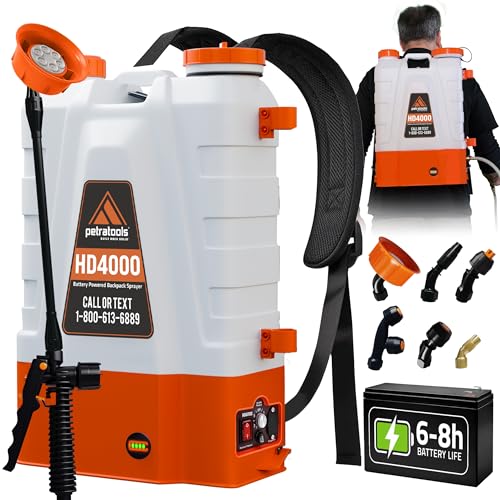
| Battery-Powered (e.g., Field King 190515, FlowZone Cyclone 2V, PetraTools HD4000) | 4.0 gal / 4.0 gal (15L / 15L) | 12V-18V diaphragm pump | 20-70 PSI adjustable, constant | 9.5 – 12.5 lbs with battery | 20-30 in stainless wand, 4-6 nozzles | Viton |
| Compact Manual (e.g., Chapin 63924, Stanley 2-Gallon) | 2.0 gal / 1.8 gal (7.5L / 6.8L) | Piston | 40-55 PSI, declining | 4.5 – 5.5 lbs | 14-18 in wand, 1-2 nozzles | EPDM |
Decision Matrix: Which Sprayer Fits Your Situation
Match your primary job, frequency, and physical needs to the column on the right.
| Your Situation | Best Fit | Why |
|---|---|---|
| 1/4 acre+ lawn, weeds and fertilizer 4-8 times per year, budget-conscious | 4-Gallon Manual Piston | Largest coverage per fill, simple to maintain, lowest upfront cost. General market range $65-$120. |
| Large property, fence lines, orchard, or food plot requiring 30+ minutes of continuous spraying | 4-Gallon Battery-Powered | Constant pressure eliminates pumping fatigue and keeps application rate even over long sessions. General market range $130-$280. |
| Small garden, raised beds, spot-spraying, or limited storage / limited lifting ability | 2-Gallon Manual Piston | Under 20 lbs full, easy to carry and clean, precise control in tight spaces. General market range $35-$70. |
| Frequent use of wettable powders, bleach, or abrasive suspensions | 4-Gallon Manual Diaphragm or Battery Diaphragm | Diaphragm tolerates particles and corrosive mixes without scoring the pump cylinder. |
| Need to spray insecticides with drift control near ornamentals and vegetables | Any 4-Gallon with Viton seals + Low-Drift Nozzles | Chemical resistance plus correct nozzle matters more than pump type for drift management. |
Worked Calculation: Coverage and How Many Tanks You Need
Do not guess application rate. Use this to avoid running out mid-yard or over-applying.
Formula: Tanks Needed = Total Area to Spray / (Application Rate per Gallon x Usable Gallons)
Example: You have 5,000 sq ft of lawn to treat with a herbicide labeled at 1 gallon of mixed spray per 1,000 sq ft.
- Usable capacity of a 4-gallon sprayer is about 3.6 gallons after leaving headspace.
- Coverage per tank = 3.6 gallons x 1,000 sq ft per gallon = 3,600 sq ft.
- Tanks needed for 5,000 sq ft = 5,000 / 3,600 = 1.39, so 2 partial tanks.
If your product rate is 2 gallons per 1,000 sq ft (common for fertilizers), that same tank only covers 1,800 sq ft and you would need 3 tanks for 5,000 sq ft. A 2-gallon compact sprayer would require double the refills, which is why capacity matters for broadcast jobs but not for spot-spraying where you may use less than one gallon total.
Calibrate once: Fill with water only, spray a measured 1,000 sq ft area at your normal walking speed and pressure, and measure how much water you used. That is your true application rate.
Durability and Ownership Realities
What wears first is predictable. Planning for it saves replacement cost.
- First to fail: Nozzle screens and filter baskets clog, O-rings at the pump and shut-off valve dry out, and the hose cracks at the wand connection. These are consumables. Choose a model where replacement seals, hoses, and nozzles are sold separately.
- Pump seals: Piston models need the piston cup and pressure chamber O-ring replaced every 1-3 seasons with regular use. Diaphragm models last longer with powders but the diaphragm itself will eventually crack if left dry.
- Tank lid gasket: Leaks down the back are almost always a twisted or chemical-swollen lid gasket. Remove it after cleaning, wipe dry, and store the lid loosely to prevent compression set.
- Battery care: For battery models, lithium-ion packs lose capacity if stored fully discharged or in freezing sheds. Charge to 50-80% for winter storage and keep indoors.
- Common mistakes: Using high pressure with a fine mist near garden plants causes drift damage; leaving pressure in the tank during storage stresses seals; mixing different chemical types without a full triple-rinse causes phytotoxicity and clogs.
Maintenance and Winter Storage: Step-by-Step
Proper cleaning takes five minutes and doubles the life of the sprayer.
- 1. Release pressure via the pressure relief valve before opening the lid.
- 2. Empty any remaining mix according to label directions. Never pour onto the ground near wells or drains.
- 3. Triple-rinse the tank, hose, and wand as described above, spraying rinse water onto a labeled target area or waste area per local regulations.
- 4. Remove the nozzle and filter, soak in warm soapy water, brush clean, and reinstall.
- 5. Pump or run a tank of clean water with a small amount of tank cleaner if you used oil-based or sticky products.
- 6. Leave the tank empty, lid off or loose, and store upright with the wand secured. For battery models, remove the battery and store separately.
- 7. Lightly lubricate pump O-rings with silicone grease once per season if the manual recommends it.
FAQ
Can I use one backpack sprayer for both weed killer and fertilizer?
Yes, if you triple-rinse thoroughly between different chemicals. Many gardeners dedicate one sprayer to herbicides and a second to fertilizers and insecticides to eliminate any risk of herbicide residue damaging desirable plants. If you only own one, rinse immediately after each use and never assume water alone has removed all residue.
How much does a full 4-gallon sprayer weigh?
Water weighs 8.34 pounds per gallon. A 4-gallon load is about 33.4 pounds of liquid plus 7-12 pounds for the sprayer itself, for a total of 40-45 pounds. If that is too heavy, fill to 2-3 gallons or choose a 2-gallon model.
Do I need a battery sprayer for even coverage?
Not necessarily. A manual piston sprayer can deliver even coverage if you maintain steady pressure and re-pump frequently. Battery models simply make consistency automatic, which helps beginners and anyone spraying large areas without monitoring pressure.





Write Your Review
No reviews yet. Be the first to share your experience!