

Key takeaways
- Best Backpack Leaf Blowers for Yard Cleanup The best backpack leaf blower depends on your property: choose a battery model for quiet neighborhood cleanup and small-to-medium yards, an electric-corded model for the lowest running cost near an outlet, and a…
Best Backpack Leaf Blowers for Yard Cleanup
The best backpack leaf blower depends on your property: choose a battery model for quiet neighborhood cleanup and small-to-medium yards, an electric-corded model for the lowest running cost near an outlet, and a gas blower for large properties, wet leaves, and long uninterrupted work.
Quick picks by situation
| Situation | Best choice | Why | Typical budget |
|---|---|---|---|
| Small yard, nearby neighbors | 40V–60V battery backpack blower | Low noise, no fuel mixing, easy starting | $250–$600 including battery and charger |
| Large yard or acreage | Gas backpack blower | High sustained airflow and fast refueling | $350–$750 |
| Driveway, patio, or workshop cleanup | Corded electric blower | Lightweight and inexpensive to operate | $80–$220 |
| Frequent fall cleanup and wet leaves | High-output gas or dual-battery blower | More usable runtime and stronger heavy-debris performance | $500–$1,000 |
Battery vs. electric vs. gas backpack blowers
Air speed is measured in miles per hour (MPH), while airflow is measured in cubic feet per minute (CFM). MPH describes how forcefully air exits the tube; CFM describes how much air the machine moves. For leaf piles, CFM is usually the more useful number. A blower rated at 150 MPH but only 400 CFM may move less material than one rated at 130 MPH and 700 CFM.
Our top picks


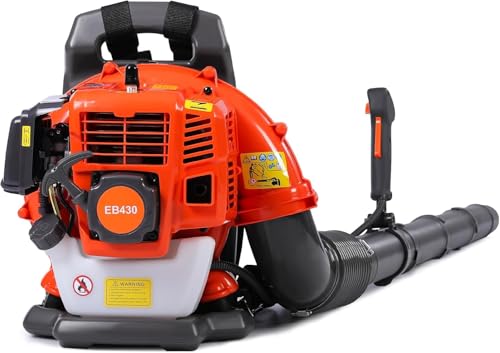
As an Amazon Associate we earn from qualifying purchases at no extra cost to you. Ratings are shown as listed on Amazon.
| Power type | Typical air speed | Typical airflow | Usable runtime | Noise and maintenance | Best property size |
|---|---|---|---|---|---|
| Battery backpack | 100–180 MPH | 400–800 CFM | 15–45 minutes per battery | Quieter; clean contacts, charge batteries, inspect tubes | Up to about 1/2 acre per battery, depending on leaves |
| Corded electric | 100–160 MPH | 350–600 CFM | Unlimited near an outlet | Low maintenance; manage extension cord and plug connections | Small yards, patios, and driveways |
| Gas backpack | 180–235 MPH | 500–1,100 CFM | 45–90 minutes per tank | Loudest; fuel, air filter, spark plug, and seasonal storage required | 1/2 acre to several acres |
These are useful comparison ranges rather than universal guarantees. Manufacturers measure output differently, and a tube-mounted measurement can look substantially higher than an end-of-nozzle measurement. Compare CFM and MPH only when the testing method is similar.
Battery models: the easiest all-around choice
Battery backpack blowers are the best fit for many residential users. Models in 40V, 56V, 60V, and 80V systems commonly deliver enough airflow for dry leaves, pine needles, grass clippings, and light debris. Examples include systems such as EGO 56V, Greenworks 60V or 80V, and STIHL AP or AR battery platforms.
The main limitation is runtime. A high-output blower can drain a 5.0Ah or 6.0Ah battery quickly, particularly at maximum throttle. A practical estimate is 20–35 minutes of active blowing from one large battery, although intermittent trigger use may cover a substantially larger yard. Two batteries, a second battery pack, or a lower power setting can make a battery blower suitable for a property of roughly one-half acre.
Battery machines also have a useful ownership advantage: there is no carburetor to gum up and no fuel to drain. Their disadvantages are battery cost, charging time, and reduced performance in very cold conditions. Buy into a platform only after checking the battery replacement price and the availability of a rapid charger.
Corded electric models: inexpensive but restricted
A corded backpack blower can make sense for a small lot with an outdoor outlet. It offers continuous runtime and typically costs less than a complete battery system. It is also lighter to maintain because there is no engine or battery pack.
The extension cord is the trade-off. Use a properly rated outdoor cord, keep connections off wet ground, and avoid running over the cable with a mower. A 100-foot cord can weigh several pounds and creates snagging hazards around shrubs, fences, and play equipment. For a compact property, that inconvenience may be acceptable; for a large yard, it quickly becomes frustrating.
Gas models: strongest for demanding cleanup
Gas backpack blowers remain the practical choice for large properties, contractors, and heavy wet leaf piles. Models such as the STIHL BR series and Husqvarna 500-series machines are widely available in this category. A full tank can often outlast one battery charge, and refueling takes minutes rather than requiring a charging break.
Gas power also brings more obligations. You must use the specified fuel mixture, keep the air filter clean, inspect the spark plug, and stabilize or drain fuel before extended storage. Old fuel is a common cause of hard starting. Gas blowers are also loud enough that hearing protection is essential, and local rules may restrict their use during certain hours or seasons.
What matters more than the headline MPH
Airflow for piles, speed for loose debris
Choose at least about 500 CFM if your main task is moving large leaf piles across a lawn. Higher airflow helps with damp leaves and pine needles. High air speed is useful for clearing cracks, gravel, roof gutters, and compacted debris, but an extremely narrow nozzle can scatter leaves instead of forming a manageable pile.
Harness comfort and machine balance
A blower weighing 12 pounds can feel better than a 10-pound model if its frame sits close to your back and the shoulder straps distribute pressure evenly. Look for padded, adjustable straps, a ventilated back panel, a supportive waist belt, and a throttle that does not require constant finger pressure.
Before buying, check whether the battery sits high on the back or low near the hips. A low battery position can improve balance, while a top-heavy design may fatigue your shoulders. If more than one person will use the blower, prioritize broad adjustment ranges rather than the lightest listed weight.
Noise and neighborhood compatibility
Gas blowers commonly produce around 70–80 decibels at the operator or manufacturer test position, while battery models often fall roughly in the 60–70 decibel range. Published measurements are not always directly comparable, but the practical difference is noticeable. A quieter blower makes early-morning cleanup less disruptive and is easier to use near pets, children, and neighbors.
Decision matrix: match the blower to your work
| Your situation | Recommended power | Target specification | Reason |
|---|---|---|---|
| First blower, occasional use | Battery | 450–650 CFM, variable speed, 15–25 minute runtime | Simple starting and little maintenance |
| Weekly cleanup on a 1/4-acre lot | Battery or corded electric | 500–700 CFM; second battery or 100-foot cord | Enough capacity without engine upkeep |
| Several acres and dense fall leaves | Gas | 700–1,100 CFM and 45-minute-plus tank runtime | Better sustained output and fast refueling |
| Wet leaves and pine needles | High-output gas or dual-battery | 650 CFM or more, cruise control, sturdy tube | Extra airflow reduces repeated passes |
| Noise-sensitive neighborhood | Battery | Low-noise rating, variable trigger, padded harness | Allows shorter, quieter cleanup sessions |
Runtime and operating-cost calculation
Suppose a battery blower gives 25 minutes of active runtime and you spend 5 minutes repositioning, raking, or emptying a bag during a 30-minute session. Its operating time is about 83 percent of the clock time. Four 30-minute sessions would therefore require approximately 100 minutes of active battery capacity, or four 25-minute charges. In practice, two batteries let you work while one charges.
For gas equipment, assume a 0.4-gallon tank and fuel costing roughly $4 per gallon. A tank costs about $1.60 before oil and maintenance. That is inexpensive per





Write Your Review
No reviews yet. Be the first to share your experience!