

Key takeaways
- The best apple peelers for bushel days: cast-iron crank machines, clamp and suction models, and one electric pick for cider, sauce and fall baking.
As an Amazon Associate we earn from qualifying purchases.
Affiliate Disclosure: This article contains affiliate links. If you buy through a link on this page, we may earn a commission at no extra cost to you. That support keeps our buying guides independent and free to read.
An apple peeler machine is a volume tool, and it is worth saying that plainly before anything else. If you are peeling four apples for a single pie, a basic hand peeler is honestly faster: it comes out of the drawer, does the job, and rinses clean in seconds, while a crank machine has to be mounted, adjusted, and washed. The machines in this guide earn their counter space on bushel days — the fall weekends when a crate of orchard apples needs to become cider, applesauce, dried rings, or a dozen freezer pies. At that volume, a hand peeler leaves your wrist aching and your slices uneven, while a crank peeler turns each apple into a peeled, cored, evenly sliced spiral in a few turns of the handle.
There are honest trade-offs, too. Every machine here shaves off some good flesh along with the peel, because the peeling blade rides the surface of the fruit rather than following it the way a careful knife hand can. Soft, overripe, or badly lopsided apples can tear or spin off the fork instead of peeling cleanly, so sort your fruit and send the oddballs to the hand-peeler pile. The slicing blade decides how thick your pie slices come out, and it is also the part that dulls first, so replaceable blades matter more than almost any other feature.
The five picks below cover the main ways these machines anchor and operate: a cast-iron crank classic on a suction base, the same design on a clamp base for rough counters, two adjustable Norpro machines, and one electric peeler for hands that would rather not crank at all.
What to Look for in an Apple Peeler
Base type decides where you can work. Suction bases are quick to set and remove, but they only hold on smooth, non-porous counters — on butcher block, textured laminate, or a scarred barn table they creep and pop loose mid-apple. Clamp bases grip almost any edge and are the right choice for outdoor processing tables and rough wood. One pick below offers both.
Blades are the wear part. The peeling knife and the coring/slicing blade do all the work, and both dull with use. Makers that sell inexpensive replacement blades keep a machine useful for years; a machine with no blade supply becomes a drawer ornament once the edge goes.
Modes matter for recipe flexibility. Most crank machines can peel, core, and slice in one pass, peel only, or core and slice without peeling. That flexibility is what lets one tool serve cider (peeled or not), sauce, dehydrator rings, and pie filling.
1. Johnny Apple Peeler VKP1010 — the Cast-Iron Classic

The VKP1010 is the machine most people picture when they think of a crank apple peeler, and it has held that spot for years on simple merits: a heavy cast-iron body that does not flex or wander, stainless steel blades, and a suction base that locks onto a smooth counter with a lever. You push an apple onto the three-prong fork, turn the handle, and the peeling knife takes the skin in one continuous ribbon while the coring blade removes the core and cuts the fruit into a single spiral you can break into even rings.
Because the body is cast iron, the machine stays planted through fast cranking, which is exactly what bushel work demands. It can also run in peel-only mode for cider fruit you plan to slice by knife, or core-and-slice mode for apples you want to keep the skin on. The peeling knife is a standard replaceable part from the maker, which keeps long-term ownership simple. Its one real limitation is the base: on rough or porous surfaces the suction cup will not hold, and that is what the next pick exists to solve.
Specs
– Type: Hand crank
– Base: Suction cup with locking lever
– Functions: Peel, core, and slice simultaneously; peel only; core and slice only
– Blades: Stainless steel peeling knife and corer/slicer blade, replaceable
– Body: Cast iron with enamel finish
– Best for: High-volume processing days on smooth kitchen counters
2. Johnny Apple Peeler VKP1011 — the Clamp-Base Version
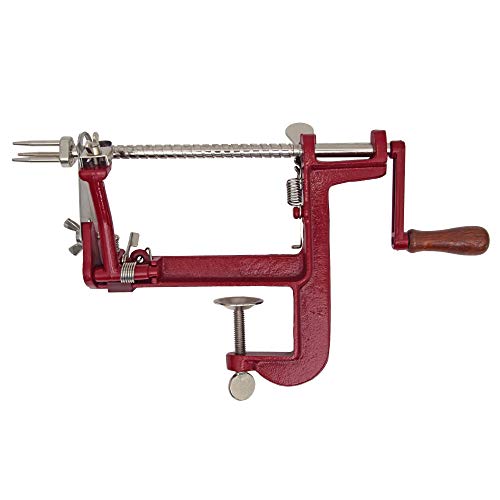
The VKP1011 is the same proven Johnny Apple Peeler mechanism — cast-iron body, stainless steel blades, peel-core-slice in one pass — mounted on a strong clamp base instead of a suction cup. That single change widens where the machine can work enormously. It clamps to butcher block, plywood processing tables, tailgates, and the scarred wooden counters in farm kitchens where suction bases simply give up.
For orchard households that process fruit outdoors or in a barn to keep the mess out of the kitchen, this is the version to buy. The clamp also holds firm through aggressive cranking on large fruit, where a suction base under strain tends to creep. Everything else about the design matches the classic: the same blade layout, the same selectable modes, and the same replaceable-blade support from the maker. If your counter is smooth stone or laminate and never changes, the suction model is quicker to move; for every other surface, clamp wins.
Specs
– Type: Hand crank
– Base: Clamp, grips counter and table edges
– Functions: Peel, core, and slice simultaneously; peel only; core and slice only
– Blades: Stainless steel peeling knife and corer/slicer blade, replaceable
– Body: Cast iron with enamel finish
– Best for: Rough, textured, or wooden surfaces; outdoor and barn processing tables
3. Norpro Apple Mate 3 (861) — Five Functions, Cast Aluminum

Norpro’s Apple Mate line takes a different approach to the same job: a rust-free, tool-grade cast aluminum frame that is noticeably lighter than cast iron, paired with a clamp base. The Apple Mate 3 is the most flexible of the line, with five separate functions — pare, core, and slice together; pare and core only; slice and core only; pare only; and core only. That last mode is genuinely useful for cider work, where you may want cored fruit with the peel left on for tannin and color.
The clamp on this model is extra wide, which helps it bite securely on thicker table edges. The lighter frame makes the machine easier to carry out to a processing table and easier to store, though it asks for a slightly steadier hand at full crank speed than the heavyweight iron machines. Like the others here, it handles pears and potatoes as happily as apples, which stretches its usefulness well past fall. Replacement blades are available from Norpro, keeping the wear parts covered.
Specs
– Type: Hand crank
– Base: Extra-wide clamp
– Functions: Five modes — pare/core/slice, pare/core, slice/core, pare only, core only
– Blades: Stainless steel paring knife and corer/slicer blade, replaceable
– Body: Cast aluminum frame
– Best for: Recipe flexibility, lighter weight, and mixed fruit and potato prep
4. Norpro Apple Master (865) — Vacuum Base and Clamp in One

The Apple Master solves the base dilemma by shipping with both options: a vacuum base for smooth counters and a clamp for everything else. If your processing moves between the kitchen and an outdoor table, or you simply are not sure which surface you will use most, this is the hedge against buying the wrong base. It runs three functions — pare, core, and slice together; pare only; or slice and core only — on the same cast aluminum frame Norpro uses across the line.
In practice, the vacuum base is the everyday convenience and the clamp is the insurance policy for fall processing days on the picnic table. The machine shares the family’s light weight and easy storage, and the stainless steel blade set is replaceable. Between this and the Apple Mate 3, the choice comes down to what you value more: the Mate 3’s five modes and core-only option, or the Master’s two bases. For households that process in more than one place, the two-base setup is the smarter buy.
Specs
– Type: Hand crank
– Base: Vacuum base and clamp, both included
– Functions: Pare, core, and slice simultaneously; pare only; slice and core only
– Blades: Stainless steel paring knife and corer/slicer blade, replaceable
– Body: Cast aluminum frame
– Best for: Households that process on more than one surface
5. Starfrit Rotato Express — the Electric Option

The Rotato Express drops the crank entirely. You seat an apple on the holder, press a button, and a motor rotates the fruit against a spring-loaded peeling blade that follows its contour. It peels only — there is no coring or slicing — so it suits a different workflow: peel a batch hands-free, then core and slice with a knife or a wedge cutter as your recipe requires. For anyone with arthritis, weak grip strength, or a long peeling session ahead, removing the cranking is a real benefit rather than a gimmick.
It runs on batteries or its power adapter, so it works at an outdoor table as easily as at the counter, and the compact plastic body stores in a drawer the crank machines cannot. The blade is the wear part here as well, and the package includes spare blades, which extends the time before you need to hunt down replacements. Be honest about its limits, though: it is slower per apple than a practiced hand on a crank machine, the peeling arm can skip on very soft or irregular fruit, and you still have knife work afterward. It is a peeling specialist, not a full processing station.
Specs
– Type: Electric, battery or adapter powered
– Base: None — sits on the counter, fruit held on prongs
– Functions: Peel only; no coring or slicing
– Blades: Stainless steel peeling blade, spares included
– Body: Plastic housing
– Best for: Hands-free peeling and anyone who cannot comfortably crank
How to Choose, and How to Get Clean Results
Match the base to your surface first, because a peeler that will not stay put is useless no matter how good its blades are. Smooth stone or laminate: suction or vacuum is fine. Anything rough, wooden, or portable: clamp. If you process in both places, take the two-base Norpro.
Then think about volume and fruit. Firm, evenly shaped apples peel beautifully on every machine here; soft or lopsided fruit belongs in the hand-peeler pile no matter which machine you own. Expect to lose a little flesh with the peel — that is the cost of speed — and expect the coring/slicing blade to set your slice thickness for you. If you mostly make pies and want thicker slices, check that the model’s blade suits that before buying, and order spare blades at the same time so a dull edge never stops a processing day halfway through a bushel.
Finally, wash and dry the blades right after a session. Apple juice is acidic and sugary, and blades left sticky in a drawer dull and corrode faster than blades that are cleaned, dried, and stored dry. A minute of care after each use is what keeps a cast-iron or cast-aluminum machine working for decades — which, for a tool that only earns its keep a few weekends a year, is exactly the lifespan it should have.
More from Amazon
Programs that pair well with the guide above. Offers and eligibility are set by Amazon and may change.
Free shipping on eligible items, Prime Video and more. Eligible new members can start with a free trial.
Start a Prime free trialA Prime membership for ages 18-24 with a trial period. Eligibility is set by Amazon.
See Prime for Young AdultsAudiobooks and podcasts to listen to on the go. Eligible new members can start with a free trial.
Try Audible freeAd-free music streaming. Eligible new subscribers can start with a free trial.
Try Music Unlimited freeAs an Amazon Associate we earn from qualifying purchases.










Write Your Review
No reviews yet. Be the first to share your experience!