

Key takeaways
- Compare the best grafting tools for orchards and nurseries: plier grafters with V, omega and U blades, complete kits with tape, and a pro grafting knife.
As an Amazon Associate we earn from qualifying purchases.
Affiliate Disclosure: This article contains affiliate links. If you buy through a link on this page, the site may earn a commission at no additional cost to you. Product details below come from manufacturer and retailer listings.
Grafting joins a cutting from one plant (the scion) to the roots of another (the rootstock) so the two grow as one. It is how orchards clone proven fruit varieties, how nurseries put named roses and ornamentals onto hardy roots, and how home growers add a second variety to an established tree. The tools fall into two families: plier-style grafters that stamp matching V, omega, or U cuts into both pieces of wood, and grafting knives that cut freehand. This guide covers both, because they solve different problems.
The limits of the plier tools deserve stating before any product names. A grafting plier only works when scion and rootstock are close to the same diameter, because the same blade stamps both cuts and the two pieces must mirror each other. On soft or pithy wood the squeezing action can crush the stem instead of slicing it, and crushed cambium does not heal. A sharp grafting knife has neither problem: it handles mismatched sizes, whip and cleft grafts, and budding, at the cost of needing a steadier hand. And no tool decides the outcome on its own — success depends on cambium alignment, tight wrapping, and grafting while the scion is still dormant. Blades of every type also dull quickly on hard wood such as walnut and jujube, which is why replaceable blades and honest diameter limits matter.
How to Choose Grafting Tools
Cut shapes. The three standard plier cuts are the V (a notch and matching tongue), the omega (a puzzle-piece profile with the largest contact area), and the U (a rounded channel). All three aim at the same thing: maximum cambium-to-cambium contact with a mechanical lock so the union holds still while it heals. Omega cuts give the most contact but demand the closest diameter match; V cuts are the most forgiving.
Diameter range. Most hand grafters are built for wood roughly 5 to 12 mm thick — pencil-sized scions. Work on thicker stock needs a heavy-duty V-cut tool or a knife and mallet-free cleft technique. Check the stated range on the listing rather than assuming, and never force oversize wood through a small tool: that is how blades chip and stems crush.
Blade steel. SK5 and other high-carbon steels take a fine edge and are the standard in this class; they need a wipe of oil to stay rust-free. Stainless blades resist corrosion but rarely match carbon steel for edge quality. On plier tools, confirm replacement blades are actually sold for the model — a grafter with a dull blade and no replacements is a disposable tool.
Knife or plier. Choose the plier for batches of same-size grafts, such as nursery bench work or a row of new fruit trees from uniform rootstock. Choose the knife for repair grafts, top-working older trees, budding in summer, and any job where the two pieces differ in size. Many orchardists own both, and the kits below bundle a knife with the plier for exactly that reason.
Kit contents. Tape is not optional: every graft must be wrapped to hold alignment and seal in moisture. Kits that include grafting tape or film, labels, and spare blades save separate orders. Labels matter more than they look — an unlabeled graft is an unknown variety by the following spring.
The 5 Best Grafting Tools
1. PUELDU Professional Grafting Tool Kit

The PUELDU kit is the most complete box in this lineup. The 2-in-1 pruner grafts and prunes, and it ships with the full set of three double-edged replacement blades in V, omega, and U shapes, made from SK5 high-carbon steel. A separate double-blade grafting knife is included for the cuts a plier cannot make, with a hawkbill blade for bark work and a straight blade for slicing, in 420J2 stainless with a walnut handle. Two rolls of PE grafting tape, 30 plant labels, six garden clips, a wrench, a screwdriver, and a storage organizer round out the set.
That completeness is the honest selling point: a beginner can open the box and graft the same day, including the labeling step most first attempts skip. The trade-offs are the usual ones for this class. The plier still only matches similar-diameter wood, the ABS-bodied tool is not the heaviest build in the roundup, and the claimed blade hardness figures come from the maker rather than any independent testing. Treat it as a full starter system rather than a lifetime professional tool.
Specs
- Type: 2-in-1 grafting pruner kit
- Blade shapes: V, omega (Ω), and U replaceable blades, double-edged
- Blade material: SK5 high-carbon steel grafting blades; #65 steel shear blade
- Kit contents: Double-blade grafting knife (420J2 stainless, walnut handle), 2 PE grafting tapes, 30 plant labels, 6 garden clips, wrench, screwdriver, storage organizer
- Cut range: Sized for small fruit-tree scion wood; no single maximum diameter published
- Weight: 0.84 kg (full kit)
2. ZALALOVA 2-in-1 Garden Grafting Tool Kit

The ZALALOVA kit covers the same ground as the PUELDU with a slightly different balance of contents. The grafting tool takes the same three interchangeable blade shapes — V, U, and omega — each double-edged so a worn edge can be flipped before the blade is replaced. The maker states a working branch diameter of 5 to 12 mm, which is the realistic heart of this tool class, and the listing is candid that the blades are #65 high-carbon steel with ABS handles rather than an all-metal build.
Where this kit differs is the extras: a separate grafting knife and a separate pruning scissor are both in the box, along with three rolls of grafting film and 40 tag cards in assorted colors. Color-coded tags are genuinely useful in a nursery row where several varieties go onto similar rootstock in one session. As with every plier grafter here, the similar-diameter limit applies in full, and soft wood can crush if the handles are squeezed carelessly instead of closed in one firm motion.
Specs
- Type: 2-in-1 grafting and pruning tool kit
- Blade shapes: V, U, and omega (Ω) replaceable blades, double-edged
- Blade material: #65 high-carbon steel (SK5 class)
- Stated cut diameter: 5–12 mm branches
- Kit contents: Grafting knife, pruning shears, 3 grafting film rolls, 40 tag cards, wrench and screwdriver
- Handle material: ABS plastic
3. Zenport ZJ68 V-Cut Top Grafting Tool
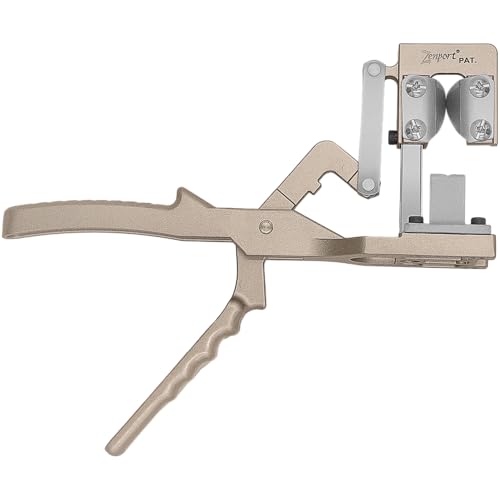
The ZJ68 is the long-established name in hand grafters, sold for years to orchard and nursery buyers, and it takes a narrower brief than the kits: it is a V-cut top grafting tool, built to stamp deep, clean V notches for top-working and fruit tree grafts. Where the kits spread their value across accessories, the ZJ68 puts it into the tool itself, and replacement blades are sold under the ZJ68A designation — an important practical point, since a grafter is only as good as its blade supply.
Two honest caveats belong with this pick. First, near-identical versions of this tool circulate under many labels, and experienced growers debate whether they all come from the same production lines; buying the Zenport name is partly buying a known blade standard. Second, a V-cut specialist does not do omega or U cuts, so growers who want the omega profile’s extra contact area should pick one of the three-blade kits instead. For straight V work on established orchard wood, it remains the reference design in this class.
Specs
- Type: Hand grafting tool (plier style), V-cut top grafter
- Blade shapes: V-cut; interchangeable blade system (ZJ68A replacement blades)
- Intended work: Top grafting of fruit trees and vines, larger scion wood
- Construction: Steel tool body with replaceable cutting blade
- Weight: 0.53 kg including packaging
- Kit contents: Tool only; no tape or knife included
4. FUNTECK V-Cut Grafting Tool for Large Branches

Most plier grafters top out around 12 mm of wood. The FUNTECK V-Cut is built for the next size up: its stated working range is branches from 1/2 to 4/5 inch in diameter, with a 0.8 inch cutting width, which covers the thicker scion wood and small limbs that defeat the standard kits. The body is full metal — aluminum alloy rather than plastic — and at 1.3 pounds it has the heft that larger cuts demand, along with an SK5 high-carbon steel blade in an anvil arrangement.
The specialization cuts both ways. This is a V-cut tool only, with no omega or U options, and the anvil action that powers through thick wood is exactly the action most likely to crush soft or thin stems — keep it for the larger, harder wood it was designed for and use a lighter tool or a knife below 1/2 inch. Within its stated band, though, it fills a gap none of the kits reach, and the metal body should outlast plastic-bodied tools worked at the top of their range.
Specs
- Type: V-cut grafting tool for large branches
- Blade shapes: V-cut only
- Blade material: SK5 high-carbon steel, anvil style
- Body material: Full metal, aluminum alloy
- Stated cut diameter: 1/2 to 4/5 in branches; 0.8 in cutting width
- Weight: 1.3 lb
5. Due Buoi 202 SU.SI. Left-Handed Grafting Knife

Due Buoi is an Italian maker known for professional agricultural knives, and the 202 SU.SI. is a folding grafting and budding knife with a straight blade in Böhler K720 carbon steel — a tool steel chosen for edge retention — in a glass-reinforced nylon handle. At 50 grams it is by far the lightest tool in this roundup, and it does the work no plier can: whip grafts on mismatched wood, cleft graft preparation, T-buds and chip buds in summer, and the trimming and bark lifting that finish every graft.
The critical detail is in the name: this listing is the left-handed version, with the blade bevel ground for left-hand use. A left-handed grafter finally gets a knife that cuts toward the thumb correctly; right-handed buyers should order the right-hand version of the same model instead of adapting to the wrong bevel, because grafting cuts are made close to the holding hand and the bevel decides whether the blade tracks straight or veers. Carbon steel also needs the standard care — dry it and oil it — in exchange for an edge stainless rarely matches.
Specs
- Type: Folding grafting and budding knife, left-handed
- Blade: Straight, folding, single blade
- Blade material: Böhler K720 carbon steel
- Handle material: Glass-reinforced nylon
- Hand orientation: Left hand (right-hand version sold separately)
- Weight: 50 g (1.75 oz)
Using and Caring for Grafting Tools
Timing and alignment decide grafts; tools just make the cuts. Graft in late winter or early spring while scion wood is fully dormant and the rootstock is just waking up. Collect scion wood earlier and keep it cold and slightly moist so the buds stay asleep until the union forms. On every graft, the green cambium layers just under the bark must touch on at least one side — on mismatched diameters, align one side perfectly rather than centering the scion and matching neither.
Wrap every union firmly with grafting tape or film, working from below the cut to above it, so the joint cannot shift or dry out. Label each graft with the variety and date immediately; memory does not survive a season. For budding work in summer, the same knives apply, and the bark must be slipping — lifting cleanly from the wood — for T-buds to succeed.
Care is mostly blade care. Clean sap and plant juice off blades after each session, because dried sap mimics dullness and corrodes carbon steel. Sharpen grafting knives on a fine stone, keeping the single bevel flat where the design uses one. For plier tools, swap or flip double-edged blades at the first sign of tearing rather than squeezing harder — extra force is what crushes stems. Store blades dry and lightly oiled, and keep a whetstone in the grafting kit so a dull edge never tempts anyone to push through a cut.
Frequently Asked Questions
Why do grafts fail even with a good tool?
The common causes are cambium layers that never touched, a union that dried out because the wrap was loose or missing, scion wood that had already broken dormancy, and cuts made with a dull blade that tore tissue instead of slicing it. The tool only controls the last one.
Can a grafting plier handle any branch size?
No. Plier grafters only work when scion and rootstock are near the same diameter and inside the tool’s stated range — typically about 5 to 12 mm for standard models. Oversize wood chips blades and undersize or soft wood gets crushed. Mismatched pieces are knife work.
Which cut shape is best: V, omega, or U?
Omega cuts give the largest cambium contact and a strong mechanical lock, but demand the closest size match. V cuts are the most forgiving and the standard for top-working. U cuts sit between the two. For a first season of grafting, the V is the easiest to succeed with.
Do left-handed grafters need a different knife?
Yes, ideally. Grafting knives are ground with a bevel that suits one hand, and using the wrong-hand version makes the blade veer and the cut less safe. The Due Buoi above is the left-hand model; a matching right-hand version exists for right-handed growers.
Bottom Line
For a first grafting setup, one of the three-blade kits — PUELDU for the most complete box, ZALALOVA for its color-coded tags and stated 5 to 12 mm range — covers the standard V, omega, and U work on uniform young wood. Growers top-working established orchard trees should look at the Zenport ZJ68 for V-cuts, and at the full-metal FUNTECK when branches run from 1/2 to 4/5 inch. Every plier owner still needs a knife for mismatched wood and budding, and the Due Buoi 202 SU.SI. gives left-handed grafters a proper professional option. Whichever route is chosen, sharp blades, matched cambium, tight wrapping, and dormant scion wood will decide the results far more than the badge on the tool.
More from Amazon
Programs that pair well with the guide above. Offers and eligibility are set by Amazon and may change.
Free shipping on eligible items, Prime Video and more. Eligible new members can start with a free trial.
Start a Prime free trialA Prime membership for ages 18-24 with a trial period. Eligibility is set by Amazon.
See Prime for Young AdultsAudiobooks and podcasts to listen to on the go. Eligible new members can start with a free trial.
Try Audible freeAd-free music streaming. Eligible new subscribers can start with a free trial.
Try Music Unlimited freeAs an Amazon Associate we earn from qualifying purchases.










Write Your Review
No reviews yet. Be the first to share your experience!