

Key takeaways
- Pointing binoculars at the night sky is a different exercise from watching birds in daylight.
Pointing binoculars at the night sky is a different exercise from watching birds in daylight. The targets are faint, the background is nearly black, and a tiny wobble turns a crisp star cluster into a smear. Anyone shopping for stargazing binoculars is really choosing between three competing goals: collecting as much light as possible, magnifying enough to reveal craters and star clouds, and keeping the whole thing steady enough to enjoy for more than a minute at a time. Pushing too hard on any one of those usually costs something on the other two.
This guide suits campers who want to add an evening activity to a trip, backyard observers stepping up from naked-eye viewing, and anyone who has been told that a big pair of binoculars is a cheaper doorway into astronomy than a telescope. Each pick below is judged only from its listed title, so details like weight, field of view, and tripod threading should be confirmed on the listing in 2026 before purchase. One compact 12×25 model surfaced for this search but its small front lenses are a weak match for dim targets, so it is left out in favor of seven stronger candidates.
Quick Picks
Our top picks




As an Amazon Associate we earn from qualifying purchases at no extra cost to you.
| Product | Best for | Key spec from the title |
|---|---|---|
| Celestron Cometron 7×50 | Handheld sweeps of the Milky Way | 7×50, porro prism, multi-coated, tripod adaptable |
| Celestron SkyMaster 15×70 | Deep-sky balance of power and brightness | 15×70 astronomy binoculars |
| 20×50 high powered binoculars | Mixed daytime and night use | 20×50, waterproof, low light vision |
| Celestron SkyMaster 20×80 | Bright deep-sky views | 80mm aperture, multi-coated BaK-4 optics |
| Stargazing Binoculars 12×60 kit | Beginners wanting a ready set | 12×60, includes carrying case |
| Celestron SkyMaster 25×70 | Long-range detail on the Moon and landscape | 25×70 for astronomy and wildlife |
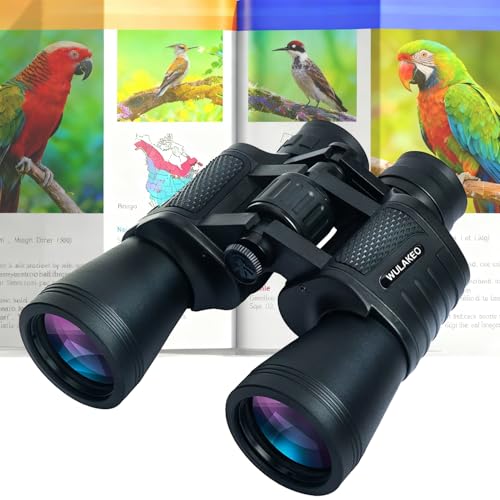
| Sfeoot 20×50 | Compact, higher-power camp pair | 20×50, waterproof, BAK4 prism |
How to Choose
Aperture decides how much you can see
The second number in a spec like 7×50 is the front lens diameter in millimeters, and it controls how much light enters. Larger apertures reveal fainter objects, which is why 70 and 80 millimeter pairs are favored for nebulae and star fields. A 50 millimeter pair is a comfortable starting point for handheld use, while 60 to 80 millimeters begins to demand a tripod or a solid rest. Divide aperture by magnification to estimate exit pupil: 7×50 gives about 7 millimeters, 12×60 gives 5, 15×70 about 4.7, and 20×50 only about 2.5, which is why very high power with a small aperture looks dim.
Magnification you can actually hold steady
Past roughly 10x, human hands cannot keep the image still, and heavy 70 or 80 millimeter models make it worse. A 15×70 or 20×80 pair is best treated as a tripod instrument, so look for a stated tripod adapter option in the listing or plan on buying an L-bracket. A reclining chair, a car roof pad, or a camp table with a rolled jacket can bridge the gap on a night out. Lower power such as 7x gives a wider, more forgiving sweep across the Milky Way.
Optical coatings and prism design
Titles that mention multi-coated optics, BaK-4 prisms, or BAK4 prisms are describing glass and coatings intended to move more light to the eye and keep star points round. Porro prism designs, like the one named on the Cometron, are common in astronomy binoculars because they are straightforward to build and tend to give a wide, bright view. Waterproof claims matter at a camp, where dew forms quickly on cold nights, but a waterproof title does not guarantee the best glass.
What to ignore and where budget models cut corners
Ignore dramatic claims about seeing planets as discs or distant galaxies in color. Binoculars show stars, clusters, the Moon, and a few brighter galaxies and nebulae as faint patches. Budget pairs tend to economize on edge sharpness, collimation, and the tripod mount, and may show color fringing around bright objects. Never point any binoculars at the Sun, even briefly, because it can cause permanent eye damage. Check weight and the eye relief of the specific model if glasses are involved.
The 7 Best Options
Celestron Cometron 7×50
This is the gentlest introduction on the list. The title names a wide field, porro prisms, multi-coated optics, comfortable handheld use, and tripod adaptability, which covers the key needs of a first astronomy pair. It also suits campers who want to scan the sky between dinner and bedtime without hauling any mounting gear, since the pair can simply be raised to the eyes and rested against a chair back.
- Strength: 7x power is easiest to hold steady, so sweeping across star fields is relaxed.
- Strength: tripod adaptability is stated for longer sessions.
- Trade-off: low magnification shows less detail on the Moon than 15x or higher models.
Skip it if close lunar detail is the main goal, or if a very faint nebula is the target; those jobs reward more aperture and more power than this gentle design provides.
Celestron SkyMaster 15×70
The title frames this model as an ideal balance of power and brightness for deep-sky and long-range night viewing. A 70 millimeter aperture gathers a lot of light while 15x power adds noticeable reach. Buyers who already own a sturdy photo tripod and have outgrown a 7×50 often land here, because it pulls in star clusters with more structure while staying more portable than the largest models.
- Strength: 70 millimeter lenses are a popular middle ground for faint clusters and nebulae.
- Strength: it is positioned directly at stargazing rather than general outdoor use.
- Trade-off: 15x is hard to keep still handheld for long.
Skip it if no tripod or rest is available, since long handheld sessions will tire the arms quickly and blur the very details the extra power is meant to reveal.
20×50 High Powered Binoculars
This pair mixes magnification with a smaller 50 millimeter front lens. The title mentions waterproof construction, low light vision, and uses from birding to stargazing. That versatility is the draw: one compact pair can cover a hillside bird walk by day and a quick look at the Moon after dark, which suits travelers who refuse to pack two sets of optics.
- Strength: compact, waterproof body works at a camp in damp weather.
- Strength: it can serve for daytime scenery as well as the night sky.
- Trade-off: 20x with a 50 millimeter aperture gives a narrow exit pupil, so faint objects look dimmer.
Skip it if deep-sky brightness is the priority; buyers chasing faint clusters will be happier with a larger front lens such as the 70 or 80 millimeter models in this guide.
Celestron SkyMaster 20×80
With 80 millimeter objectives and multi-coated BaK-4 optics in the title, this pair is built for bright deep-sky views. It is the light-gathering leader in this group, and it appeals to observers who treat binoculars as a stand-alone instrument, mounted and aimed with care, rather than something to throw in a daypack.
- Strength: the 80 millimeter aperture collects the most light of any model here.
- Strength: multi-coated BaK-4 optics are named.
- Trade-off: its size and 20x power make a tripod almost mandatory.
Skip it if weight, portability, or one-handed use matter, or if the plan is to share a pair among kids who will want to pick it up without setting up a mount.
Stargazing Binoculars 12×60 Kit
The title calls out a 60 millimeter clear view and a carrying case, pitched at adults who are new to the hobby. It sits between the Cometron and the SkyMaster models in both power and aperture. The ready-to-go packaging is attractive to gift buyers and to families who want a single box to open, though every optical detail beyond what the title states should be confirmed on the listing.
- Strength: 12×60 offers a gentle step up in detail without extreme shake.
- Strength: a carrying case is included.
- Trade-off: the title lists no tripod adapter or coatings, so verify those on the listing.
Skip it if advanced optical details are important, such as a known prism glass type or a specific tripod thread, because those are not spelled out in the title.
Celestron SkyMaster 25×70
This model is marketed for astronomy, wildlife, and land viewing with exceptional long-range detail. The 25x power pairs with a 70 millimeter aperture. Buyers who split their time between the night sky and spotting distant ridgelines or animals by day get the most from this combination, as long as they plan to mount it.
- Strength: the highest magnification in the group suits the Moon and distant terrain.
- Strength: 70 millimeter lenses keep the view usable in low light.
- Trade-off: a very narrow field and strong shake mean a tripod is essential.
Skip it if wide Milky Way sweeps are the goal; the narrow field at 25x makes sweeping and finding objects slower than with the lower-power pairs.
Sfeoot 20×50 Binoculars
Another compact, waterproof 20×50 option, with BAK4 prisms and an easy-focus design named in the title. It is a camp-friendly pair that does double duty, and the compact build means it can sit in a jacket pocket on the walk out to a dark viewing spot after dinner.
- Strength: BAK4 prism and waterproof body are stated.
- Strength: compact size packs easily.
- Trade-off: the small aperture limits faint-object brightness.
Skip it if the night sky is the sole use; a larger aperture will always serve that job better, and a pair this small is best viewed as a casual option for a quick look.
Which One Fits Your Situation
First night under dark skies
Start with the Celestron Cometron 7×50. The low power and wide field make the Milky Way easy to find without a mount.
A tripod and a serious interest
The Celestron SkyMaster 20×80 offers the biggest aperture here, and the 15×70 is the more manageable alternative when weight matters.
Gift for a newcomer
The 12×60 stargazing kit ships with a carrying case, which makes it straightforward to hand over as a ready set.
One pair for the Moon, wildlife, and the view from the ridge
The Celestron SkyMaster 25×70 is aimed at both astronomy and land viewing, while the Sfeoot 20×50 is the lighter, waterproof compromise.
Common Mistakes
- Buying maximum magnification with a small aperture and getting a dim, shaky image.
- Skipping a tripod or rest for any 15x or higher pair.
- Expecting planets or galaxies to look like photographs.
- Forgetting dew control; a wiped lens in cold air fogs again quickly.
- Letting a child point binoculars toward the Sun.
Related guides
- Battery Powered Generator For Refrigerator
- Portable Power Station For Refrigerator
- Portable Power Station For Camping
Frequently Asked Questions
Are 10×50 or 7×50 binoculars better for stargazing?
Both are classic. The 7×50 is easier to hold and shows a wider field, while a 10×50 reveals a little more detail with slightly more shake.
Do stargazing binoculars need a tripod?
Anything above roughly 10x benefits from one. Larger 70 and 80 millimeter models are heavy enough that a tripod is the realistic choice.
What can binoculars show in the night sky?
Craters on the Moon, star clusters, the Milky Way’s star fields, and some bright nebulae. Planets appear as bright points, and results vary with sky darkness.
Can the same pair be used in daytime?
Yes. Models marketed for wildlife and land viewing, such as the 25×70 and the 20×50 pairs, work in daylight as well.
More from Amazon
Programs that pair well with the guide above. Offers and eligibility are set by Amazon and may change.
Free shipping on eligible items, Prime Video and more. Eligible new members can start with a free trial.
Start a Prime free trialA Prime membership for ages 18-24 with a trial period. Eligibility is set by Amazon.
See Prime for Young AdultsAudiobooks and podcasts to listen to on the go. Eligible new members can start with a free trial.
Try Audible freeAd-free music streaming. Eligible new subscribers can start with a free trial.
Try Music Unlimited freeAs an Amazon Associate we earn from qualifying purchases.


Write Your Review
No reviews yet. Be the first to share your experience!