

Key takeaways
- Best for occasional backyard use: a 10-by-10-foot steel-frame pop-up from brands such as Coleman or Caravan Canopy. It offers good coverage at a moderate market price and is usually forgiving of infrequent setup.
- Best for frequent events: a commercial-style 10-by-10-foot or 10-by-15-foot shelter from E-Z UP, Eurmax, or ABCCANOPY, preferably with a reinforced truss frame, thicker top, and replaceable sidewalls.
- Best for beach shade: a lightweight aluminum-frame pop-up with a silver or UV-resistant coated polyester top. Keep it anchored with sand-specific anchors; ordinary tent stakes are inadequate in loose sand.
- Best for maximum coverage: a 10-by-20-foot straight-leg canopy, but only if your site and transport method can accommodate its roughly 200-square-foot footprint and heavier packed weight.
- Best for occasional markets or festivals: a straight-leg commercial canopy with a full wall kit, wheeled carry bag, and clearly marked fire-safety compliance if the event requires it.
The best canopy tents for most buyers are a 10-by-10-foot straight-leg pop-up with a steel or reinforced aluminum frame, a coated polyester canopy rated around 500 denier, and a wheeled bag; choose a 10-by-15 or 10-by-20-foot model when you need seating, food service, or event coverage rather than simple shade.
A canopy tent is only as useful as its frame, fabric, footprint, and anchoring system. A low-cost shelter may look similar to a premium one in a product photo, yet differ substantially in wind stability, seam quality, setup effort, and how well it survives repeated folding. The choices below are organized by situation so you can match the shelter to the way you will use it.
Quick picks by situation
- Best for occasional backyard use: a 10-by-10-foot steel-frame pop-up from brands such as Coleman or Caravan Canopy. It offers good coverage at a moderate market price and is usually forgiving of infrequent setup.
- Best for frequent events: a commercial-style 10-by-10-foot or 10-by-15-foot shelter from E-Z UP, Eurmax, or ABCCANOPY, preferably with a reinforced truss frame, thicker top, and replaceable sidewalls.
- Best for beach shade: a lightweight aluminum-frame pop-up with a silver or UV-resistant coated polyester top. Keep it anchored with sand-specific anchors; ordinary tent stakes are inadequate in loose sand.
- Best for maximum coverage: a 10-by-20-foot straight-leg canopy, but only if your site and transport method can accommodate its roughly 200-square-foot footprint and heavier packed weight.
- Best for occasional markets or festivals: a straight-leg commercial canopy with a full wall kit, wheeled carry bag, and clearly marked fire-safety compliance if the event requires it.
What separates a good canopy tent from a flimsy one?
Frame strength
The frame carries wind loads, the weight of the fabric, and the force applied when people pull the shelter open. Steel frames generally provide greater stiffness for the money, but they are heavier and can rust if scratched or stored damp. Aluminum frames are easier to transport and resist corrosion, though inexpensive tubing can bend at joints.
Look for square or hexagonal legs, substantial truss bars, reinforced corner brackets, and a height-adjustment system that locks positively. A 10-by-10-foot canopy with four legs is not automatically stable: its large, flat roof can act like a sail. Weight bags, guy lines, and stakes are part of the structure, not optional accessories.
Canopy fabric and weather protection
Polyester is the usual material because it is lighter and less expensive than heavier vinyl. A 150D to 300D polyester top can work for occasional shade, while 500D polyester or a similarly reinforced fabric is a better target for frequent use. Look for a water-resistant coating, taped or covered seams, reinforced stress points, and a roof peak that sheds water instead of forming a large puddle.
Water-resistant does not mean waterproof under every condition. A canopy with open sides remains vulnerable to wind-driven rain, and a roof can leak around stitching or attachment points after years of folding. Never leave a pop-up canopy unattended in changing weather unless its manufacturer specifically permits that use and it is properly anchored.
Comparison: canopy types at a glance
| Canopy type | Typical size | Approximate packed weight | Best use | Main compromise |
|---|---|---|---|---|
| Lightweight aluminum pop-up | 8 x 8 or 10 x 10 ft | 25–45 lb | Beach trips, day events, easy transport | Less resistant to rough handling and strong gusts |
| Standard steel pop-up | 10 x 10 ft | 35–55 lb | Backyards, picnics, occasional parties | Heavier and vulnerable to rust if stored wet |
| Commercial straight-leg pop-up | 10 x 10 or 10 x 15 ft | 45–75 lb | Markets, clubs, repeated event use | Higher cost and larger transport footprint |
| Large event canopy | 10 x 20 ft | 65–100+ lb | Dining, registration, food service, large gatherings | Needs more people, space, and anchoring |
| Slant-leg recreational canopy | 10 x 10 ft nominal | 25–45 lb | Low-cost occasional shade | Less usable floor area than straight-leg designs |
These are practical buying ranges rather than universal specifications. Frame geometry, roof fabric, sidewalls, roller bags, and accessories can change the weight substantially. Check the current manufacturer specification before ordering.
Best canopy tents by use case
For a backyard party: standard 10 x 10 steel pop-up
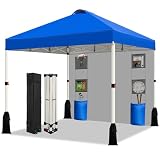
A 10-by-10-foot canopy provides 100 square feet of roof coverage, enough for a small buffet, four to six chairs, or a compact gathering. Coleman and Caravan Canopy offer accessible options in this category. Choose one with straight legs if you want the full advertised footprint; slant-leg shelters use the same nominal roof size but reduce usable space at ground level.
For a six-person seated meal, allow approximately 10 to 12 square feet per person before adding tables or serving equipment. That makes a single 10-by-10 canopy workable only for compact furniture. Two canopies may be more flexible than one 10-by-20 because they can be separated, reconfigured, or packed into different vehicles.
For repeated events: commercial-style straight-leg canopy
E-Z UP, Eurmax, and ABCCANOPY sell product lines aimed at more frequent setup. Prioritize a reinforced frame, replaceable roof, heavy-duty carry bag, and sidewalls that attach without stressing the roof corners. A commercial-style shelter is worthwhile when you expect a dozen or more uses per year, because the cost is spread across repeated setups and replacement parts are easier to find.
For vendor or public events, confirm whether the organizer requires a particular flame-resistance label, anchoring method, or sidewall configuration. A canopy suitable for a backyard is not necessarily compliant with an event’s rules.
For the beach: lightweight frame, serious anchoring
Aluminum reduces the burden of carrying the shelter from a vehicle to the beach. A reflective or silver-coated top can reduce radiant heat under the roof, while a vented peak may help release hot air. However, lightweight construction does not make a canopy safe in wind. Use sand anchors, buried deadman anchors, or manufacturer-approved sandbag systems, and lower or remove the canopy when gusts increase.
Do not drag a wet, sand-covered canopy into its bag. Shake out sand, rinse salt and grit with fresh water where practical, and dry every component completely. Sand inside telescoping legs and hinge joints accelerates wear.
Coverage calculation: choose the size before the brand
Measure the area you need, then add room for people to move around furniture. A 10-by-10 canopy has 100 square feet of roof area, but tables and chairs do not use that area efficiently. A 10-by-15 provides 150 square feet, while a 10-by-20 provides 200 square feet.
For example, suppose you need space for a 6-by-3-foot buffet table, a 6-by-3-foot dining table, and a 3-foot walking aisle. The furniture occupies 36 square feet, but clearance around it can easily double the practical requirement to about 72 square feet. A 10-by-10 canopy can cover it tightly; a 10-by-15 canopy gives more comfortable circulation and better protection from angled rain.
Pop-up assembly: the method that prevents damage
- Choose a flat site. Remove sharp stones and check overhead branches. Uneven ground twists the frame while it is opening.
- Partially expand the frame. With two people, pull opposite corners outward while keeping hands away from sliding joints.
- Attach or position the roof correctly. Do not force hook-and-loop fasteners while the frame is fully collapsed; this can pull seams and corner patches.
- Raise the legs one level at a time. Confirm every locking pin is seated. An unlocked leg can collapse when the roof is loaded by rain.
- Install anchors before adding walls. Sidewalls increase wind resistance and can turn a lightly anchored shelter into a sail.
- Check drainage and tension. Remove sagging and never allow water to pool on the roof.
For a 10-by-10 canopy, two adults usually make setup easier and reduce frame twisting. A 10-by-20 model may require three or four people, particularly on uneven ground or when sidewalls are attached.
Durability and ownership costs
The first parts to wear are commonly roof corners, hook-and-loop fasteners, leg-release buttons, hinge rivets, and the carry bag’s wheels or zipper. Folding the canopy while dirty or damp shortens fabric life and encourages mildew. Before storage, brush off debris, wash according to the manufacturer’s instructions, air-dry fully, and store it loosely rather than compressed under heavy equipment.
Expect accessories to be ongoing expenses: replacement tops, sidewalls, guy lines, stakes, sandbags, and frame parts. A cheaper canopy that needs a new roof after several seasons may cost more than a sturdier shelter with replaceable components. Avoid using duct tape as a structural repair, forcing a bent leg, or leaving the frame partially open in a vehicle where it can be crushed.
Final buying checklist
- Choose straight legs when usable floor area matters.
- Match the roof size to furniture and walking clearance, not just the number of guests.
- Prefer reinforced polyester and covered seams for regular outdoor use.
- Buy the anchoring system at the same time as the canopy.
- Check packed dimensions and weight against your vehicle and storage space.
- Confirm replacement-top availability before choosing an unfamiliar model.
- For events, verify local rules for flame resistance, weights, guy lines, and sidewalls.
For most people, a well-anchored 10-by-10 straight-leg canopy is the best balance of coverage, portability, and price. Move up to a commercial-style frame when setup is frequent, choose aluminum when carrying weight is the priority, and select 10-by-15 or 10-by-20 coverage only after measuring the site and planning how the larger shelter will be transported and secured.




Write Your Review
No reviews yet. Be the first to share your experience!