

Key takeaways
- Fifth wheel hitches compared by mount, rating and slider type, with fixed, sliding, puck-system and gooseneck-ball picks for heavy trailers.
As an Amazon Associate we earn from qualifying purchases.
Affiliate Disclosure: This article contains affiliate links. If you buy through a link on this page, the site may earn a commission at no additional cost to you.
A fifth wheel hitch sits in the bed of the truck, centered over or slightly ahead of the rear axle, and locks onto the trailer’s kingpin. That position is what gives a fifth wheel its stability compared with a bumper-pull trailer, but it also means the hitch, the mounting system under it, and the truck itself all share the load. Choosing well comes down to three things that have to match at the same time: the hitch’s own ratings, the way it mounts in your bed, and whether your bed length calls for a fixed hitch or a slider.
One rule governs everything below. A hitch never raises the truck’s rated capacity. The working limit for any combination is the lowest rating in the chain: the truck’s tow rating and payload, the mounting system, the hitch, and the trailer. A hitch rated well above the truck does not make the truck stronger; it only means the hitch itself is not the weak point. Pin weight deserves the same respect as gross weight, because pin weight comes straight out of the truck’s payload along with passengers, cargo, and the weight of the hitch itself.
How the mounting systems differ
Standard rails are the long-running universal fitting: two steel rails bolt through the bed floor to brackets on the frame, and the hitch legs pin into slots in the rails. Rails stay in the bed when the hitch comes out, which some owners dislike, but the system is widely supported across brands.
The OEM puck system is the factory alternative offered on many newer heavy-duty trucks. Four or five covered openings in the bed floor connect to structure under the bed, and a puck-system hitch drops in and locks with quarter-turn anchors. When the hitch is removed, the covers close and the bed floor is flat.
The third route uses a gooseneck ball. Some hitches mount on a single underbed gooseneck ball, and adapter-style connections clamp over a standard gooseneck ball and convert the trailer’s kingpin to a ball-and-socket coupling. These setups are light and leave a clean bed, but they load the bed through one point rather than four, and the trailer side of the connection changes too, so the trailer maker’s position on gooseneck-style connections is worth checking before choosing this route.
Fixed hitches and sliders
A fixed hitch holds the kingpin in one position. On a long-bed truck that position already leaves enough room between the trailer’s front corners and the back of the cab, so a fixed hitch is the simpler and lighter answer.
A slider exists for short beds. With a short bed, the kingpin sits closer to the cab, and in a tight turn the trailer’s front corner can swing toward the cab. A sliding hitch lets the head move rearward, typically about 12 inches, for low-speed maneuvering, which buys the clearance the short bed lacks. The head must be returned to the forward, locked towing position for travel. A slider solves a clearance problem; it does not add capacity, and it adds weight and moving parts a long-bed truck does not need.
1. B&W Companion RVK3500

The Companion RVK3500 is the fixed, single-point entry in the B&W line. Instead of rails or pucks, it mounts on the B&W Turnoverball underbed gooseneck system, anchoring through the center ball socket. Removing it leaves the Turnoverball fitting in the bed, which can still serve a gooseneck trailer, so one underbed system covers both trailer types.
B&W rates the RVK3500 at 20,000 lb of gross trailer weight and 5,000 lb of vertical (pin) weight. The head articulates front-to-back and side-to-side, which helps the jaws meet the kingpin cleanly when truck and trailer are not sitting at the same angle. A cam-action latching handle is designed to release even when the combination is parked on uneven ground, and polyurethane bushings around the head are there to keep the connection quiet rather than to change any rating. Because this is a fixed hitch, it suits long beds, or short beds only where cab clearance has been carefully confirmed by other means.
Specs
- Maker and model: B&W Trailer Hitches Companion RVK3500
- Gross trailer weight rating: 20,000 lb, as stated by B&W
- Vertical (pin) weight rating: 5,000 lb, as stated by B&W
- Mounting system: Single-point mount on the B&W Turnoverball underbed gooseneck system (Turnoverball sold separately)
- Fixed or sliding: Fixed, non-sliding
- Head: Fully articulating head with cam-action latching handle and polyurethane bushings
2. Andersen Ultimate 5th Wheel Connection 3220, Gen 3

The Andersen Ultimate takes the gooseneck-ball adapter approach further than any steel hitch here. The truck-side piece is an aluminum base that clamps over a standard 2-5/16 inch gooseneck ball, and a coupler block bolts onto the trailer’s kingpin, turning the connection into a ball-and-socket coupling with a funnel that guides the coupler onto the ball. A remote latch cable lets the coupler be released from outside the bed.
Andersen rates the Gen 3 3220 at 24,000 lb gross trailer weight and 4,500 lb of tongue (pin) weight, and states that it is tested to SAE J2638. Note the pairing of those numbers: the pin rating is proportionally lower than on the steel hitches in this list, so a trailer with a heavy pin can reach the 4,500 lb limit well before its gross weight reaches 24,000 lb. The aluminum construction is the draw for owners who remove the hitch often, since the base is far lighter than a steel hitch. It is a fixed connection with no slider function, and because it changes how the trailer couples, confirming that the trailer maker accepts a gooseneck-style connection is part of choosing it.
Specs
- Maker and model: Andersen Hitches Ultimate 5th Wheel Connection 3220, Gen 3
- Gross trailer weight rating: 24,000 lb, as stated by Andersen
- Pin weight rating: 4,500 lb, as stated by Andersen
- Mounting system: Gooseneck-ball adapter style; base clamps over a 2-5/16 inch gooseneck ball (ball and underbed gooseneck hitch sold separately), with a coupler block fitted to the trailer kingpin
- Fixed or sliding: Fixed, non-sliding
- Construction: Aluminum base with ball-funnel coupler and remote latch cable; stated as tested to SAE J2638
3. CURT A20 Slider 16531

The A20 Slider is CURT’s answer for short-bed trucks that use standard rails. It pairs the A20 head with the S20 slider on industry-standard rails, so the head can be moved rearward for maneuvering and locked forward for towing. CURT states 12 inches of slider travel, which is the clearance mechanism described above: it moves the trailer’s swing away from the cab at parking speeds.
CURT rates the 16531 at 20,000 lb gross trailer weight and 5,000 lb vertical load, tested to SAE J2638. The head uses interlocking dual jaws around the kingpin, a cast yoke with poly-torsion inserts intended to damp shock loads and chucking, and a three-position coupling indicator that shows coupled, uncoupled, or ready to tow. The handle is lockable and self-resetting, returning to the ready-to-couple position after uncoupling. Height adjusts across a stated range of 17-1/2 to 21-1/2 inches in this slider configuration. Rails and brackets are not part of the hitch and are sold separately, and the assembly is heavy, so most owners treat it as a two-person lift in and out of the bed.
Specs
- Maker and model: CURT A20 5th Wheel Slider Hitch 16531 (A20 head on S20 slider)
- Gross trailer weight rating: 20,000 lb, as stated by CURT
- Vertical (pin) weight rating: 5,000 lb, as stated by CURT
- Mounting system: Industry-standard 5th wheel rails (rails and brackets sold separately)
- Fixed or sliding: Manual slider, 12 inches of rearward travel for short-bed turning clearance; towed in the forward locked position
- Head: Fully articulating torsion head, interlocking dual jaws, poly-torsion inserts, three-position coupling indicator, self-resetting lockable handle; tested to SAE J2638
4. B&W Companion Slider RVK3405

The RVK3405 takes the Companion design and puts it on a sliding base, while keeping the single-point Turnoverball mount. For a short-bed truck that already has the B&W underbed gooseneck system, it offers slider clearance without giving up the clean-bed benefit of the single-point fitting or switching to rails.
B&W rates the RVK3405 at 20,000 lb gross trailer weight and 5,000 lb vertical weight, with 12 inches of slide travel. The head is the Companion pattern: fully articulating front-to-back and side-to-side, a cam-action latching handle that can release on unlevel ground, and polyurethane bushings for a quieter connection. As with every slider here, the travel is for maneuvering; the hitch is towed locked in the forward position. Owners choosing between this and the rail-mounted CURT slider are really choosing a mounting system first, since the ratings and travel are closely matched while the bed hardware is entirely different.
Specs
- Maker and model: B&W Trailer Hitches Companion Slider RVK3405
- Gross trailer weight rating: 20,000 lb, as stated by B&W
- Vertical (pin) weight rating: 5,000 lb, as stated by B&W
- Mounting system: Single-point mount on the B&W Turnoverball underbed gooseneck system (Turnoverball sold separately)
- Fixed or sliding: Sliding, 12 inches of travel for short-bed turning clearance; towed in the forward locked position
- Head: Fully articulating head with cam-action latching handle and polyurethane bushings
5. B&W Companion OEM 25K RVK3715
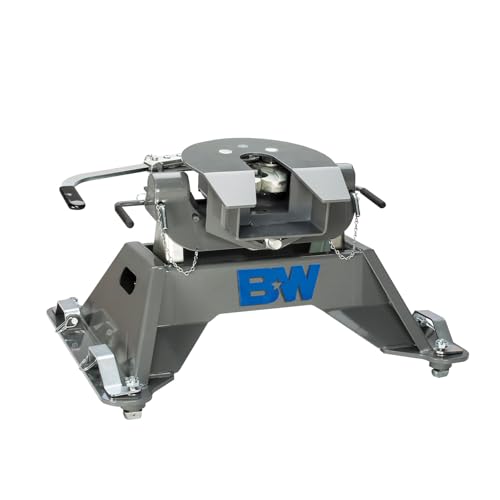
The heaviest-rated hitch in this list is built for one specific fitting: the factory puck system on 2020 and later Chevrolet and GMC heavy-duty trucks. The RVK3715 base locks into the GM puck points with no rails and no drilling, and when it is removed the puck covers restore a flat bed floor. That vehicle specificity is the point and the limitation in one: it fits the GM puck pattern it is made for and no other truck.
B&W rates the RVK3715 at 25,000 lb gross trailer weight and 6,250 lb vertical weight. The head follows the Companion pattern, articulating front-to-back and side-to-side, with a cam-action latching handle for release on uneven sites and polyurethane bushings at the connection. It is a fixed hitch, which matches the long-bed trucks this puck configuration is most often ordered on; GM puck owners with short beds who need maneuvering clearance should look at a puck-system slider instead of assuming a fixed hitch will clear the cab. The higher rating also changes nothing about the truck itself: a 25,000 lb hitch behind a truck rated for less still tows at the truck’s limit, and the 6,250 lb pin rating counts against payload like any other.
Specs
- Maker and model: B&W Trailer Hitches Companion OEM 25K RVK3715
- Gross trailer weight rating: 25,000 lb, as stated by B&W
- Vertical (pin) weight rating: 6,250 lb, as stated by B&W
- Mounting system: OEM puck system, for the factory puck system on 2020 and later Chevrolet and GMC heavy-duty trucks
- Fixed or sliding: Fixed, non-sliding
- Head: Fully articulating head with cam-action latching handle and polyurethane bushings
How to choose among these five
Start with the bed, not the brand. If the truck already has a factory puck system, a puck-specific hitch such as the RVK3715 uses the fitting the truck was built with. If the truck has a B&W Turnoverball, the two Companion models build on it. If the bed has standard rails, or will get them, the CURT A20 Slider fits that system, and if a gooseneck ball is already fitted and a light, removable connection matters most, the Andersen adapter style is the remaining route.
Then settle bed length. Long beds take fixed hitches. Short beds need either a slider, as with the CURT 16531 and the B&W RVK3405, or a different clearance solution confirmed for the specific truck and trailer; a fixed hitch on a short bed without that check risks cab contact in a tight turn.
Finally, run the numbers in the right order: the trailer’s gross weight against every rating in the chain, and its pin weight, loaded, against both the hitch’s vertical rating and what remains of the truck’s payload after people, cargo, and the hitch itself. The right hitch is the one whose mount matches the bed, whose configuration matches the bed length, and whose lowest relevant rating still covers the trailer as it is actually loaded.
Recall check
Each model above was checked by model and product class against the U.S. Consumer Product Safety Commission recall database at SaferProducts.gov before inclusion. The product-class and model searches returned no recalls covering these five hitches, and no pick was excluded on recall grounds. Recall status can change, so a fresh check of the exact model before purchase remains worthwhile on any load-bearing towing component.
More from Amazon
Programs that pair well with the guide above. Offers and eligibility are set by Amazon and may change.
Free shipping on eligible items, Prime Video and more. Eligible new members can start with a free trial.
Start a Prime free trialA Prime membership for ages 18-24 with a trial period. Eligibility is set by Amazon.
See Prime for Young AdultsAudiobooks and podcasts to listen to on the go. Eligible new members can start with a free trial.
Try Audible freeAd-free music streaming. Eligible new subscribers can start with a free trial.
Try Music Unlimited freeAs an Amazon Associate we earn from qualifying purchases.






Write Your Review
No reviews yet. Be the first to share your experience!