

Key takeaways
- The best exhaust pipe cutters for clean tailpipe cuts: chain, ratcheting and rotary cutters compared by pipe range, stainless ability and working room.
As an Amazon Associate we earn from qualifying purchases.
Cutting an exhaust pipe off a car is a different job from cutting pipe on a bench. The pipe is already installed, it sits inches from a fuel tank, brake lines and the floorpan, and there is rarely room to swing a hacksaw or spin a conventional cutter a full turn. An exhaust pipe cutter solves that geometry problem: it wraps the pipe where it sits and works in short back-and-forth strokes, scoring a groove around the circumference until the section drops free. The cut comes out square, spark-free and quiet, which is exactly what you want when the new muffler, resonator or tailpipe section has to slip over or butt against the pipe that stays on the car.
This guide covers the three designs that dominate the class. Chain cutters loop a chain of small cutting wheels around the pipe and are the standard under-car tool. Ratcheting cutters clamp a C-shaped head on the tube and walk a single wheel around in short strokes, and the better ones are rated for stainless. Rotary cutters are the familiar plumber-style wheel tools; they give the squarest ends but need a full circle of clearance, so they belong on the bench with new pipe. One boundary worth stating plainly: these are not plumbing pipe cutters. A separate guide covers tube cutters for copper, PVC and PEX water line; those tools are sized and wheeled for soft plumbing tubing, while everything here is built to cut installed steel exhaust pipe in place.
Affiliate Disclosure: This article contains affiliate links. If you buy through these links, we may earn a commission at no additional cost to you. This helps support our work and allows us to continue providing detailed tool guides.
What to Look for in an Exhaust Pipe Cutter
Pipe diameter range comes first. Most car exhaust systems run between 1-3/4 and 3 inches, and most pliers-style chain cutters cover roughly 3/4 to 3-1/4 inches, which spans nearly every passenger-car job. Diesel trucks and large performance systems run 3-1/2 to 5 inch pipe and need a long-chain specialist. Measure your pipe’s outside diameter before ordering; a cutter whose range tops out below your pipe is a paperweight, and one whose minimum is above your pipe will not close on it.
Stainless steel separates the class. Most factory and replacement exhaust tubing is aluminized mild steel, and any chain cutter here handles it. Stainless systems are harder, and chain wheels dull quickly on them. If your system is stainless, look for a cutter the maker explicitly rates for stainless — in this group that is the ratcheting JEGS — or accept that a saw is the fallback. Also note that chain cutters generally will not cut double-wall pipe; makers state this limit openly.
Working room decides the design. A chain cutter needs only enough space to wrap the chain and rock the handles through a short arc, sometimes as little as a quarter turn of travel. A ratcheting cutter needs even less swing but more setup time per cut. A rotary cutter needs unobstructed room all the way around the pipe, which is why it is a bench tool for cutting new sections to length rather than an under-car tool.
Wheel care is part of the tool. Cutting wheels are consumables. A drop of oil on the wheels before each cut keeps them rolling instead of skidding, and a skidding wheel dulls fast and wanders off line. Models with replaceable wheels, or a spare wheel in the box, stay useful far longer than sealed designs. Tighten gradually as you work; forcing the wheels in one bite crushes thin, rusty pipe instead of cutting it.
The 5 Best Exhaust Pipe Cutters
1. OEMTOOLS 27045 Tailpipe Cutter

The OEMTOOLS 27045 is the reference design for this class: a pliers-handled chain cutter that wraps pipe from 3/4 to 3-1/4 inches, which covers the overwhelming majority of car and light-truck exhaust work. You hook the chain of hardened cutting wheels around the pipe, close the plier jaw until the wheels bite, and rotate the tool by hand until the groove cuts through. It is built for one-handed rotation, which matters when your other hand is steadying a muffler that is about to come loose.
The cushion-grip handles and compact 10.7 inch frame suit the reality of under-car work, where the tool often operates inches from a crossmember. The wheels ride on press-fit pins, so a dulled wheel can be replaced instead of retiring the tool, and OEMTOOLS backs it with a limited lifetime warranty. Like every chain cutter, it is a mild-steel tool at heart: keep the wheels oiled, clean heavy rust off the cut line first, and do not expect it to chew through double-wall pipe.
Specs
- Type: chain cutter, pliers handle
- Pipe range: 3/4 to 3-1/4 inches
- Operation: one-handed rotation, on- or off-vehicle
- Handles: cushion grip
- Tool length: 10.7 inches
- Weight: 1.35 lb
- Warranty: OEMTOOLS limited lifetime
- Model: 27045
2. JEGS 555-80696 Exhaust Pipe and Roll Cage Cutter

The JEGS 555-80696 is the pick for stainless. Instead of a chain, a C-shaped head clamps onto the tube and a ratcheting mechanism walks a single cutting wheel around it in short strokes, so it keeps cutting in spaces where a chain tool’s handles cannot swing. JEGS rates it for mild, hardened and stainless steel tubing, which makes it the only tool in this group that addresses stainless head-on rather than as an afterthought. A quick-release feature backs the wheel off fast when the cut is done.
The trade-off is range. It fits tubing from 1-3/8 to 2-5/8 inches, a mid-size window aimed at common exhaust tubing and roll cage tube. Small tailpipes below that window and big truck pipe above it are both out of reach, so it complements a chain cutter rather than replacing one. At a little over two pounds it is a dense, deliberate tool: slower to set up than a chain wrap, but controlled, and the cut quality on hard tubing is the reason to own it.
Specs
- Type: ratcheting cutter, C-shaped head
- Pipe range: 1-3/8 to 2-5/8 inches
- Materials: mild, hardened and stainless steel (maker rated)
- Feed: ratcheting with quick-release cutting wheel
- Weight: about 2.27 lb
- Model: 555-80696
3. Powerbuilt 940538 Tail Pipe Cutter
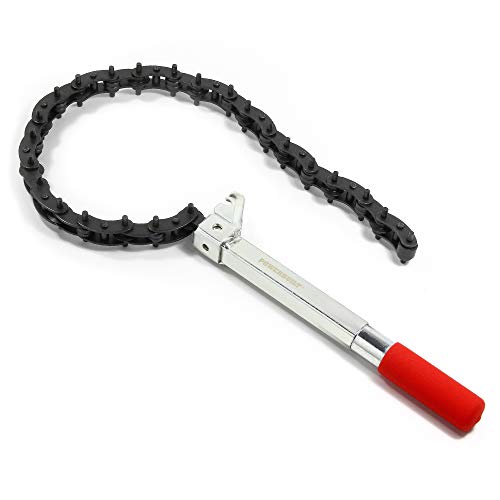
When the pipe is too big for a pliers-style chain, this is the tool built for it. The Powerbuilt 940538 takes pipe from 3-1/2 to 6 inches in diameter — diesel truck exhaust and large performance systems that no standard chain cutter can wrap. Its long chain carries 12 cutting wheels and hooks to a single bar handle with a turning grip, so instead of squeezing pliers you crank the chain around the pipe. Powerbuilt states the tool meets or exceeds ANSI standards.
That size comes with honest costs. The format needs two hands and more swing room than a compact chain tool, and the 3-1/2 inch minimum means it cannot close down on ordinary car pipe at all; it is a specialist, not a general replacement. Buy it because your truck runs 4 or 5 inch pipe, and keep a standard chain cutter for everything smaller. Within its window, the long handle’s leverage makes the cut steady and square.
Specs
- Type: chain cutter, single bar handle
- Pipe range: 3-1/2 to 6 inches
- Cutting wheels: 12
- Standards: meets or exceeds ANSI standards (maker stated)
- Weight: 1.7 lb
- Model: 940538
4. Godora Heavy Duty Pipe Cutter
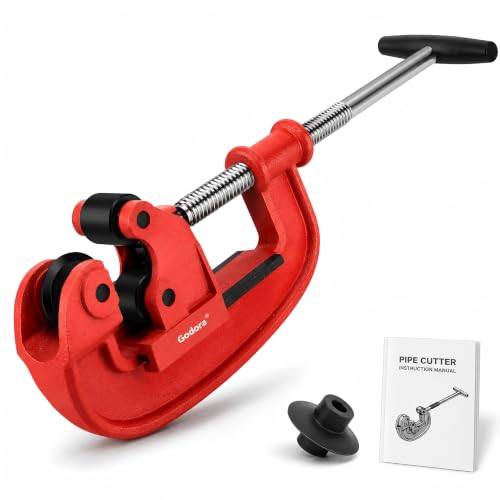
The Godora is the rotary entry, and it plays a different role from the chain tools: cutting new pipe to length on the bench before it goes on the car. Its carbon steel frame carries a single alloy steel cutting wheel on a ball thrust bearing feed screw, so pressure stays smooth and even as you walk the tool around the tube, producing the square, clean end that slip-fit joints and clamps seal best against. The listed capacity is 1 to 3 inches, covering standard exhaust tubing sizes, and an extra cutter wheel is included in the box for the day the fitted wheel dulls.
At roughly 3 pounds the frame has real heft, which helps the wheel track instead of chattering on steel and galvanized pipe. The limitation is the rotary format itself: the tool must travel a full circle around the pipe, so it rarely works on a system still under the car. Think of it as the fabrication partner to a chain cutter — the chain tool removes the old section in place, the Godora cuts the new section square on the bench.
Specs
- Type: rotary wheel cutter, screw feed
- Pipe range: 1 to 3 inches
- Frame: carbon steel
- Cutting wheel: alloy steel, spare wheel included
- Feed: ball thrust bearing screw
- Materials: steel and iron pipe
- Weight: about 3 lb
5. QWORK DG37834 Exhaust Pipe Cutter

The QWORK DG37834 follows the same pliers-and-chain layout as the OEMTOOLS, sized for the same 3/4 to 3-1/4 inch span of pipe, and it suits the occasional job: a single muffler swap in the driveway rather than weekly shop use. The routine is the familiar wrap, hook, close and rotate, workable one-handed, and the cushion-grip handles are comfortable while you rock the tool back and forth. QWORK also lists it for PVC and copper pipe within the same range, which adds a little household utility.
The compromises are in the fine print. The listing does not state a maximum pipe-wall thickness, does not claim stainless capability, and does not spell out a warranty, so treat it as a thin-wall mild-steel tool and oil the wheels before every cut to get the most from them. For a one-time repair on a standard car exhaust, that is a reasonable set of trade-offs; high-mileage or stainless systems deserve the heavier tools above.
Specs
- Type: chain cutter, pliers handle
- Pipe range: 3/4 to 3-1/4 inches
- Operation: one-handed, wrap, hook, close, rotate
- Handles: cushion grip
- Materials listed: exhaust pipe, PVC, copper
- Model: DG37834
How to Cut an Exhaust Pipe Cleanly
Let the system cool completely first; exhaust components hold heat long after the engine stops. Support the vehicle on jack stands, never on a jack alone, and wear eye protection, because rust and scale rain down as the cut progresses. Mark the cut line all the way around the pipe, clean heavy rust from that band with a wire brush so the wheels track on metal rather than crust, and put a drop of oil on the cutting wheels.
Wrap the chain or clamp the head on the line, snug it until the wheels bite, then work in short back-and-forth strokes, tightening a little at a time. Rushing the feed is what crushes rotted pipe and dulls wheels. Support the section being removed before the final strokes so it does not drop and tear the cut edge. Deburr the pipe that stays on the car with a file so the new section slips on without shaving its gasket or coating.
One legal note that belongs in any exhaust guide: cutting out a catalytic converter is only lawful as part of installing a proper replacement. Removing emissions equipment without replacing it is tampering under emissions law, and some states add their own rules about which replacement converters are acceptable.
Frequently Asked Questions
Can a chain cutter cut stainless steel exhaust pipe? Most cannot do it well. Chain wheels are made for mild steel and dull quickly on stainless. The ratcheting JEGS in this guide is maker-rated for stainless; for other tools, expect slow progress and shortened wheel life, or use a saw.
What size cutter do I need for a 3 inch exhaust? A cutter whose range includes 3 inches with a little headroom, such as the 3/4 to 3-1/4 inch chain cutters here. For pipe above 3-1/2 inches, step up to the Powerbuilt’s 3-1/2 to 6 inch range.
Why not just use a reciprocating saw? A saw is faster on rusty or thick pipe and is the right call for a system coming off in pieces. A hand cutter wins on a single clean cut: it is quieter, throws no sparks near the fuel tank, and leaves a square edge that clamps and slip joints seal against.
How long do cutting wheels last? It depends on material and lubrication. Oiled wheels cutting clean mild steel last through many jobs; rust, stainless and dry cutting shorten life sharply. That is why replaceable wheels, or a spare in the box, are worth looking for.
More from Amazon
Programs that pair well with the guide above. Offers and eligibility are set by Amazon and may change.
Free shipping on eligible items, Prime Video and more. Eligible new members can start with a free trial.
Start a Prime free trialA Prime membership for ages 18-24 with a trial period. Eligibility is set by Amazon.
See Prime for Young AdultsAudiobooks and podcasts to listen to on the go. Eligible new members can start with a free trial.
Try Audible freeAd-free music streaming. Eligible new subscribers can start with a free trial.
Try Music Unlimited freeAs an Amazon Associate we earn from qualifying purchases.

Write Your Review
No reviews yet. Be the first to share your experience!