

Key takeaways
- Compare five exhaust pipe expanders for slip-fit muffler and tailpipe work, with exact diameter ranges, drive types and limits for thin or rusted tubing.
As an Amazon Associate we earn from qualifying purchases.
Affiliate Disclosure: This article contains affiliate links. If you buy through a link on this page, we may earn a commission at no extra cost to you.
An exhaust pipe expander does one specific job: it stretches the end of a muffler or tailpipe tube just enough that the next section slips over it, so a slip-fit joint can be clamped instead of welded. The tool is a tapered collet or cone that sits inside the pipe end. Driving the centre bolt, either with a wrench, an impact gun or a hydraulic ram, pulls the cone through the collet and forces the segments outward against the tube wall. Done in small steps, the tube grows evenly and stays round. Done in one greedy pass, it splits.
That limit deserves stating before any product list. An expander can only work with metal that is still willing to move. Sound mild-steel tubing stretches well. Thin-wall tubing stretches a little and then thins further at the stretched band, so the finished joint is weaker than the pipe either side of it. Rusted tubing does not stretch at all in any useful sense: the corroded wall tears along the rust line instead of expanding, and a pipe that crumbles under the collet needed replacement, not resizing. Every pick below is therefore rated first on its stated working diameter range, because a tool used outside its range is the fastest way to tear a pipe that might otherwise have survived, and second on how its drive system meters out force.
These tools are also narrower in purpose than they are sometimes sold as. An expander is not a pipe bender, and it will not put a curve in tubing. It is not a flaring tool either, and it will not form the flared seat a flare nut seals against. It rounds out clamp grooves, corrects slightly oval pipe ends, and enlarges a tube end by a modest amount for a slip fit. Buy it for that job and it earns its space in the toolbox.
1. Astro Pneumatic Tool 78835 Exhaust Pipe Stretcher Kit
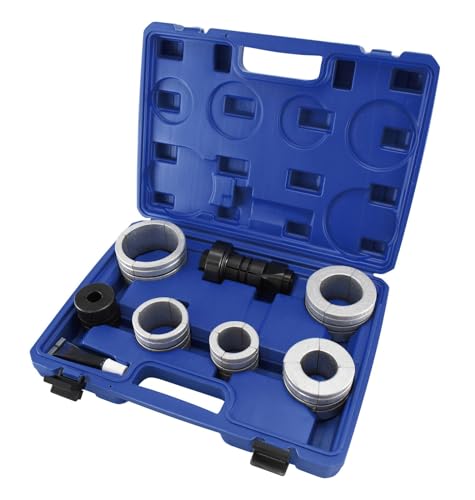
The Astro 78835 is the impact-driven collet kit that most of the generic kits in this class are patterned on, right down to the sizing. A 28 mm bolt head drives the expanding tool, and the included collet sets cover the full spread of common exhaust tubing, so one kit handles everything from a small car tailpipe to a large light-truck muffler inlet. The maker is explicit that the threads get greased before use, and that guidance matters: a dry drive screw galls under impact load, and a galled screw is how these kits die.
Astro also publishes the most demanding drive requirement in this group, recommending an impact wrench with a high tightening capacity for most jobs. Treat that as honest information about how much force stretching steel actually takes. On mild steel within the stated range the kit works as intended. Note the maker’s own warning, printed on its data sheet, that the kit is not for use on stainless exhaust piping, which work-hardens and resists the collet far more than mild steel does.
Specs
- Working range: 1-5/8 to 4-1/4 inches
- Drive: 28 mm bolt head, impact wrench driven
- Collets: Multiple collet sets covering the full range in graduated bands
- Material limit: Not for use on stainless exhaust piping, per the maker
- Preparation: Grease the drive threads before use, per the maker
- Weight: 10.4 pounds
2. Orion Motor Tech Exhaust Pipe Expander Tool Kit

The Orion Motor Tech kit covers the same diameter spread as the Astro with the same basic architecture: a 28 mm hex drive, a set of collets in graduated size bands, and a storage case to keep the collets paired with the driver. It is listed for use with a half-inch or three-quarter-inch impact wrench, which makes it the faster option for repeated slip-fit joints compared with turning a drive bolt by hand, and the maker advises lubricating the parts before use and clamping the pipe before expanding it.
That clamping advice is worth following literally. An impact-driven collet can walk a loose pipe across the bench or spin it in a loose hold, and an expansion that starts off-centre finishes oval. Within its range, on mild steel, the kit does the standard job of this class: pick the collet whose band contains the target diameter, expand in small increments, and test-fit the mating pipe between increments rather than driving straight to a number.
Specs
- Working range: 1-5/8 to 4-1/4 inches
- Drive: 28 mm hex, for use with a 1/2-inch or 3/4-inch impact wrench
- Collets: Multiple collets in graduated size bands
- Included: Storage case
- Preparation: Lubricate parts before use and clamp the pipe, per the maker
- Weight: 4.8 kilograms
3. SCITOO 3-Pieces Pipe Expander Tool Set

The SCITOO set is the manual counterpoint to the two impact kits above. Three separate expanders, rather than one driver with collets, cover the smaller half of the exhaust size range, and each tool is turned with a hand ratchet, breaker bar or hand wrench. The maker is unusually direct about the boundary of the design: use a manual wrench, because an electric ratchet may damage the tool. That is not a defect. For rounding out clamp grooves and making small corrections to a pipe end, hand drive gives the clearest feel for the moment the metal stops moving willingly, which is exactly the moment to stop.
The size bands overlap, so most common car and light-truck pipes fall inside at least one tool with room to spare. The beveled steel cone has to be inserted fully into the pipe before turning; a half-inserted cone concentrates force on the pipe lip and flares the very edge while leaving the rest of the band undersized. Like every tool here, it cannot rescue rusted tubing, and its ceiling of 3-1/2 inches leaves larger truck pipe to the collet kits.
Specs
- Working range: 1-1/8 to 3-1/2 inches across three tools
- Size bands: Small 1-1/8 to 1-3/4 inches; medium 1-1/2 to 2-1/2 inches; large 2-1/8 to 3-1/2 inches
- Drive: Hand ratchet, breaker bar or hand wrench only; the maker warns against electric ratchets
- Model: 109503
- Weight: 5.9 pounds
- Package dimensions: 11.02 x 6.69 x 2.76 inches
4. maXpeedingrods Hydraulic Exhaust Pipe Expander

The hydraulic option replaces arm and impact force with a 10-ton manual hydraulic pump, connected to the expander head by a four-foot hose. Hydraulic drive changes the character of the job: force builds slowly and evenly, the operator can stop at any point and hold it, and there is no impact shock through the collet. For a fabricator making repeated slip-fit joints in the larger sizes, that control is the reason to accept a kit that is far heavier and slower to set up than a collet driver in a case.
The collet coverage is the most finely divided in this group, split into seven overlapping bands across the full range, which lets the operator choose a collet close to the starting diameter of the pipe rather than asking one collet to span a wide band. The trade-offs are bulk and the starting size: the range begins at 1-5/8 inches, so smaller tailpipes are outside it, and the hose and pump make this a bench tool rather than something to use under a vehicle on a lift.
Specs
- Working range: 1-5/8 to 4-1/4 inches
- Collet bands: 1-5/8 to 1-7/8; 2 to 2-1/2; 2-3/8 to 2-3/4; 2-3/4 to 3-1/8; 3-1/8 to 3-1/2; 3-1/2 to 3-7/8; 3-7/8 to 4-1/4 inches
- Drive: 10-ton manual hydraulic pump with a 4-foot hose
- Construction: Alloy steel
- Weight: 23.1 pounds
- Dimensions: 16.93 x 15.75 x 6.3 inches
5. GEARWRENCH Exhaust and Tailpipe Expander 2071D

The GEARWRENCH 2071D is the traditional single expander: one tool, one diameter band, no collets to sort and no case to keep track of. Its band sits in the middle of the passenger-car exhaust range, which is where the classic jobs for this tool shape live: removing the grooves a U-bolt clamp has crushed into a pipe, rounding an end that has gone slightly oval, and nudging a tube end just enough to slide over the next section. For occasional repair work on one vehicle, that focused range is a reasonable trade against a full kit.
The limits are the flip side of the simplicity. A single band means pipes below or above it need a different tool entirely, and this design is a reshaping and light-expanding tool rather than a heavy stretcher, so expectations should be set accordingly: small corrections, worked gradually, on sound metal. Ask it to perform a large stretch on thin or corroded tubing and the tubing, not the tool, will give up first.
Specs
- Working range: 1-13/16 to 2-1/2 inches
- Model: 2071D
- Format: Single expander, no collet set
- Typical use: Removing clamp grooves and rounding out tailpipe and muffler tubing within the stated band
- Manufacturer: K-D Tools
How to Choose an Exhaust Pipe Expander
Start with the tape measure, not the tool catalogue. Measure the inside diameter of the pipe end you need to enlarge and the outside diameter of the pipe or muffler inlet it must slip over. The difference between those two numbers is the expansion you actually need, and for sound mild steel it should be a small difference. If the required growth is large, the correct answer is a reducer or a different pipe section, not a bigger expander, because tubing stretched too far thins at the band and can split along the seam.
Next, match the working range exactly. Every pick above states its range, and the range is a hard boundary, not a suggestion. A collet started in a pipe below its minimum will not grip evenly, and a pipe at the very top of a band leaves the tool no travel to finish the job. Where a kit divides its range into bands, choose the band that contains your target diameter with the starting diameter comfortably inside it.
Then choose the drive you will genuinely use well. Impact-driven collet kits such as the Astro and the Orion Motor Tech are fast and cover the widest ranges, but they demand the right impact wrench, greased threads, and the discipline to expand in increments instead of holding the trigger. Manual sets such as the SCITOO and the single GEARWRENCH trade speed for feel, which suits occasional repairs and small corrections. The hydraulic maXpeedingrods kit gives the smoothest, most controllable force and suits repeated larger work, at the cost of setup time and weight.
Finally, judge the pipe before the tool touches it. Wire-brush the end and look at the wall. Bright, even metal with full thickness will stretch. Metal with deep pitting, flaking scale or a wall you can flex with thumb pressure will tear, and no expander in this list changes that. Cutting back to sound metal, or replacing the section, is the honest repair in that case. Work the expansion in small steps, rotate your test fits between steps, stop the moment the mating pipe slips on with a firm push, and deburr the edge before clamping the joint.
More from Amazon
Programs that pair well with the guide above. Offers and eligibility are set by Amazon and may change.
Free shipping on eligible items, Prime Video and more. Eligible new members can start with a free trial.
Start a Prime free trialA Prime membership for ages 18-24 with a trial period. Eligibility is set by Amazon.
See Prime for Young AdultsAudiobooks and podcasts to listen to on the go. Eligible new members can start with a free trial.
Try Audible freeAd-free music streaming. Eligible new subscribers can start with a free trial.
Try Music Unlimited freeAs an Amazon Associate we earn from qualifying purchases.

Write Your Review
No reviews yet. Be the first to share your experience!