

Key takeaways
- Planetary torque multipliers compared: truck lug nut crank kits, a conservative US wrench, a shop reaction-bar tool and a compact car-size labor saver.
As an Amazon Associate we earn from qualifying purchases.
A torque multiplier is a planetary gearbox with a handle. You turn the input side with modest effort, the gear set trades speed for force, and the output side turns the socket with many times the torque you applied. That trade is exactly what a seized semi-truck lug nut demands: nuts torqued to several hundred foot-pounds at installation, then corroded in place for years, will not move for a cross wrench and a boot heel. A multiplier breaks them loose slowly, smoothly and without an impact gun, a compressor or a cheater pipe slipped over a breaker bar.
One honesty note has to lead this guide, because it decides how these tools should be used. A torque multiplier is a removal tool first. The big output numbers on the box are maker claims, not measurements, and internal gear friction means the torque actually delivered at the socket is lower than the gear ratio alone suggests — sometimes noticeably lower. That does not matter when you are breaking a nut loose. It matters a great deal when you are tightening one to a specification. Final tightening of any wheel belongs on a calibrated torque wrench, worked in the vehicle maker’s sequence, and several picks below show exactly why the claims need a skeptical eye: one listing advertises a headline figure in its title that its own specification table contradicts by more than a third.
Affiliate Disclosure: This article contains affiliate links. If you buy through these links, we may earn a commission at no additional cost to you. This helps support our work and allows us to continue providing detailed tool guides.
Two Families of Multiplier
Crank-style lug nut wrenches are the roadside design. The gearbox sits over the nut on a deep socket, a brace on the housing rests against a neighboring lug nut or the hub, and a rocking or crank handle drives the input. Ratios run from about 1:16 on car-size versions to 1:58, 1:64 and 1:65 on truck kits, and the kits ship with the large sockets truck wheels use. They are slow — dozens of handle turns per nut — but they need no power source and they fit in a storage case behind a seat.
Reaction-bar multipliers are the shop design. A compact planetary head takes input from an ordinary ratchet or torque wrench on a 1/2 inch square drive and delivers output on a 3/4 inch drive, while a straight reaction bar braces the head against a frame rail, a suspension part or another fixed point. Ratios are modest, around 3:1 to 4:1, which is precisely why this family can also be used for controlled tightening with the maker’s conversion chart: the friction losses are smaller and more consistent. The trade-off is a hard ceiling on output and the need for a solid object to brace against.
What to Check Before Buying
Gear ratio versus real output. Multiply your realistic input by the ratio, then discount it. A 1:58 kit fed with 60 ft-lb of handle effort does not deliver 3,480 ft-lb at the socket; friction in the planetary set eats a share of it. Treat published maximums as the gearbox’s structural ceiling, not a promise.
The reaction point. All that multiplied torque pushes back somewhere. On crank kits the housing braces against an adjacent lug nut, which is why these kits only work where lug nuts are clustered in a circle. On reaction-bar tools you choose the anchor, and it must be genuinely immovable — a bar that slips off a rounded bracket at full load is a safety problem, not an inconvenience.
Sockets. Truck kits should include deep, thick-wall sockets in the sizes your wheels actually use — commonly 32, 33, 38 and 41 mm hex plus a 21 mm square socket for Budd-style inner nuts. Six-point sockets grip corroded flats better than twelve-point. Car kits cover 17, 19 and 21 mm. Check the list against your vehicle before ordering, because a multiplier without the right socket is dead weight.
Drive size. Truck kits are 1 inch drive throughout. Shop multipliers step 1/2 inch input up to 3/4 inch output, so your existing heavy sockets may already fit.
The 5 Best Torque Multipliers
1. Performance Tool M208 Torque Multiplier Wrench

The M208 is the mainstream branded version of the classic truck lug nut kit, sold by Performance Tool (Wilmar) through ordinary auto parts channels. The gearbox runs a 1:58 ratio on a 1 inch drive, and the kit pairs it with a rocking bar handle, an extension bar and a blow-molded case. Six 6-point sockets cover the common hex lug sizes and a 4-point open-ended square socket handles square and tapered Budd nuts.
This listing is also the clearest illustration of why this guide treats output figures as claims. The product title advertises 3,688 ft-lb, while the specification table in the same listing puts item torque at 2,350 ft-lb. Both numbers come from the maker; they cannot both describe the same gearbox, and the lower figure is the safer planning number. Even at 2,350 ft-lb of claimed output, the tool has several times the breakaway capacity a truck lug nut torqued to 450–500 ft-lb can resist, so the discrepancy changes nothing about what the tool can do — it only underlines that the headline is marketing. At 24 pounds the kit is a substantial box, best kept in the truck rather than carried.
Specs
- Type: crank-style lug nut multiplier kit
- Gear ratio: 1:58
- Drive: 1 in input and output
- Maker-rated output: 3,688 ft-lb headline; 2,350 ft-lb in the listing’s own spec table (treat as claims)
- Sockets: six 6-point hex sockets plus one 4-point open-end square socket
- Reaction: housing braces against adjacent lug nut; rocking bar handle
- Included: multiplier, rocking bar, extension bar, sockets, blow-mold case
- Weight: 24 lb
2. VEVOR Torque Multiplier, 1 Inch Drive (BD-58D-A)

VEVOR’s kit follows the same proven layout as the M208 with a slightly wider socket spread. The 1:58 gearbox is rated by the maker at 4,800 Nm of output — roughly 3,540 ft-lb — and drives 1 inch sockets. Eight chrome-vanadium sockets run from 24 mm to 38 mm, which covers the hex sizes on most medium and heavy truck, trailer and RV wheels, and the set adds the usual extension bar and rocking handle in a storage case.
Socket coverage is the reason to pick this one over its near-identical rivals: the 24 mm bottom end reaches smaller truck and large SUV hardware that 32 mm-starting kits skip. Construction is alloy steel and the kit weighs 25.2 pounds, so it lives in the vehicle or on a shelf, not in a tool bag. The same claim discipline applies as with every crank kit here: 4,800 Nm is the maker’s ceiling for the gearbox, not a figure to set a wheel by.
Specs
- Type: crank-style lug nut multiplier kit
- Gear ratio: 1:58
- Drive: 1 in
- Maker-rated output: 4,800 Nm (approx. 3,540 ft-lb), maker claim
- Sockets: eight Cr-V sockets, 24–38 mm
- Reaction: housing braces against adjacent lug nut; rocking handle bar
- Included: multiplier, rocking handle bar, extension bar, sockets, storage case
- Material: alloy steel; weight 25.2 lb
3. Cheater Wrench Torque Multiplier Lug Nut Wrench

The Cheater Wrench is the American original of this tool class, made by DT Industries, and it takes a different approach to the numbers game. Its ratio is the tallest here at 1:65, yet the maker rates maximum output at a comparatively modest 2,000 ft-lb — a figure that looks weak next to the 4,800 Nm claims above until you remember that every number in this category is a claim, and a conservative claim from a maker that also offers a lifetime warranty is worth more than an inflated one. In practice 2,000 ft-lb of breakaway is several times what a properly installed truck lug nut needs.
The kit is built around deep 1 inch drive impact sockets: 33, 38 and 41 mm hex sizes plus a 21 mm square socket for Budd inner nuts, with a 1 inch male-to-female adapter for reach. The housing braces against a neighboring lug nut in the usual way. There is no long socket list and no attempt to be a universal kit; it is a single-purpose wheel tool for trucks, trailers, RVs, buses and tractors. For a fleet or an owner-operator who will use it for years, that focus and the warranty make it the premium pick of the crank kits.
Specs
- Type: crank-style lug nut multiplier
- Gear ratio: 1:65
- Drive: 1 in
- Maker-rated output: 2,000 ft-lb maximum (maker claim, deliberately conservative)
- Sockets: deep impact sockets 33, 38, 41 mm hex and 21 mm square (Budd)
- Adapter: 1 in male-to-female
- Reaction: housing braces against adjacent lug nut
- Warranty: lifetime, per maker
4. Neiko PRO 03715B Torque Multiplier
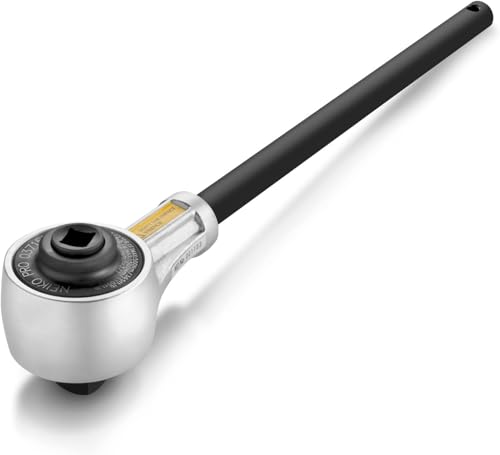
The 03715B represents the other family entirely. It is a compact planetary head — the head measures about 2.9 inches across and the tool is 13.75 inches long — with a 1/2 inch input drive and a 3/4 inch output drive. Neiko rates it at 365 ft-lb maximum input and 1,100 ft-lb maximum output, an effective multiplication of about 3:1 after the stated 3.3:1 gearing and friction. A straight chrome-vanadium reaction bar braces the head against any solid fixed point, and the head itself is chrome-molybdenum steel. It ships in a hard ABS case, with no sockets included.
That modesty is the point. Because the ratio is low and the losses are comparatively predictable, Neiko supplies a conversion chart so the tool can be driven by a torque wrench for controlled tightening of high-torque fasteners, as well as for breaking them loose. It will not replace a crank kit at the roadside, since 1,100 ft-lb is its ceiling and it needs a brace point the wheel area may not offer, but in a workshop it is the most versatile tool here and the only one designed to tighten as well as remove.
Specs
- Type: reaction-bar planetary multiplier (shop style)
- Gear ratio: 3.3:1 stated; about 3:1 effective output
- Input drive: 1/2 in; output drive: 3/4 in
- Maker-rated limits: 365 ft-lb max input; 1,100 ft-lb max output
- Reaction: straight reaction bar against a fixed point
- Construction: Cr-Mo head, Cr-V reaction bar; head approx. 2.9 in; length 13.75 in
- Included: multiplier, reaction bar, hard ABS case; no sockets
- Tightening: maker conversion chart supplied for torque-wrench use
5. DUOYI Torque Multiplier Lug Nut Removal Tool (1:16)

Most labor-saving wrenches are built for truck wheels and are useless on a passenger car, both because the sockets start too large and because a 25 pound case is overkill for a 100 ft-lb lug nut. The DUOYI kit scales the idea down. Its 1:16 gearbox works on a 1/2 inch drive and comes with the three sockets cars actually use — 17, 19 and 21 mm — in a compact case sized for a trunk or boot well.
The maker’s stated maximum output is 320 Nm, roughly 236 ft-lb. That is a realistic number for the class: two to three times the installation torque of a typical car lug nut, which is what breakaway on a corroded or over-tightened shop-installed nut actually requires. A support bracket braces the tool against the wheel while the small crank handle turns. It is not a precision instrument and the final quarter-turn of tightening still belongs on a torque wrench, but as an alternative to standing on a cross wrench — or for a driver who cannot generate breaker-bar force — it solves the roadside flat problem in a package that fits beside the spare.
Specs
- Type: compact crank-style labor-saving wrench for cars
- Gear ratio: 1:16
- Drive: 1/2 in
- Maker-rated output: 320 Nm maximum (approx. 236 ft-lb), maker claim
- Sockets: 17, 19, 21 mm
- Reaction: support bracket braces against the wheel
- Included: multiplier wrench, three sockets, carry case
- Best for: passenger cars, SUVs and light vans
Using a Multiplier Safely
Set the socket fully on the nut before applying force, and confirm the reaction brace is seated against its anchor — most failures happen in the first quarter turn, when a half-seated socket cams off or a brace slips. Turn the handle smoothly rather than jerking it; planetary gears multiply steady force and dislike shock loads, which is also why none of these tools should ever be driven by an impact wrench unless the maker explicitly allows it. Once the nut breaks free, spin it off with a regular wrench or the kit’s extension bar, because cranking a loose nut through sixty turns of gearing is nobody’s idea of a good time.
When the wheel goes back on, run the nuts down snug with the multiplier if you must, then finish with a torque wrench in the maker’s star pattern and re-check after the first short drive. A multiplier gets you out of a roadside jam with hand power alone; the torque wrench is what makes the repair correct.
More from Amazon
Programs that pair well with the guide above. Offers and eligibility are set by Amazon and may change.
Free shipping on eligible items, Prime Video and more. Eligible new members can start with a free trial.
Start a Prime free trialA Prime membership for ages 18-24 with a trial period. Eligibility is set by Amazon.
See Prime for Young AdultsAudiobooks and podcasts to listen to on the go. Eligible new members can start with a free trial.
Try Audible freeAd-free music streaming. Eligible new subscribers can start with a free trial.
Try Music Unlimited freeAs an Amazon Associate we earn from qualifying purchases.

Write Your Review
No reviews yet. Be the first to share your experience!