

Key takeaways
- Compare the best combustion leak testers for blown head gaskets by chamber design, included fluid volume, diesel compatibility and tests per kit.
As an Amazon Associate we earn from qualifying purchases.
An engine that loses coolant with no puddle under it, overheats under load, or pushes bubbles up through the radiator neck is telling a short list of stories, and a blown head gasket is the expensive one. A combustion leak tester — most mechanics call it a block tester — settles the question before any teardown. The tester seals onto the radiator or expansion tank filler neck, draws the air sitting above the coolant through a chamber of indicating fluid, and answers with chemistry: if combustion gases are leaking into the cooling system, carbon dioxide in those gases changes the fluid’s color. No color change, no combustion leak.
Every kit in this guide works on that same fluid principle. None of them is an electronic gas analyzer, a cooling system pressure tester, or a cylinder leak-down gauge. What separates the five kits below is chamber design, how much test fluid is in the box, whether the included fluid covers diesel engines or only gasoline ones, and how the vapor sample gets drawn through the fluid.
Affiliate Disclosure: This article contains affiliate links. If you buy through a link, the site may earn a commission at no additional cost to you.
How to choose a combustion leak tester
Single chamber versus dual chamber. A single-chamber tester bubbles the sampled air straight through one body of fluid. It is simple and it works, but coolant mist or alkaline particles carried up with the vapor can tint the fluid and imitate a weak positive. A dual-chamber tester passes the sample through a first chamber that traps those contaminants before the gas reaches the indicating fluid, which cuts down false readings. If a first test gives a borderline result, the dual-chamber design is the one that removes doubt.
Fluid is a consumable, so count it. The indicating fluid does the actual work, it degrades once opened, and a kit with no fluid in the box tests nothing. Note how much fluid each kit below includes and what the maker says it covers in tests. Replacement fluid is sold separately for every tester here, and using the correct fluid for the tester matters more than brand loyalty — but never top up a chamber with fluid of unknown age, because tired fluid is a classic source of muddy, unreadable results.
Gasoline fluid is not diesel fluid. Standard block test fluid is formulated for gasoline engines. Diesel combustion gas reacts differently, and some kits handle that with a dedicated diesel fluid that starts a different color, while others use one fluid whose positive color differs by fuel. Check the Specs of each pick before assuming a kit that tests your gasoline car also tests your diesel truck.
How the sample is drawn. Most testers use a rubber squeeze bulb or aspirator the operator pumps by hand. The Lisle design below instead connects to engine vacuum or a hand vacuum pump, which pulls a steadier stream of vapor through the fluid over several minutes. A steady draw matters on marginal leaks that only seep under sustained running.
Know what a negative result does not prove. This test detects one failure path only: combustion gas entering the coolant. A head gasket can also fail between cylinders, into an oil gallery, or externally, and none of those will turn the fluid. A clean result rules out the coolant path, not the gasket. Likewise, a positive result confirms gas is crossing into the cooling system — from a gasket, a cracked head, or a cracked block — but does not say which part failed or where.
1. Block Tester BT-500 — the straightforward complete kit
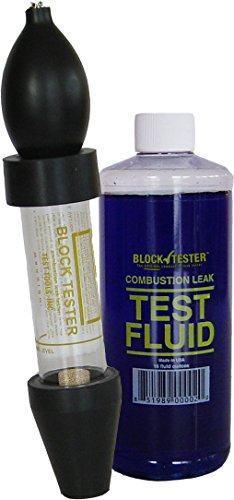
The BT-500 from Block Tester is the kit most home garages end up with, because the box contains everything the test needs: the tester body, the tapered adapter that seals into the filler neck, and the indicating fluid. Nothing else has to be ordered before the first test, which is not true of every kit in this class.
The tester is a single-chamber design with a hand aspirator bulb. Vapor drawn from above the coolant bubbles through the fluid, and combustion gas turns the fluid from blue to yellow. Block Tester builds the kit in the USA and backs it with a limited lifetime warranty, the strongest coverage stated by any maker in this guide. The maker rates the kit for the full range of coolant-side combustion leak sources: a blown head gasket, a cracked or warped cylinder head, a cracked block, and pulled head studs or bolts that have let the gasket lose its seal.
Choose the BT-500 if you want one complete, honestly specified kit for gasoline engine diagnosis and no interest in maintaining a shelf of tester variants. Its limits are the class limits: it is a single chamber, so keep coolant well below the neck and draw gently to avoid splashing fluid into the chamber, and diesel work is outside what the standard included fluid is made for.
Specs
- Chamber design: single chamber
- Test fluid: included in the kit
- Indication: fluid changes blue to yellow with combustion gas present
- Sample draw: hand aspirator bulb
- Detects: head gasket leaks, cracked head or block, pulled studs, warped sealing surfaces
- Origin: made in the USA
- Warranty: limited lifetime, per the maker
- Model: BT-500
2. UView 560000 — the dual-chamber kit for gas and diesel

UView’s 560000 is the pick for anyone who has chased a borderline block test result and wants the second chamber’s insurance. Its dual-chamber tester routes the vapor sample through a first chamber that filters out alkaline particles before the gas reaches the indicating fluid in the second chamber. Those particles are the main cause of false positives in single-chamber testers, so the design targets the exact weakness of the basic test.
The fluid story is also the most flexible here. The kit includes a 16 oz bottle of tester fluid, which UView rates at roughly sixteen applications, and the same fluid serves both fuel types with a different positive color for each: blue to yellow on a gasoline engine, blue to green on a diesel. That makes the 560000 the one kit in this guide that covers a diesel truck and a gasoline car with what is in the box. The tester body is glass, the kit ships in a storage case, and at just under three pounds it lives comfortably in a tool cabinet drawer.
Choose the 560000 if diesel coverage matters or if a previous single-chamber test gave an ambiguous tint you could not trust. Handle the glass chamber with more care than the plastic testers here, and keep the case — it is doing real protective work.
Specs
- Chamber design: dual chamber, filters alkaline particles
- Test fluid: 16 oz included, rated by the maker for about 16 applications
- Indication: blue to yellow (gasoline), blue to green (diesel)
- Engines: gasoline and diesel with the included fluid
- Chamber material: glass
- Included: dual-chamber tester, 16 oz fluid, instructions, carry case
- Weight: 2.9 lb
- Model: 560000
3. Lisle 75500 — the vacuum-drawn professional standard

Lisle’s 75500 takes a different approach to sampling. Instead of a squeeze bulb, the tester connects by hose to a vacuum source — an engine vacuum line on the vehicle, or a hand vacuum pump through the included adapter — and that vacuum draws vapor through the indicating fluid continuously while the engine runs. A long, steady draw is exactly what a small seep needs to show itself, and it frees the operator’s hands during a test that should run for several minutes.
The kit includes a 16 oz bottle of fluid, and the indication on a gasoline engine is the familiar blue to yellow. Diesel owners need to read this part carefully: the included fluid is the gasoline formula. Lisle sells a separate diesel indicating fluid, number 75730, which starts red and turns yellow on diesel combustion gas, and that bottle is not in this box. Budget for it separately if the diesel in your life is the vehicle being tested. The 75500 itself is made in the USA, and its tapered end seats directly into the radiator opening.
Choose the 75500 if you already own a hand vacuum pump or work on engines with an easy vacuum tap, and you value the steady draw over bulb pumping. If you want one box that tests diesel on day one with nothing extra to buy, the UView above is the better fit.
Specs
- Chamber design: single chamber
- Test fluid: 16 oz included, gasoline formula
- Indication: blue to yellow (gasoline)
- Diesel use: requires Lisle 75730 diesel fluid, sold separately (red to yellow)
- Sample draw: engine vacuum line or hand vacuum pump, adapter included
- Origin: made in the USA
- UPC: 083045755005
- Model: 75500
4. RELD Head Gasket Tester Kit — the high test count option
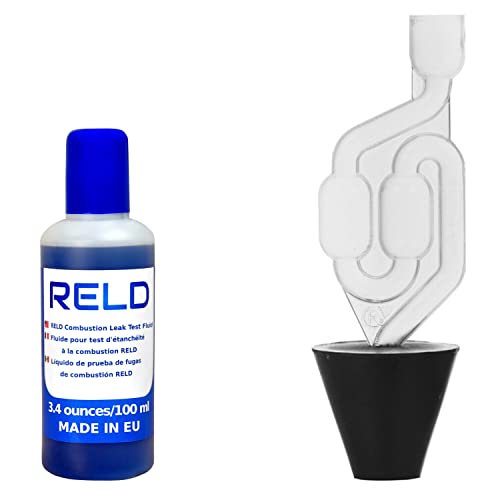
RELD’s kit is built around economy of repetition: the maker rates the included reaction fluid for 50 tests, the highest count in this guide, which suits anyone checking several vehicles — a small fleet, a used-car habit, or a shop that confirms a diagnosis before quoting engine work. The tester is a universal-fit design with a tapered cone that seals against radiator and expansion tank necks across makes.
Fuel coverage is broad. RELD specifies the kit for liquid-cooled petrol, diesel, and LPG engines, so one kit follows you between the family cars and a diesel work vehicle. The kit is made in the European Union. As with every fluid tester, the 50-test figure assumes the fluid is stored sealed, kept out of the chamber between tests, and replaced once it starts losing its clean original color — fluid that has sat open in a hot garage will not deliver fifty trustworthy tests.
Choose the RELD if test volume is the priority and you are disciplined about fluid storage. Occasional users will get more value from a kit whose fluid they will finish before it ages out.
Specs
- Chamber design: single chamber, universal tapered cone fit
- Test fluid: included, rated by the maker for 50 tests
- Engines: petrol, diesel, and LPG liquid-cooled engines
- Origin: made in the European Union
- Model number: 7777252
5. Gold Label Detailing Combustion Leak Detector Kit — the big fluid supply
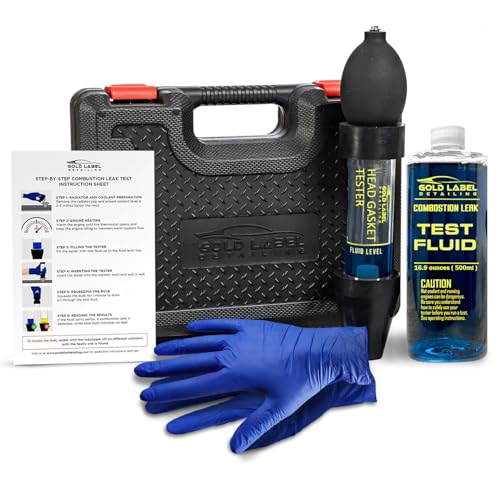
Gold Label Detailing’s kit leads with volume: the box pairs the tester with an 18 oz bottle of fluid, the largest supply in this guide, and the maker rates that combination at over one hundred tests. The tester itself is built from plastic and rubber, which shrugs off the knocks of a working garage better than a glass chamber does.
The test procedure is the standard one for the class — seal the tester to the filler neck, draw vapor through the fluid with the engine warm and running, and read the color. With that much fluid on hand, there is no reason to ration a retest: if a first run is interrupted or the result looks marginal, fresh fluid and a second, longer draw cost nothing but time, which is the right way to treat any borderline block test. The kit is aimed at gasoline engine diagnosis; the maker does not claim diesel coverage for the included fluid, so diesel owners should look at the UView or the Lisle with its separate diesel fluid instead.
Choose this kit if you expect to test often and want the fluid supply to stop being the limiting factor, in a tester body that tolerates rough handling.
Specs
- Chamber design: single chamber
- Test fluid: 18 oz included
- Test capacity: maker rates the kit at 100+ tests
- Construction: plastic and rubber
- Engines: gasoline
- Model: GLD-HEADGASKETKIT
Running the test so the result means something
Warm the engine fully first — a leak that only opens at operating temperature will not show on a cold one. Lower the coolant level a few inches below the filler neck so no coolant can splash into the tester, because coolant drawn into the chamber contaminates the fluid and can fake a color change. Fill the chamber to the marked line with fresh fluid, seal the tester onto the neck, and draw vapor steadily for the time the kit’s instructions specify, keeping the engine running.
Read the fluid promptly and in good light. A true positive is an unmistakable shift toward yellow (or green, for the UView on diesel). A faint greenish tint in a gasoline test usually means the draw ran too long, the fluid is old, or coolant mist reached the chamber — refill with fresh fluid and repeat with a gentler draw before concluding anything. If the second careful test is clean and the symptoms persist, remember this tool’s boundary: it only sees combustion gas in coolant. Pressure testing, a cylinder leak-down test, and checking the oil and plugs are the next steps.
More from Amazon
Programs that pair well with the guide above. Offers and eligibility are set by Amazon and may change.
Free shipping on eligible items, Prime Video and more. Eligible new members can start with a free trial.
Start a Prime free trialA Prime membership for ages 18-24 with a trial period. Eligibility is set by Amazon.
See Prime for Young AdultsAudiobooks and podcasts to listen to on the go. Eligible new members can start with a free trial.
Try Audible freeAd-free music streaming. Eligible new subscribers can start with a free trial.
Try Music Unlimited freeAs an Amazon Associate we earn from qualifying purchases.
Write Your Review
No reviews yet. Be the first to share your experience!