

Key takeaways
- Stabilization: Electronic stabilization works best when the camera is firmly attached. A loose backpack strap can bounce more than software can correct. Stabilization modes may crop the image, so test framing before a trip.
- Battery planning: Carry spare batteries close to your body in cold weather and swap them before they are empty. Do not rely on a single advertised runtime for a full day of filming; record short clips and turn the camera off between them.
- Waterproofing: Before entering water, inspect the battery door and seals for grit, hair, sand, or damage. Close the door fully, rinse the camera with fresh water after salt or sand exposure, and let it dry before opening the compartment.
- Mount wear: Screws, adhesive mounts, and quick-release clips can loosen or deteriorate. Check them before each outing, especially after heat, dust, or repeated wetting. Replace a mount if it is cracked, swollen, or no longer grips securely.
- Storage: Use a padded case to protect lenses and screens from keys, cookware, and grit. A lens scratch is especially costly on a 360 camera because it can appear across the reframed image.
Best Action Cameras for Outdoor Adventures
The best action camera for most outdoor adventures is the DJI Osmo Action 5 Pro: it combines strong stabilization, a deep waterproof rating without a housing, useful front and rear screens, and better-than-average low-light performance for an action camera. Choose the GoPro HERO13 Black instead if you want its broad accessory ecosystem and lens-mod options; pick the Insta360 X5 if capturing a full 360-degree view matters more than keeping the camera small and simple.
Those picks suit different trips. A camera’s headline video resolution matters, but so do the conditions that quietly shorten a day of filming: cold-weather battery drain, awkward mounting points, water ingress through a poorly seated door, and footage that looks noisy after sunset. The comparison below focuses on those practical trade-offs.
Our top picks
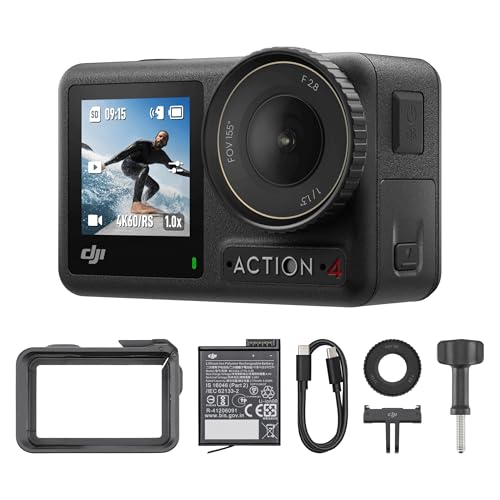


As an Amazon Associate we earn from qualifying purchases at no extra cost to you. Ratings are shown as listed on Amazon.
Quick comparison: leading action cameras
Figures are manufacturer-published specifications or approximate dimensions and weights; recording time varies with resolution, frame rate, temperature, and settings. Prices are broad new-product market ranges and can change with bundles and sales.
| Camera | Approx. size and weight | Waterproof without housing | Battery and typical 4K runtime | Best fit | Typical price range |
|---|---|---|---|---|---|
| DJI Osmo Action 5 Pro | 70.5 × 44.2 × 32.8 mm; about 146 g | 20 m | 1,950 mAh; up to about 240 minutes under specified test conditions | Hiking, mixed weather, and dusk footage | $300–$450 |
| GoPro HERO13 Black | About 72 × 51 × 34 mm; about 159 g | 10 m | 1,900 mAh; around 1.5–2.5 hours depending on settings | Accessory choice and adaptable shooting | $350–$500 |
| Insta360 X5 | About 124 × 46 × 38 mm; about 200 g | 15 m | 2,400 mAh; roughly 1–2 hours of intensive recording | 360-degree scenes and group activities | $450–$600 |
| DJI Osmo Action 4 | About 71 × 44 × 33 mm; about 145 g | 18 m | 1,770 mAh; up to about 160 minutes under specified test conditions | Saving money without giving up a rugged design | $200–$350 |
Manufacturer runtime figures are best treated as ideal-condition ceilings, not a promise for a cold, windy day. Continuous high-resolution recording, bright screens, wireless connections, and frequent starts and stops all affect real-world endurance.
Choose by the trip, not just the spec sheet
For one camera to cover hiking, camping, and water sports: DJI Osmo Action 5 Pro
The Action 5 Pro is the balanced choice when a trip may involve rain, a river crossing, trail footage, and a campsite after sunset. Its 20-meter waterproof rating gives more breathing room than the common 10-meter rating, and its stabilization is designed to smooth walking and action footage without a gimbal. The large battery and front-and-rear displays are convenient when filming yourself or checking framing while the camera is mounted.
It is still an action camera, not a night camera. Low light is challenging for small sensors: expect cleaner results at dusk than in a dark forest, and use a headlamp or camp light if you want to record people clearly. For prolonged underwater use, verify the current depth and temperature limits and consider a compatible dive housing rather than relying on the bare camera’s rating.
For the widest accessory and mounting options: GoPro HERO13 Black
GoPro is the safer pick if you already own compatible mounts or want a large choice of third-party supports. Its standard mounting setup, optional accessories, and lens-mod system give experienced users room to adapt the camera for different viewpoints. Strong stabilization makes it suitable for walking, cycling, and paddling, though stabilization can crop the frame and is not a substitute for a securely mounted camera.
At 10 meters waterproof without a housing, it has less depth margin than the DJI picks in this comparison. The HERO13’s battery performance is respectable, but spare batteries are worth budgeting for a full day of frequent clips. Its image quality in dim conditions is serviceable for an action camera; if dusk filming is a priority, compare sample footage at the resolution you actually plan to use.
For capturing the whole group or a hard-to-frame moment: Insta360 X5
A 360 camera records around itself, letting you choose the final viewing direction later. That is useful when you cannot point a conventional camera at every moment—such as a group ride or a moving boat. The trade-off is a larger editing workload and files that need reframing for ordinary flat video. The X5’s exposed lenses also need more care than a camera with a protected front lens: scratches can affect footage across a wide area.
Choose it when reframing is a feature you will use, not just a novelty. For a compact, quick-to-share hiking clip, a conventional action camera is usually easier.
For a capable lower-cost option: DJI Osmo Action 4
The Action 4 remains a sensible budget choice if you find it at a meaningfully lower price than newer models. It offers a rugged, waterproof body and stabilization suitable for everyday outdoor clips. The savings can go toward a spare battery, a reliable chest or handlebar mount, and a protective case—often a more useful upgrade than paying extra for a feature you will rarely use.
Match the camera to your actual use
| Your situation | Recommended direction | Why |
|---|---|---|
| First camera; occasional weekend trips | DJI Osmo Action 4 or discounted Action 5 Pro | Simple setup; prioritize spare power and a stable mount |
| Frequent water sports or snorkeling | Action 5 Pro or Action 4; add a housing for deeper or extended immersion | Deeper bare-camera rating, with housing for extra protection |
| One-bag hiking with limited space | GoPro HERO13 Black or DJI Osmo Action 5 Pro | Compact conventional-camera form; avoid carrying unused mounts |
| Filming a group, ride, or activity you cannot frame in advance | Insta360 X5 | Capture all directions and select the view later |
| Regular filming in dim campsites | Action 5 Pro, plus a small light | Low-light advantage helps, but added light matters more than a resolution upgrade |
Budget for the complete kit
A camera-only price is an incomplete comparison. For a full day outdoors, a practical kit often needs a spare battery, a charger or charging case, a card, and at least one mount suited to the activity. A rough extra budget is $50–$150, depending on whether you choose manufacturer accessories, third-party mounts, or a protective housing. A waterproof rating does not mean that every mount or accessory is waterproof.
For example, compare two setups rather than two camera bodies: a $350 camera plus a $40 spare battery and $25 chest mount costs about $415 before tax; a $450 camera with a useful battery bundle and mount may cost less overall than buying those pieces separately. Check what is actually included in the bundle and whether the mount is compatible with your existing gear.
Stabilization, battery, and care: details that matter on the trail
- Stabilization: Electronic stabilization works best when the camera is firmly attached. A loose backpack strap can bounce more than software can correct. Stabilization modes may crop the image, so test framing before a trip.
- Battery planning: Carry spare batteries close to your body in cold weather and swap them before they are empty. Do not rely on a single advertised runtime for a full day of filming; record short clips and turn the camera off between them.
- Waterproofing: Before entering water, inspect the battery door and seals for grit, hair, sand, or damage. Close the door fully, rinse the camera with fresh water after salt or sand exposure, and let it dry before opening the compartment.
- Mount wear: Screws, adhesive mounts, and quick-release clips can loosen or deteriorate. Check them before each outing, especially after heat, dust, or repeated wetting. Replace a mount if it is cracked, swollen, or no longer grips securely.
- Storage: Use a padded case to protect lenses and screens from keys, cookware, and grit. A lens scratch is especially costly on a 360 camera because it can appear across the reframed image.
Bottom line
For the best all-around mix of stabilization, waterproofing, battery capacity, and low-light performance, start with the DJI Osmo Action 5 Pro. Choose the GoPro HERO13 Black if accessory flexibility is your deciding factor, or the Insta360 X5 if capturing and reframing a full 360-degree scene is worth the extra editing and lens care. For occasional trips on a tighter budget, the DJI Osmo Action 4 can leave more money for the batteries and mounts that make a camera useful outdoors.






Write Your Review
No reviews yet. Be the first to share your experience!