

Key takeaways
- Step height: Aim for approximately 7–9 inches between surfaces. A very tall rise can be difficult for children, older campers, and anyone carrying gear. Count the RV’s built-in threshold as part of the climb.
- Platform width: A tread around 20–24 inches wide gives room for both feet and makes turning at the doorway easier. Narrow 12–16-inch stools save space but demand more precise foot placement.
- Weight capacity: Treat the published limit as a combined load for the person and anything being carried. A 300 lb rating leaves little margin for a 240 lb user carrying a 50 lb cooler; a 500 lb rating provides a more comfortable buffer.
- Storage footprint: Measure folded height, width, and depth, not just the open dimensions. Some large steps fit inside a trailer doorway but will not fit through a pass-through compartment.
- Attachment style: Door-mounted systems are tidy and quick, while ground-supported systems usually feel more stable on uneven terrain. A detachable step is more universal but can be easier to misplace.
The best RV steps for most campers are an adjustable, full-width two- to four-step platform system: choose an interior-folding model for a travel trailer, a ground-supporting folding step for a high motorhome entrance, or a compact single-step stool when storage space matters most.
Our top picks
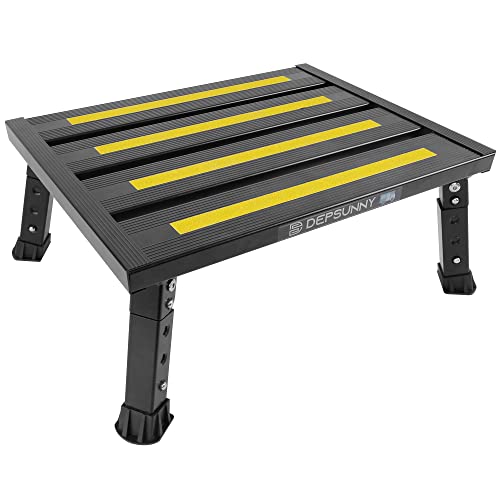


As an Amazon Associate we earn from qualifying purchases at no extra cost to you. Ratings are shown as listed on Amazon.
Best RV steps by camping situation
| Situation | Best choice | Useful target specifications | Why it fits |
|---|---|---|---|
| High travel-trailer doorway | Interior-folding multi-step system | 3–4 steps, 8–9.5 in tread rise, 500 lb capacity, 22–24 in platform width | Reaches the ground securely without relying on a narrow factory step |
| Frequent setup and teardown | Lightweight aluminum folding steps | 10–20 lb, 2–4 steps, positive locking mechanism | Reduces lifting effort and packs quickly |
| Limited exterior storage | Compact single or two-step platform | Under 12 in folded depth, 8–12 lb, 300–500 lb capacity | Fits a pass-through compartment or under-bed storage |
| Uneven campsites or soft soil | Ground-contacting platform steps | Adjustable legs, 20–24 in tread width, large feet or add-on supports | Transfers load to the ground instead of the RV doorway |
| Permanent residential-style use | Fixed or semi-permanent porch steps | 24–30 in wide, steel or heavy aluminum, 500 lb or higher capacity | Offers the least movement, but requires more storage and installation space |
What separates good RV steps from merely tall ones?
Step height is the first measurement to check, but it is not the only one. A step that reaches the ground can still feel awkward if each rise is too tall, the tread is narrow, or the bottom support rocks on gravel.
- Step height: Aim for approximately 7–9 inches between surfaces. A very tall rise can be difficult for children, older campers, and anyone carrying gear. Count the RV’s built-in threshold as part of the climb.
- Platform width: A tread around 20–24 inches wide gives room for both feet and makes turning at the doorway easier. Narrow 12–16-inch stools save space but demand more precise foot placement.
- Weight capacity: Treat the published limit as a combined load for the person and anything being carried. A 300 lb rating leaves little margin for a 240 lb user carrying a 50 lb cooler; a 500 lb rating provides a more comfortable buffer.
- Storage footprint: Measure folded height, width, and depth, not just the open dimensions. Some large steps fit inside a trailer doorway but will not fit through a pass-through compartment.
- Attachment style: Door-mounted systems are tidy and quick, while ground-supported systems usually feel more stable on uneven terrain. A detachable step is more universal but can be easier to misplace.
Head-to-head: the main RV step designs
Interior-folding steps: best for travel trailers
Products such as the MORryde StepAbove and Lippert Solid Step fold into the RV when traveling. Their broad treads and multiple attachment points generally feel more like permanent stairs than the original narrow metal step.
The main advantage is that the stairs do not occupy campsite space and are not left on wet ground. The trade-off is fit: the door opening, threshold height, hinge location, and available interior clearance must all match the model. Measure the door threshold to the ground with the trailer level, then compare that measurement with the manufacturer’s step range.
These systems are a strong choice for people who camp often, want a wide platform, and have enough interior clearance to store the folded assembly. They are less suitable when the doorway opens directly against a bed, cabinet, or screen door.
Ground-contacting folding steps: best for uneven sites
Ground-supported designs place much of the load on adjustable legs or feet. Torklift’s GlowStep Revolution is a well-known example of this style, while many generic aluminum and steel versions use the same basic approach.
They can be more forgiving than door-mounted steps because the height can be adjusted to the actual campsite. On gravel, however, small feet may sink or rock. A wide foot, leveling pad, or firm step mat improves stability. Do not assume that adding more steps automatically solves a high entrance; the lowest step still needs a broad, stable landing area.
Single-step stools: best for low entrances and small storage bays
A portable stool is inexpensive, easy to replace, and useful for a van, pop-up camper, or low motorhome entry. Look for a non-skid top, rubber feet, drainage holes, and a load rating of at least 300 lb.
Its limitation is geometry. One 9-inch step may be comfortable at a low door but inadequate at a high trailer entrance. Stacking two stools is unsafe unless they are specifically designed to connect, because the upper unit can slide or tip.
Recommended picks by design
Best overall: a full-width, adjustable platform step
For the widest range of users, choose a two- to four-step aluminum or steel platform with ground contact, adjustable legs, and a 500 lb capacity. This combination handles uneven campsites, provides a generous tread, and avoids placing every pound on the RV’s entry frame.
Best for a travel trailer: MORryde StepAbove or Lippert Solid Step
These interior-folding product families are worth considering when their sizing matches the trailer. Choose the version that gives a comfortable rise and leaves enough clearance for the door and screen door. Their broad treads are especially useful when bringing pets, groceries, or mobility equipment through the entrance.
Best for frequent travelers: lightweight aluminum folding steps
An aluminum model weighing roughly 10–20 lb is easier to remove at every stop than a heavy steel porch step. Prioritize a locking hinge and positive leg adjustment over the lowest possible weight. A step that flexes or requires loose pins is frustrating when used several times a day.
Best for a high motorhome entrance: multi-step ground-supported stairs
A high motorhome door often benefits from three or four evenly spaced steps. A platform width of at least 20 inches and adjustable feet matter more than decorative handrails. If the final rise into the RV remains unusually high, a compatible handrail can improve confidence, but confirm that it does not block the door or awning.
How to measure before buying
- Park the RV on the type of surface where you normally camp and level it as usual.
- Measure from the ground to the lower edge of the doorway threshold.
- Measure the doorway width and the distance from the threshold to nearby cabinets, beds, or the opposite wall.
- Record the available storage opening, including its narrowest point. A folded step must pass through that point, not merely fit once it is inside.
- Calculate the remaining rise after the steps are installed. Divide it into approximately 7–9-inch increments rather than choosing by the advertised number of steps alone.
- Check the load rating against the heaviest expected user plus carried items, then leave a reasonable margin.
For example, if the threshold is 32 inches above the ground, three equal rises would be about 10.7 inches each, which may feel steep. Four rises would average 8 inches and are usually a more comfortable target. The actual result depends on the step design and the RV’s threshold height.
Ownership realities: what wears out first
The tread surface, hinge hardware, adjustment pins, and rubber feet usually need attention before the main frame. Grit can prevent locking parts from seating fully, while road salt and fertilizer residue accelerate corrosion on steel hardware.
- Rinse mud and salt from the steps, then dry them before storage.
- Inspect hinge bolts, rivets, welds, and locking pins before each trip.
- Replace cracked or hardened rubber feet rather than compensating with loose blocks.
- Keep drainage holes clear so rainwater does not freeze inside a hollow tread.
- Use the manufacturer-approved lubricant sparingly; excess oil attracts dust.
- Never leave a folding step partially locked or supported on only two of its feet.
Steel steps tend to feel exceptionally solid but are heavier and need better rust protection. Aluminum steps are easier to handle and resist ordinary corrosion, though thin sections can bend if dragged or overloaded. Fiberglass and plastic stools are light and weather-resistant, but they can become brittle after prolonged ultraviolet exposure.
Bottom line
The best RV steps are the ones that create comfortable, even rises while staying stable on the ground and fitting the RV when folded. Start with threshold height and storage measurements, then choose the widest practical tread and a capacity with plenty of margin. For a trailer, an interior-folding system is usually the cleanest solution; for uneven sites or high motorhome doors, adjustable ground-supported steps are the more adaptable choice; and for a low entrance with minimal storage, a properly rated single-step platform is often all you need.





Write Your Review
No reviews yet. Be the first to share your experience!