

Key takeaways
- External flick locks: Fast to operate with gloves and easy to inspect. They are usually the best choice for variable terrain and winter use.
- Twist locks: Neat and low-profile, but they can loosen from vibration, become difficult to turn when dirty, and be harder to adjust with cold hands.
- Folding cable systems: Very compact and quick to deploy. They are excellent for portability, but require correct tension and careful storage.
- Hybrid designs: Combine a folding upper section with an adjustable lower section. This is a useful compromise when you need both packability and a broad fit range.
The best trekking poles for stable hiking are adjustable aluminum poles with secure flick locks for rough, varied terrain, while carbon poles make more sense when low weight and compact packing matter more than maximum abuse resistance.
Our top picks
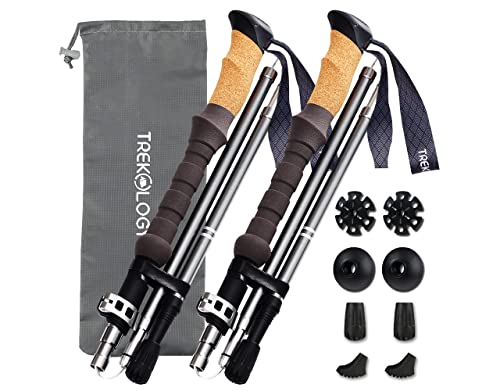
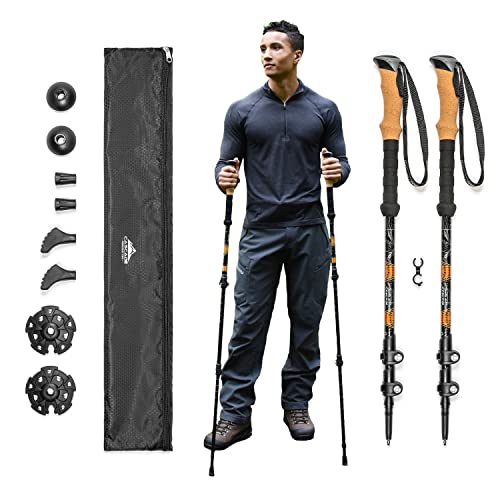

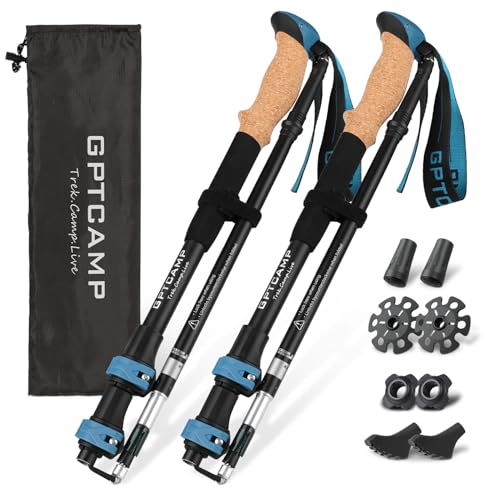
As an Amazon Associate we earn from qualifying purchases at no extra cost to you. Ratings are shown as listed on Amazon.
Best trekking poles by hiking situation
| Hiking situation | Best choice | Why it fits | Target specifications |
|---|---|---|---|
| Budget day hikes | Adjustable aluminum pair | Durable, repairable, and usually the lowest-cost option | 500–600 g per pair; 63–135 cm range |
| Frequent backpacking | Three-section aluminum or hybrid pole | Good balance of strength, packability, and value | 450–550 g per pair; collapsed length under 65 cm |
| Fast hiking and long climbs | Carbon or carbon-composite pole | Reduces swing weight over thousands of steps | 350–450 g per pair; cork or ventilated foam grip |
| Air travel and small packs | Foldable three- or four-section pole | Shortest packed length, often 35–45 cm | 350–500 g per pair; reinforced joints |
| Rocky, snowy, or off-trail routes | Strong adjustable aluminum pole | Handles impacts and allows length changes on steep ground | Aluminum shaft; flick lock; interchangeable baskets |
Aluminum versus carbon: which construction is more stable?
Aluminum poles
Aluminum is the safer default for hikers who expect frequent contact with rocks, roots, or hard-packed ground. It can bend under excessive force, but a bent shaft often gives you warning before it fails completely. That makes aluminum especially practical for beginners, winter hikers, and people who use poles to steady themselves while carrying a heavy pack.
The trade-off is weight. A typical aluminum pair weighs about 450–650 grams, depending on diameter, adjustment hardware, and grip material. The extra mass is noticeable during fast walking, but it also gives many aluminum poles a more solid feel when planted firmly.
Carbon poles
Carbon fiber reduces weight and vibration. A quality pair may weigh roughly 300–450 grams, which can make a difference on long ascents or multi-day trips. Carbon is also comfortable on repetitive hard surfaces because it tends to damp small vibrations better than aluminum.
Carbon does not simply “break easily,” but it is less forgiving of concentrated impacts, crushing, and side loads. A carbon shaft can crack after being trapped between rocks or used as a pry bar. For careful hikers on established trails, its low weight is valuable. For rough scrambling, crowded trails, or frequent equipment abuse, aluminum is the more forgiving choice.
Stability depends on more than shaft material. Tip design, lock security, grip shape, pole diameter, correct length, and your planting technique often matter more than a difference of 100 grams.
Head-to-head features that affect real-world stability
Collapsed length and section count
A conventional three-section telescoping pole normally collapses to about 55–70 cm. It is easy to adjust and usually strong because each section overlaps the next. A foldable pole can pack down to approximately 35–45 cm, making it better for a small daypack or checked luggage, but its internal cable and joints add complexity.
Choose a collapsed length that fits inside your pack without forcing sharp bends. A pole that is technically packable but sticks out of the side pocket can catch on branches and become a nuisance. If you are taller than about 183 cm, check the extended length carefully; some compact poles top out near 120–125 cm and may be too short for comfortable level walking.
Locking mechanisms
- External flick locks: Fast to operate with gloves and easy to inspect. They are usually the best choice for variable terrain and winter use.
- Twist locks: Neat and low-profile, but they can loosen from vibration, become difficult to turn when dirty, and be harder to adjust with cold hands.
- Folding cable systems: Very compact and quick to deploy. They are excellent for portability, but require correct tension and careful storage.
- Hybrid designs: Combine a folding upper section with an adjustable lower section. This is a useful compromise when you need both packability and a broad fit range.
For maximum confidence, extend each section beyond its intended length, engage the lock, and apply firm downward pressure before hiking. Do not rely on the printed maximum mark as a usable adjustment range.
Grip materials
Cork grips are comfortable on long outings and become more shaped to your hand over time. They absorb some moisture and are a strong choice for warm-weather backpacking, though they can wear faster if repeatedly soaked.
Closed-cell foam grips are light, soft, and comfortable when hands are damp. They also extend farther down the shaft, allowing a quick lower grip on steep uphill sections. The downside is reduced abrasion resistance: rubbing against rock or storing poles carelessly can tear the foam.
Rubber grips are durable and easy to clean, but can feel sweaty in hot weather. They are useful for wet climates, snow travel, and hikers who prefer a firm, defined grip.
Strap comfort
A strap should support your wrist without making you grip the handle tightly. Look for a left/right-specific padded strap, a smooth adjustment tab, and enough range to fit over a thin glove. To use it correctly, place your hand up through the strap from below, then wrap your fingers around the grip. This lets the strap carry part of your weight and reduces hand fatigue.
A narrow strap can cut into the wrist during a long descent. A heavily padded strap may feel comfortable at first but become bulky with gloves. If you hike in winter, test the adjustment while wearing your thickest gloves.
Tip options for different terrain
| Tip or basket | Best terrain | Important limitation |
|---|---|---|
| Carbide or steel tip | Soil, gravel, roots, and firm trails | Can damage delicate surfaces and make a sharp clicking sound on rock |
| Rubber walking tip | Rock slabs, pavement, boardwalks, and indoor transitions | Wears more quickly and may slip in loose mud |
| Small trekking basket | General three-season hiking | Can clog with sticky mud |
| Snow basket | Soft snow and winter trails | Adds drag and can catch between rocks in summer |
Removable tips are worth prioritizing if your routes change throughout the year. Tips are consumable parts: on abrasive rock, a carbide tip may become noticeably rounded after roughly 300–800 trail miles, while rubber tips can wear sooner on pavement. Actual life depends heavily on surface and pole angle.
How to size trekking poles for stable movement
Set the poles so your elbows are close to a right angle when the tips touch level ground. As a starting point, multiply your height in centimeters by 0.68, then adjust for footwear, arm length, and personal preference. Someone 175 cm tall would start near 119 cm:
175 × 0.68 = 119 cm
Use shorter poles for sustained uphill travel and longer poles for descents. A practical change is 5–10 cm: shorten both poles before a climb, then lengthen them before a long downhill. On traverses, keep the uphill pole shorter and the downhill pole longer so your shoulders remain relatively level.
Ownership realities: what wears first
- Tips: Replace them when the point is rounded, the rubber is smooth, or traction has clearly declined.
- Lock surfaces: Dirt and grit reduce holding power. Wipe shafts clean before collapsing them.
- Flick-lock bolts: If a lock slips, tighten the bolt gradually. Overtightening can prevent the lever from closing correctly.
- Foam grips: Keep them out of prolonged direct sunlight and avoid crushing them inside a tightly packed bag.
- Folding cables: Store them dry and with no sharp bends. If deployment becomes difficult, inspect the joints rather than forcing them.
After a muddy hike, rinse the poles with clean water, extend every section fully, and let them dry before storage. Do not store telescoping poles collapsed while wet; grit and moisture can remain inside the joints and make the next adjustment rough.
Bottom line
Choose adjustable aluminum poles with external flick locks if stability, durability, and terrain versatility come first. Choose carbon when you hike frequently, value low swing weight, and can avoid severe side impacts. Choose a folding design only when its 35–45 cm packed length solves a real storage or travel problem. Whichever construction you select, prioritize a secure lock, comfortable straps, replaceable tips, and a usable length range over the smallest advertised weight.





Write Your Review
No reviews yet. Be the first to share your experience!