

Key takeaways
- Measure the width at the top, middle, and bottom.
- Use the narrowest width for a snug fit, unless the manufacturer specifies a deduction.
- Measure depth from the front edge of the recess to the glass or obstruction.
- Check the shade’s minimum mounting depth; many require roughly 1 1/2 to 3 inches.
Best Roman Shades for Light Control and Style
The best roman shades for most rooms are cordless, inside-mounted shades made from a medium-weight light-filtering fabric, while blackout-lined shades are the better choice for bedrooms, media rooms, and camper windows where glare and heat matter more than a bright view.
Roman shades combine the soft appearance of fabric curtains with the compact profile of a roller shade. The right choice depends less on the pattern than on six practical details: fabric opacity, insulation, mounting depth, window dimensions, operating mechanism, and how easily the material can be cleaned.
Our top picks

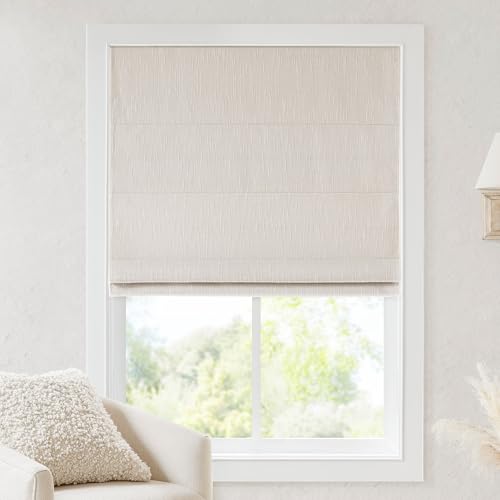

As an Amazon Associate we earn from qualifying purchases at no extra cost to you. Ratings are shown as listed on Amazon.
Quick comparison: which roman shade suits your situation?
| Situation | Recommended shade | Typical fabric or lining | Useful mounting choice | Expected price range |
|---|---|---|---|---|
| Lowest-cost room refresh | Standard flat roman shade | Light-filtering polyester, about 50–70% light reduction | Outside mount if the window frame is shallow | $40–$120 per shade |
| Bedroom or nursery | Blackout roman shade | Blackout backing, commonly 95–100% light reduction | Inside mount plus side overlap, or outside mount | $80–$250 per shade |
| Cold or sunny window | Cellular or insulated roman shade | Thermal lining, bonded backing, or cellular-style construction | Inside mount with a deep enough headrail | $120–$400 per shade |
| Frequent daily use | Premium cordless or motorized shade | Durable woven fabric with reinforced lift points | Inside or outside mount, depending on clearance | $150–$700 per shade |
| RV, camper, or narrow window | Custom-sized cordless shade | Polyester or coated fabric that tolerates occasional wiping | Outside mount when the interior frame is uneven | $100–$350 per shade |
Fabric opacity: light filtering versus blackout
Light-filtering fabric
Light-filtering roman shades soften sunlight without making the room completely dark. They are a good fit for living rooms, kitchens, dining areas, and windows where you want daylight during the day. Pale fabrics scatter more light and can make a small room feel brighter, but they usually provide less privacy after sunset unless paired with curtains.
Opacity is not the same as color. A dark fabric can reduce visible glare while still allowing silhouettes through at night. If privacy matters, look for a stated privacy level or a lined construction rather than choosing by color alone.
Room-darkening and blackout fabric
Room-darkening fabric reduces glare and is often sufficient for a home office, television room, or occasional guest room. Blackout-lined fabric blocks substantially more light, but light can still enter around the edges. An outside mount extending at least 2 inches beyond each side of the glass generally controls edge leakage better than an inside mount.
For a bedroom, check the shade’s total width, not only the glass width. A 36-inch-wide window with a 2-inch overlap on both sides needs an outside-mounted shade about 40 inches wide, provided the surrounding wall has enough clearance.
Insulation and heat control
Roman shades can improve comfort near glass, but they are not a replacement for properly sealed windows. The most useful insulating features are a thermal lining, multiple fabric layers, tight side coverage, and a close fit at the top and bottom. Cellular-style construction can add air pockets, while thick woven fabrics reduce radiant heat more effectively than a single sheer layer.
For a sunny south- or west-facing window, a white or reflective lining helps reject solar heat. In a cold climate, a bonded thermal lining reduces the sensation of a cold window. Avoid assuming that every blackout shade is highly insulating: blackout describes light control, not necessarily thermal performance.
A simple comparison illustrates the tradeoff. Suppose two shades cost $90 and $210. If the more expensive lined shade lasts 10 years and the cheaper unlined shade needs replacement after 4 years, the purchase cost is approximately $21 per year for the lined shade versus $22.50 per year for the cheaper one. That excludes energy savings, cleaning, and installation, but it shows why durability can matter more than the initial price.
Inside mount or outside mount?
Inside mount
An inside mount sits within the window recess and gives the cleanest, most built-in appearance. It preserves trim and leaves the wall around the window visible. Choose it when the recess is deep, square, and free of handles or locks that interfere with the headrail.
- Measure the width at the top, middle, and bottom.
- Use the narrowest width for a snug fit, unless the manufacturer specifies a deduction.
- Measure depth from the front edge of the recess to the glass or obstruction.
- Check the shade’s minimum mounting depth; many require roughly 1 1/2 to 3 inches.
Outside mount
An outside mount covers the frame or wall around the window. It is more forgiving when the recess is shallow, uneven, or obstructed by a crank, screen, or deep sill. It also improves blackout performance because the fabric can overlap the opening.
- Add at least 2 inches to each side of the opening when wall space allows.
- Add 3 to 4 inches above the opening if you want the raised shade to clear the glass.
- Confirm that the mounting surface is solid enough for the headrail and brackets.
In a camper or RV, outside mounting is often the safer option because window frames may be thin, curved, or hidden behind trim. Use the manufacturer’s approved fasteners and avoid drilling near wiring, plumbing, or the window seal.
Operating mechanisms: cord, cordless, or motorized?
Corded shades are often the least expensive, but dangling cords are a safety concern around children and pets. Cordless shades use a spring-assisted bottom rail and are convenient for small and medium windows. They are usually the best balance of price, appearance, and ease of use.
Motorized roman shades make sense for tall, hard-to-reach, or numerous windows. Battery-powered versions commonly use replaceable batteries or rechargeable battery packs; battery life varies widely with shade weight and use, so treat a manufacturer estimate as a planning figure rather than a guarantee. A shade opened and closed twice daily will generally consume less power than one adjusted repeatedly throughout the day.
For motorized shades, verify these details before buying:
- Whether the motor is built into the headrail or an external component.
- Whether controls use a remote, wall switch, app, or voice-compatible hub.
- Where the battery is located and whether it can be reached after installation.
- The maximum shade width and fabric weight supported by the motor.
- Whether a power outage leaves the shade movable by hand.
Flat, hobbled, and relaxed roman styles
Flat roman shades have uninterrupted fabric folds and suit modern rooms. They stack compactly when raised, although thicker blackout fabrics may create a taller stack at the top. Hobbled shades retain soft, overlapping folds when lowered and provide a more traditional look, but their stacked depth is greater.
Relaxed roman shades curve gently at the bottom and look informal. They are attractive on fixed or rarely adjusted windows, but the fabric may not hang perfectly symmetrically on wide shades. For a broad window used every day, a flat design with reinforced lift points is usually easier to keep aligned.
Cleaning and long-term ownership
Dust is the most common cause of a tired-looking roman shade. Vacuum fabric gently with an upholstery attachment once or twice a month, keeping suction low around seams, cords, and lift rings. A soft brush can remove surface dust from textured fabric.
For small marks, blot with a barely damp white cloth and mild diluted detergent after testing an inconspicuous area. Do not saturate lined fabric: moisture can loosen adhesives, create water marks, or distort the folds. Avoid removing fabric for machine washing unless the care label specifically permits it.
The parts most likely to wear first are lift cords, cord locks, fabric rings, hook-and-loop attachments, and battery packs in motorized models. Uneven folds often indicate a stretched cord or a loose ring rather than a defective fabric panel. Keep the shade level while raising it, and do not force the bottom rail when it catches on a handle or plant.
How to choose the best roman shades
- Measure the window three times in both directions and record the smallest inside width.
- Decide whether glare, privacy, darkness, or heat reduction is the primary goal.
- Check mounting depth before selecting a fabric or style.
- Choose cordless operation for ordinary reachable windows and motorization for tall or frequently used windows.
- Compare the raised stack height with the visible glass area.
- Read the cleaning label and confirm that replacement batteries or hardware are available.
For the broadest usefulness, select a cordless, medium-weight, light-filtering shade with a washable-looking polyester or blended fabric. Choose a blackout-lined shade when sleep or screen glare is the priority, and choose an outside mount when the window recess is shallow or maximum light control matters more than a perfectly inset appearance.





Write Your Review
No reviews yet. Be the first to share your experience!