

Key takeaways
- Compare five plain chinchilla food pellets by base hay, protein, fibre and calcium, with honest feeding amounts and a slow transition plan for owners.
As an Amazon Associate we earn from qualifying purchases.
A chinchilla’s teeth never stop growing, and neither does its need for fibre. In the wild, chinchillas survive on sparse, coarse mountain grasses, and a pet chinchilla’s digestive system still expects that kind of diet: long-strand hay, chewed for hours, wearing the teeth down and keeping the gut moving. That is why hay is the diet. Pellets are the measured supplement on top of it — roughly a tablespoon or two a day for a typical adult — there to deliver the vitamins, minerals and protein that hay alone does not guarantee.
That framing matters when shopping, because it reverses the usual logic. A plain, uniform pellet is not the boring option. It is the safe one. Chinchillas are unusually sugar-sensitive animals. Rich, fatty, sweet foods are linked to hepatic lipidosis (fatty liver disease), bloat and gut stasis, and a chinchilla that fills up on tasty extras eats less hay, which means less tooth wear and slower digestion. Every food below is a single, uniform pellet made for chinchillas, with nothing loose in the bag to pick through.
Why the Colourful Mixes Are Not on This List
Many bags sold as chinchilla food are muesli-style blends: pellets mixed with seeds, dried fruit, corn pieces and coloured extrusions. They look generous, but they create two problems. The first is selective feeding — a chinchilla eats the sweet and starchy pieces first and leaves the fortified pellets behind, so the nutrition printed on the bag is not the nutrition the animal actually gets. The second is the ingredients themselves: dried fruit and corn deliver sugar a chinchilla gut is not built for, and seeds add fat it does not need.
For that reason, seed-and-fruit mixes are excluded from this list as a class, however well known the brand. Treats are excluded too, and so is hay, which deserves its own shopping trip. One more exclusion worth explaining: pellets made for rabbits or guinea pigs are not interchangeable substitutes. Guinea pig pellets are fortified with vitamin C for an animal that cannot make its own; rabbit pellets are balanced for a different calcium and protein target. A pick here has to be sold for chinchillas.
How to Choose Chinchilla Food Pellets
Know the base hay. Alfalfa-based pellets are richer in protein and calcium, which suits young, growing, pregnant or nursing chinchillas. Timothy-based pellets are leaner and are the usual maintenance choice for healthy adults. Neither is wrong; buying the one that matches the animal’s life stage is the point.
Read the analysis panel, not the front of the bag. Across the foods below, protein runs from 16 to 20 percent, fat stays low at around 2.5 to 3 percent, and fibre is the number to favour — the higher the better, within a formula a chinchilla will actually eat. Calcium typically sits between 0.6 and 1.0 percent; more is not better for an adult, since excess calcium is a urinary concern in this species.
Insist on a uniform pellet. Every piece should look the same. Uniformity is what guarantees that the analysis on the bag is the analysis in the bowl, bite after bite.
Match the bag to the household. Pellets lose freshness once opened. A single chinchilla eating two tablespoons a day works through a small bag slowly, so a giant sack is only sensible for multi-chinchilla homes that can store it sealed, cool and dry.
Plan the switch before opening the bag. Chinchilla digestion punishes abrupt change. Makers below describe transitions running three to four weeks, and that patience is part of the product choice, not an afterthought.
The Five Pellets
1. Oxbow Essentials Chinchilla Food, 3 lb

The long-running reference point for chinchilla pellets, and the formula most rescue and veterinary feeding guidance is built around. Alfalfa meal is the first ingredient, which puts this at the richer end of the list: protein at 18 percent and calcium up to 1.10 percent. Oxbow positions it for chinchillas of all ages, feeding young animals free-choice and adults a measured ration of an eighth to a quarter cup a day alongside free-choice grass hay.
The pellet is completely uniform, fortified with antioxidants and prebiotics, and made without artificial preservatives, colours or flavours. One honest detail from the ingredient list: cane molasses appears partway down it. In a uniform pellet this is a binder holding the pellet together, not a sweetened coating or a loose treat piece, but it is there, and owners who want the leanest possible label should know it. For a single adult chinchilla, this 3 lb bag is the size that stays fresh.
Specs
- Base ingredient: Alfalfa meal (first ingredient)
- Crude protein: min 18%
- Crude fat: min 2.5%
- Crude fibre: min 18%, max 23%
- Calcium: min 0.60%, max 1.10%
- Feeding guide: Adults 1/8 to 1/4 cup daily, plus free-choice grass hay
- Bag weight: 3 lb
2. Oxbow Garden Select Chinchilla Food, 3 lb
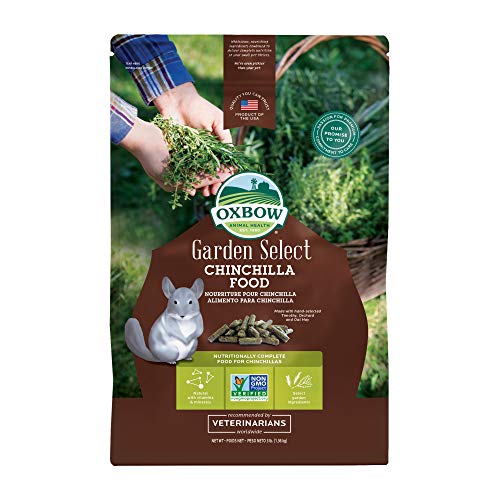
Oxbow’s second chinchilla formula takes the opposite route on base hay. Timothy grass leads the ingredient list, backed by oat grass and orchard grass — three grass hays in one pellet — with sunflower meal and canola meal supplying much of the protein. The result is a slightly leaner analysis than Essentials: 17 percent protein, the same 2.5 percent fat floor, fibre in the same 18 to 23 percent band, and a calcium ceiling of 1.00 percent.
The Garden Select line is built on non-GMO ingredients and adds rosemary and thyme to the formula, with the same antioxidant and prebiotic support as the Essentials line and no artificial preservatives, colours or flavours. The feeding direction is a flat eighth of a cup a day for adults over one year, in addition to unlimited grass hay. For an adult chinchilla whose owner prefers a timothy-led, lower-calcium profile from a mainstream maker, this is the natural counterpart to the first pick — and the two bags together frame the alfalfa-versus-timothy decision.
Specs
- Base ingredient: Timothy grass (first ingredient), with oat grass and orchard grass
- Crude protein: min 17%
- Crude fat: min 2.5%
- Crude fibre: min 18%, max 23%
- Calcium: min 0.60%, max 1.00%
- Formula notes: Non-GMO ingredients; antioxidants and prebiotics
- Feeding guide: Adults 1/8 cup daily, plus unlimited grass hay
- Bag weight: 3 lb
3. Mazuri Chinchilla Diet, 2.5 lb

Mazuri makes feeds for zoos and exotic-animal collections, and its chinchilla diet (formula 5M01) is the most protein-forward food here at 20 percent, with fat at 3 percent and fibre capped at 18 percent on the guaranteed analysis. The base is a blend of fibre sources including timothy hay and alfalfa, and the formula includes live probiotics — the maker guarantees a minimum of 270,000 CFU/g of total microorganisms — plus flaxseed as an omega-3 source, guaranteed at 0.50 percent minimum.
The pellet itself is small and consistent, 5/32 of an inch in diameter and 3/8 of an inch long, sized for an animal that holds food in its front paws. Mazuri’s feeding guidance is the most precise on this list: adults eat approximately 20 grams, about two tablespoons, of pellets per day with unlimited grass hay, while juveniles and lactating females get unlimited pellets. Calcium is stated as a 0.75 percent minimum and phosphorus at 0.60 percent minimum. This 2.5 lb bag is the household size; a much larger sack serves breeders and collections.
Specs
- Base ingredients: Multiple fibre sources including timothy hay and alfalfa
- Crude protein: min 20%
- Crude fat: min 3%
- Crude fibre: max 18%
- Calcium: min 0.75%
- Formula notes: Live probiotics (min 270,000 CFU/g); flaxseed for omega-3 (min 0.50%)
- Pellet size: 5/32 inch diameter x 3/8 inch length
- Feeding guide: Adults about 20 g (2 tablespoons) daily, plus unlimited grass hay
- Bag weight: 2.5 lb
4. Supreme Science Selective Chinchilla Food, 4 lb 6 oz

The import on the list, from Supreme Petfoods in the UK, and the one whose design starts from the sugar problem. Science Selective is a uniform extruded pellet with lucerne (alfalfa) meal as the first ingredient, and the brand’s stated position is zero added sugar — no molasses binder of the kind noted on the first pick. The analysis is the most moderate here: 16 percent protein, 3 percent fat, 19 percent crude fibre and 0.8 percent calcium, with phosphorus at 0.4 percent.
Linseed in the formula supplies omega fatty acids for skin and coat, and the ingredient list includes dried parsley and plantain, ground into the pellet rather than left as loose pieces a chinchilla could select or reject. That distinction is the whole argument of this article in miniature: botanicals inside a uniform pellet are part of a balanced bite; botanicals loose in a bag are an invitation to pick and choose. The listed bag is 4 lb 6 oz, a mid-size option for one chinchilla or a pair.
Specs
- Base ingredient: Lucerne (alfalfa) meal (first ingredient)
- Crude protein: 16%
- Crude fat: 3%
- Crude fibre: 19%
- Calcium: 0.8%
- Phosphorus: 0.4%
- Formula notes: Zero added sugar; linseed for omega fatty acids
- Bag weight: 4 lb 6 oz
5. Oxbow Essentials Chinchilla Food, 10 lb
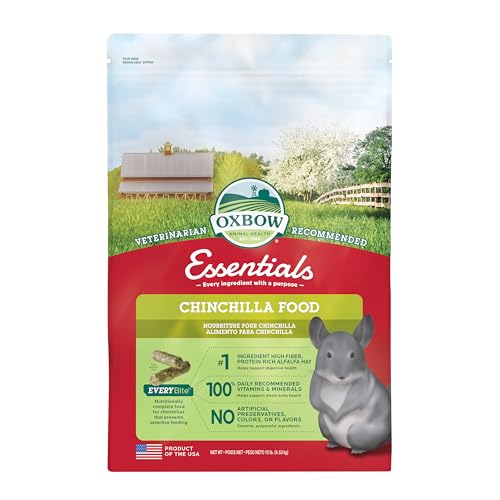
This is the same Essentials formula as the first pick — same alfalfa meal base, same 18 percent protein, same 18 to 23 percent fibre band, same calcium range — in the 10 lb bag. It earns its own place on the list because bag size is a real decision in this category, and pretending otherwise would leave multi-chinchilla homes and rescues without their obvious option.
The honest trade-off is freshness. A single chinchilla on a quarter cup a day takes months to finish 10 lb of pellets, and an open bag slowly loses ground to air and time. Households with several chinchillas, or a rescue, will finish it while it is still fresh, and for them the big bag is the sensible buy. Single-chinchilla homes should either choose the 3 lb bag above or portion this one into a sealed container, stored cool and dry, keeping the main bag closed between refills.
Specs
- Base ingredient: Alfalfa meal (first ingredient)
- Crude protein: min 18%
- Crude fat: min 2.5%
- Crude fibre: min 18%, max 23%
- Calcium: min 0.60%, max 1.10%
- Feeding guide: Adults 1/8 to 1/4 cup daily, plus free-choice grass hay
- Bag weight: 10 lb
Feeding Amounts and Switching Foods
Across all five makers, the adult ration lands in the same small territory: about two tablespoons to a quarter cup of pellets a day, always next to unlimited grass hay and fresh water. Young, pregnant and nursing chinchillas are the exception, with makers directing free-choice pellets for growth. If an individual chinchilla is gaining or losing weight, the pellet ration is the dial to adjust — the hay supply should not be.
Switching foods deserves the same care as choosing them. The transition schedules printed by the makers above run three to four weeks: start with a quarter new food mixed into three quarters of the old, move to half and half, then three quarters new, and only then feed the new pellet on its own. Watch appetite and droppings through the change; smaller, fewer or softer droppings are a signal to slow down a step. A chinchilla that refuses a new pellet outright is usually telling you the swap went too fast, not that the food is wrong.
Frequently Asked Questions
How many pellets should a chinchilla eat each day?
For a typical adult, roughly one to two tablespoons, or an eighth to a quarter cup depending on the maker’s directions for that formula. Pellets are the supplement; unlimited grass hay is the diet.
Can a chinchilla eat rabbit or guinea pig pellets instead?
It should not be the plan. Those formulas are balanced and fortified for different animals — guinea pig pellets carry vitamin C fortification chinchillas do not need, and rabbit pellets target different protein and calcium levels. A chinchilla-labelled pellet is formulated for the species.
Is alfalfa or timothy better as a base?
Alfalfa-based pellets are richer in protein and calcium and suit young, growing, pregnant or nursing animals. Timothy-based pellets are leaner and are the usual maintenance choice for healthy adults. Match the bag to the life stage.
How long does an open bag of pellets stay fresh?
Store the bag sealed, cool and dry, and treat freshness as a matter of weeks to a few months rather than a year. If a bag smells stale or the pellets look dull or dusty, replace it — and size the next bag to how fast the household actually uses it.
Affiliate Disclosure: This article contains affiliate links. If you buy through these links, we may earn a commission at no additional cost to you. This helps support our work in creating free content.
More from Amazon
Programs that pair well with the guide above. Offers and eligibility are set by Amazon and may change.
Free shipping on eligible items, Prime Video and more. Eligible new members can start with a free trial.
Start a Prime free trialA Prime membership for ages 18-24 with a trial period. Eligibility is set by Amazon.
See Prime for Young AdultsAudiobooks and podcasts to listen to on the go. Eligible new members can start with a free trial.
Try Audible freeAd-free music streaming. Eligible new subscribers can start with a free trial.
Try Music Unlimited freeAs an Amazon Associate we earn from qualifying purchases.










Write Your Review
No reviews yet. Be the first to share your experience!