

Key takeaways
- Compare the best chainsaws for yard work, tree cleanup and firewood: battery, gas and corded picks with bar lengths, chain specs and safety notes.
As an Amazon Associate we earn from qualifying purchases.
A chainsaw earns its place in the shed three or four times a year: a storm drops a limb across the drive, a dead tree needs to come down in pieces, a winter’s worth of firewood needs bucking into stove lengths. For those jobs nothing else cuts as fast, and for every other job in the yard a handsaw or loppers are usually the smarter tool. That is the right frame for buying one — you are choosing a machine for occasional, heavy work, not a daily driver.
Start with the plain safety facts, because they are part of the purchase and not an afterthought. A chainsaw is the most dangerous tool most households own. The chain runs at highway speed, and the characteristic accident is kickback: the nose of the bar catches, and the saw rotates up and back toward the operator faster than anyone can react. What protects you is a working chain brake that stops the chain in a fraction of a second, a low-kickback chain, and technique — never cutting with the bar tip, never working above shoulder height, never cutting from a ladder. Protective gear belongs in the same budget line as the saw itself: chainsaw chaps or trousers, a helmet with visor and ear muffs, eye protection, gloves and steel-toe boots. If the gear money is not there, the saw money should wait.
Bar length should match the wood, not your ambitions. Most yard work — limbs, small dead trees, firewood rounds — is 14 to 16 inch work. A longer bar adds weight, cost and kickback leverage, and an oversized saw tires you out, which is when accidents happen. Battery runtime needs honest framing too: on a cordless saw, endurance is measured in cuts, not minutes. A pack that makes over a hundred cuts through fence-post-sized softwood will make far fewer through seasoned oak rounds, and cold weather shortens it further.
Every model below was checked against current CPSC recall records before inclusion. Two widely sold families were deliberately left out: Milwaukee’s M18 FUEL top-handle saws, recalled in late 2025 because the chain brake may not activate, and a group of Positec-built corded saws sold under the Worx, Hyper Tough and Portland names, recalled in 2025 because the main switch can fail and leave the chain running. A chainsaw roundup that ignores recall lists is not doing its job.
Affiliate Disclosure: This article contains affiliate links. If you buy through a link on this page, we may earn a commission at no extra cost to you. We only list products we can verify, and every specification below comes from the maker or the retailer listing for that exact model.
1. EGO Power+ CS1611 — the 16-inch battery saw most yards need
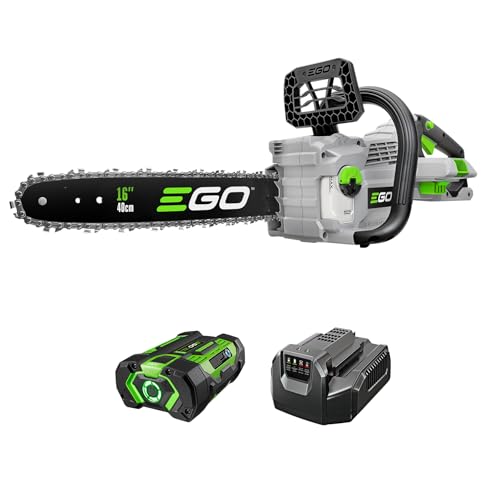
The CS1611 is the saw that fits the actual workload described above. Its 16-inch bar covers limbs, small trees and firewood rounds without the weight penalty of an 18 or 20 inch saw, and the brushless 56V motor is rated by the maker as equivalent to a 40cc gas engine — believable in softwood and honest enough in hardwood as long as you let the chain do the work instead of leaning on it. It starts with a trigger pull, makes no exhaust, and can live in a garage corner without stale fuel turning into a carburetor job.
The kit matters here: the battery and charger are in the box, so the saw works the day it arrives, and the same 56V pack fits the rest of the EGO yard range. The maker’s endurance figure — up to 130 cuts through 4×4 lumber on the included 2.5Ah pack — is a softwood, ideal-conditions number, and it is still the right way to think about a battery saw: count your cuts, not your minutes. Tool-free chain tensioning is a thumb dial on the side cover, which makes the mid-job adjustment everyone actually needs quick enough that you will do it instead of running a slack chain.
Specs
- Power source: battery, 56V ARC Lithium, brushless motor
- Bar length: 16 inches
- Chain: 3/8 inch low-profile pitch, .043 inch gauge
- Chain brake: yes, with low-kickback chain
- Tensioning: tool-free dial
- Weight: about 9 lb bare, about 11.6 lb with the 2.5Ah battery fitted
- Battery status: 2.5Ah battery and charger included
- Best for: limbs, storm cleanup, firewood in modest volumes
- Source: https://www.amazon.com/dp/B09X26ZHPV
2. Greenworks Pro 80V 18-inch (GCS80421) — the bigger battery step

Greenworks’ 80V saw is the answer when 16 inches and a small pack are not enough but gas still is not wanted. The 18-inch bar and brushless motor put it in the felling-and-bucking class for medium trees, and the 80V platform is the strongest in the Greenworks range, shared with blowers, mowers and trimmers aimed at larger properties. With the included 2.0Ah pack it weighs 14.2 lb ready to cut — gas-saw weight, carried honestly, in exchange for gas-saw reach without fuel mixing or pull starts.
Two details separate it from cheaper cordless saws. The chain brake is a proper mechanical brake worked by the front hand guard, the same arrangement as a gas saw, and the chain is a standard 3/8 inch pitch, .050 gauge loop you can buy anywhere — no proprietary consumable. Tensioning is the older tooled style: you loosen the bar nuts with the wrench and turn a screw. That is slower than a dial, and it is also the system that holds tension most securely on an 18-inch bar. Expect endurance in cuts, not hours: a pack is a session of storm cleanup or a modest stack of rounds, and owners who cut firewood seriously should plan on a second pack from the start.
Specs
- Power source: battery, 80V, brushless motor
- Bar length: 18 inches
- Chain: 3/8 inch pitch, .050 inch gauge, 62 drive links
- Chain brake: mechanical, hand-guard activated
- Tensioning: tooled, bar nuts and screw
- Weight: 11 lb without battery, 14.2 lb with the 2.0Ah battery fitted
- Battery status: 2.0Ah battery and rapid charger included
- Best for: medium trees, heavier storm damage, larger yards
- Source: https://www.amazon.com/dp/B00R6Z4R42
3. Husqvarna 455 Rancher — the firewood saw

The 455 Rancher is the traditional answer to a woodpile: a 55.5cc X-Torq two-stroke turning a 20-inch bar, built for owners who buck firewood every year and fell the occasional tree. X-Torq is Husqvarna’s engine design for lower fuel use and reduced exhaust emissions, and the supporting details are the ones that matter over a decade of ownership — a centrifugal air-cleaning system that keeps the filter clear longer, a decompression feature (Smart Start) that reduces pull resistance, and anti-vibration mounts that take some of the buzz out of long bucking sessions.
The safety hardware is standard pro practice: an inertia-activated chain brake that fires when the saw kicks or when you push the guard forward, and a chain in standard 3/8 inch pitch and .058 gauge, stocked everywhere. Tensioning is side-mounted and tooled, adjusted with the combination wrench that lives in every saw owner’s pocket. What you take on with any gas saw is the upkeep: fresh fuel mixed at the maker’s ratio, a carburetor that dislikes being stored wet, and hearing protection that is not optional. In return you get unlimited runtime wherever there is a fuel can, and a saw that will still be serviceable when a battery platform has been discontinued twice over.
Specs
- Power source: gas, 55.5cc X-Torq 2-stroke, 3.5 hp
- Bar length: 20 inches (accepts 13 to 24 inches)
- Chain: 3/8 inch pitch, .058 inch gauge
- Chain brake: inertia-activated
- Tensioning: side-mounted, tooled
- Weight: 12.8 lb dry, powerhead only
- Battery status: not applicable — recoil start, fuel and oil tanks onboard
- Best for: annual firewood, felling medium trees, rural properties
- Source: https://www.amazon.com/dp/B00080MIJI
4. ECHO CS-590 Timber Wolf — the heavy end of homeowner gas

The CS-590 is a professional-pattern saw sold at a homeowner-rancher level: 59.8cc, a 20-inch bar, and a feature list borrowed from ECHO’s pro range, including a decompression valve that bleeds cylinder pressure so the starter rope pulls without a fight, and a pre-cleaner that spins debris out of the intake air before it reaches the two-piece air filter. It is the saw on this list for big firewood, large storm trees and land clearing — work where the Husqvarna above will do the job but the ECHO does it with displacement to spare.
The chain brake is a dual-post design that can be triggered by inertia or by the hand guard striking your wrist — the correct, belt-and-braces arrangement on a saw this size. Chain specification is the common 3/8 inch pitch with a slimmer .050 gauge than the Husqvarna, so do not assume the two saws share spare chains. Tensioning is the traditional tooled side adjuster, and at 13.2 lb for the powerhead alone this is a heavy tool that will punish poor technique and reward a methodical operator. Buy it for the workload, not the spec sheet: if your trees are small, this saw is weight you never needed to lift.
Specs
- Power source: gas, 59.8cc professional-grade 2-stroke
- Bar length: 20 inches
- Chain: 3/8 inch pitch, .050 inch gauge
- Chain brake: dual-post, inertia and hand-guard activated
- Tensioning: side-mounted, tooled
- Weight: 13.2 lb dry, without bar and chain
- Battery status: not applicable — recoil start with decompression valve
- Best for: large firewood rounds, big storm trees, land clearing
- Source: https://www.amazon.com/dp/B00CHRP8XS
5. Oregon CS1500 — the corded saw for work near the house
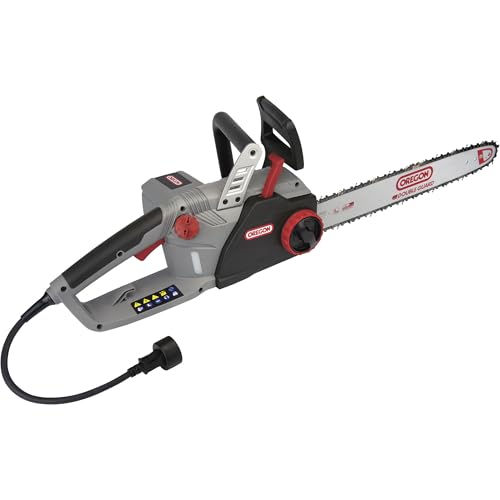
A corded saw sounds like a compromise until you list what it removes: no fuel, no battery platform, no runtime countdown, and a motor that delivers the same pull on the last cut of the day as the first. The CS1500’s 15-amp motor drives an 18-inch reduced-kickback bar, and its party trick is the built-in PowerSharp system — pull a lever for a few seconds and a stone inside the saw dresses the chain’s cutters from the top, restoring an edge without files or a bench. The matching PowerSharp chain is the one consumable you must buy by name; pitch and gauge are standard 3/8 inch low-profile and .050, but the sharpening system needs its own chain.
The limits are physical and obvious: your range is the length of a heavy outdoor extension cord, the cord is one more thing to keep out of the chain’s path, and this is not a tool for the far end of a wooded lot. Around a house, a barn or a camp building — bucking delivered logs, clearing a fallen limb off the fence line, cutting up a tree the arborist already felled — those limits barely bind. It has a chain brake, tool-less tensioning, and at 12.6 lb it weighs about what the big battery saw does, with no pack to recharge between sessions.
Specs
- Power source: corded electric, 15 amp motor
- Bar length: 18 inches, reduced-kickback
- Chain: 3/8 inch low-profile pitch, .050 inch gauge, PowerSharp
- Chain brake: yes
- Tensioning: tool-less
- Weight: 12.6 lb
- Battery status: not applicable — corded, needs an outdoor-rated extension cord
- Best for: firewood and cleanup within cord reach of a building
- Source: https://www.amazon.com/dp/B00OIZ1XHW
How to choose
Match the bar to the wood first. A saw cuts comfortably through wood up to about twice the bar length when you can work from both sides, but the everyday cut should be well inside the bar. Sixteen inches handles the great majority of yard trees and firewood; go to 18 or 20 inches only if your rounds and trunks genuinely demand it.
Pick the power source by where the work is. Battery saws win on storage, noise and instant starting, and their honest currency is cuts per charge. Gas wins on unlimited runtime and long-term serviceability, and charges you in fuel mixing, noise and carburetor care. Corded wins on simplicity anywhere an outlet is near, and loses the moment the work moves away from the building.
Check the chain numbers before you need a spare. Pitch and gauge must match the bar and sprocket exactly; the five saws above use three different combinations, and a chain that almost fits is a chain that comes off. Note your combination on the shed wall the day the saw arrives.
Treat tensioning and the brake as daily checks, not features. A chain brake you never test is a hope, not a device: trip it by hand before the first cut of the day. Chain tension changes as the chain warms and stretches, which is why tool-free systems earn their keep on lighter saws — the best tensioner is the one you will actually stop and use.
Budget the protective gear with the saw. Chaps, a helmet with visor and muffs, eye protection, gloves and boots are part of this purchase, and a basic rule keeps the whole category in proportion: if a job needs a ladder, a rope, or cutting above your shoulders, it is a job for a professional with a harness and insurance, not for a homeowner with a new saw.
More from Amazon
Programs that pair well with the guide above. Offers and eligibility are set by Amazon and may change.
Free shipping on eligible items, Prime Video and more. Eligible new members can start with a free trial.
Start a Prime free trialA Prime membership for ages 18-24 with a trial period. Eligibility is set by Amazon.
See Prime for Young AdultsAudiobooks and podcasts to listen to on the go. Eligible new members can start with a free trial.
Try Audible freeAd-free music streaming. Eligible new subscribers can start with a free trial.
Try Music Unlimited freeAs an Amazon Associate we earn from qualifying purchases.










Write Your Review
No reviews yet. Be the first to share your experience!