

Key takeaways
- Blade tenderizers, mallets, a disc pounder and a hand-crank cuber compared on blades, build and cleanup, with straight talk on bacteria risk and thickness.
As an Amazon Associate we earn from qualifying purchases.
A meat tenderizer earns its drawer space on the cuts that need help: a chewy round steak, a venison roast from a hard-working muscle, a chicken breast that cooks unevenly because one end is twice as thick as the other. The five tools below cover the four honest ways to do that work — press-in blades that sever fibres, a mallet and a weighted pounder that flatten and loosen, and a hand-crank cuber that turns cheap round into cube steak. They are not interchangeable, and each comes with a trade-off worth knowing before you buy. Marinade powders, meat glues and injector-only gadgets are not on this list; this is about tools that change the meat mechanically, with your hands.
Affiliate Disclosure: This article contains affiliate links. If you buy through them, we may earn a commission at no extra cost to you. Products were chosen on blade design, build and cleaning, not on commission.
How to Choose a Meat Tenderizer
Blade tenderizers work — and they change how you must cook the meat. A blade or needle tool drives dozens of thin knives through the surface, cutting long fibres and connective tissue into shorter pieces and opening channels that pull marinade deep into the cut. That part is real. The part that gets skipped in most marketing is food safety: those same blades carry surface bacteria — including E. coli on beef — from the outside of the steak straight into the centre, where a rare or medium-rare cook may never get hot enough to kill them. Health agencies in the US and Canada advise cooking blade-tenderized meat thoroughly rather than serving it rare, and mechanically tenderized beef is labelled as such in US shops for exactly this reason. If you love a blushing centre, tenderize with a mallet instead, or buy your steaks untenderized and choose a naturally tender cut. If you do use a blade tool, treat every cut it touches as ground meat from a hygiene standpoint: cook it through, and wash the tool like it matters, because it does.
Mallets flatten as much as they tenderize — and that is the point. A mallet does loosen fibres, but its real skill is thickness control. An even half-inch chicken breast cooks through at the same moment everywhere; an uneven one gives you dry edges and a raw centre. Pound from the centre outward, work the meat between sheets of plastic wrap or inside a split freezer bag so the surface does not tear, and stop when the thickness is uniform rather than when the meat looks beaten. Heavy, wild swings tear fibres into mush and can crack a thin cutting board. Steady, overlapping strikes with the flat face do the flattening; the textured face is for working over a stubborn steak before it hits the grill.
Disc pounders are the quiet specialists. A weighted pounder has no swinging arc at all — you press and rock it, or strike straight down in short drops. That makes it the most controlled tool here for delicate work: veal and pork scallopini, schnitzel, and chicken cutlets that a mallet tends to shred at the thin edges. It will not sever fibres the way blades do, and it is slower over a big batch, but for even thickness without torn surfaces, nothing else on this page is as precise.
Cuber machines are for cheap cuts, in quantity. A hand-crank cuber pulls meat through rows of small blades that score both faces in the crosshatch pattern of cube steak. It is built for one job: taking stacks of lean round, chuck trim and venison and making them fry tender. Running a ribeye or a strip steak through one is a waste of a good steak — the machine cannot add anything the cut does not already have. If your autumn involves a deer or two and a freezer to fill, a cuber earns its counter space. If you tenderize twice a month, a blade tool and a mallet cover you.
Cleaning decides whether you keep using the tool. Blade tenderizers trap meat juice and fibre fragments in their blade channels; rinse one immediately after use, work a brush along the blades, and prefer models that come apart or go in the dishwasher. Mallets and pounders rinse clean in seconds. The cuber is the biggest cleaning commitment here — rollers, blades and combs all come off and get washed by hand after every session. Whatever you use, the tool that touched raw meat gets washed before it touches anything else.
The 5 Best Meat Tenderizers for Steaks, Game and Jerky Prep
1. Jaccard 48-Blade Meat Tenderizer (200348) — Best Blade Tenderizer for Steaks and Game
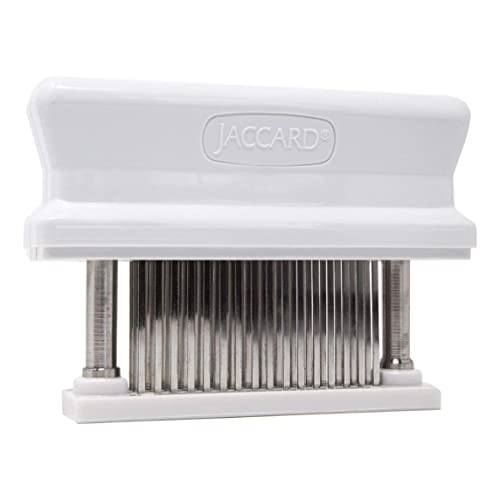
The Jaccard is the tool the blade category is measured against, and it has been a fixture in professional kitchens for decades for a simple reason: 48 double-edged stainless blades on spring-loaded columns press through a steak with firm palm pressure, no pounding, no noise, and no change to the shape of the cut. It is the right choice for venison and other lean game, where mallet work can tear the meat and where a marinade needs help getting past the surface. The columns retract into the housing as you press, so the blades only extend into the meat itself, and a clear cover keeps the blades guarded in the drawer. It comes apart for washing and goes on the top rack of the dishwasher. Two honest limits: it does nothing for thickness — an uneven steak stays uneven — and everything in the food-safety section above applies in full. Blade-tenderized steaks get cooked through, every time.
Specs
- Type: blade tenderizer, hand press
- Blades: 48 stainless steel, double-edged, on retractable columns
- Body: ABS plastic with protective blade cover
- Handle: top palm-press grip
- Dishwasher safe: yes — top rack, disassembles for cleaning
- Best use: steaks, venison and lean game, marinade absorption
2. OXO Good Grips Easy-Clean Bladed Meat Tenderizer — Best Blade Tool for Easy Cleanup

OXO’s bladed tenderizer matches the Jaccard on concept and beats it on the two things home cooks actually complain about: storage safety and washing. Fifty stainless blades sit behind a recessed toggle lock, so the sharp edges stay covered in the drawer and cannot deploy while you are scrubbing around them. The clear base lets you see exactly where the blades are landing, which makes even coverage across a wide steak easier than with an opaque tool, and the contoured non-slip grip fits a palm comfortably through a whole tray of chops. The unit separates into its component parts for the dishwasher, and those parts genuinely come clean — the open design leaves fewer blind channels for meat residue to hide in than most blade tools. It shares the category’s limits: it severs fibres but does not flatten, and the bacteria warning in the guide above applies to every cut it touches. Within those limits, it is the blade tenderizer most people will still be using in five years, because it is the one that is easy to live with.
Specs
- Type: blade tenderizer, hand press
- Blades: 50 stainless steel
- Body: plastic with clear base and recessed blade lock
- Handle: contoured, non-slip Good Grips handle
- Dishwasher safe: yes — separates into parts for washing
- Best use: everyday steaks and chops, marinade prep, smaller kitchens
3. OXO SteeL Meat Tenderizer — Best Mallet for Pounding Cutlets Even

A mallet should be heavy enough to let gravity do the work, balanced enough to aim, and simple enough to rinse and forget. The OXO SteeL is a solid stainless head on a brushed stainless handle with a soft grip section, and it gets all three right. One face is flat for pounding chicken breasts, pork loin and veal out to an even thickness; the other carries a textured pattern of raised points for working over a flank or skirt steak before grilling. Stainless throughout means no coating to chip into food and no seams at the head to trap residue, and the whole tool goes in the dishwasher. Technique matters more than the tool here: sandwich the meat in plastic, start in the middle, and walk the strikes outward, flipping once. The goal is a uniform thickness that cooks evenly — not the thinnest piece of meat you can produce. Pounded past about a quarter inch, chicken turns to lace and tears on the grill.
Specs
- Type: mallet, dual-sided
- Head: stainless steel — one flat face, one textured face
- Handle: brushed stainless steel with soft non-slip grip
- Dishwasher safe: yes
- Best use: chicken breasts, pork and veal cutlets, flank and skirt steaks
4. Norpro Grip-EZ Meat Pounder — Best for Even Thickness Without Tearing

The Norpro pounder looks like a small weighted disc on a vertical handle, and that shape is the whole idea. Instead of swinging, you press down and rock, or drop it in short, controlled strokes, which spreads force across the whole face of the disc at once. Thin, delicate cuts — veal scallopini, pork schnitzel, chicken for roulades — come out at a dead-even thickness with their surfaces intact, where a mallet’s edge strikes tend to nick and tear them. The weight of the stainless disc does most of the work, and the Santoprene Grip-EZ handle stays put in a wet hand and cushions the repeated impact. It is also a genuinely useful second tool beyond meat: the flat face crushes garlic, ice and nuts without scattering them. What it will not do is sever fibres — a tough round steak needs blades or a cuber, not pressure alone. As a thickness tool, though, it is the most precise pick on this page.
Specs
- Type: weighted disc pounder
- Head: flat stainless steel pounding disc
- Handle: Santoprene Grip-EZ vertical grip
- Dishwasher safe: yes
- Best use: scallopini, schnitzel and cutlets where surface tearing ruins the dish
5. Weston 2-in-1 Manual Cuber Tenderizer and Jerky Slicer — Best for Cube Steak and Batch Processing

When the job is a pile of venison round or a side of beef broken into family packs, hand tools stop making sense. Weston’s hand-crank unit clamps to the counter with two C-clamps and pulls each piece through 31 stainless steel blades that score both sides in one pass, turning lean round into genuine cube steak that fries up tender. A second attachment swaps in to slice uniform strips for jerky — and uniform strips are what dry evenly, which is the entire secret of consistent jerky. The cast aluminum body has a food-safe coating, the crank action is geared so the effort stays modest even on thick pieces, and everything disassembles for washing — by hand only, and it does need washing thoroughly after every session. Keep the boundary from the guide in mind: this machine exists for cheap, tough cuts in quantity. Good steaks never go through it, and jerky meat itself does not need tenderizing — the slicer earns its place by cutting even strips, while the cuber does the tenderizing work on the cuts that actually need it.
Specs
- Type: hand-crank cuber tenderizer with jerky slicer attachment
- Blades: 31 stainless steel tenderizing blades
- Body: cast aluminum with food-safe coating
- Mount: two C-clamps, fits counters up to 1.5 in thick
- Dishwasher safe: no — hand wash only, disassembles for cleaning
- Best use: cube steak from round and chuck, venison processing, uniform jerky strips
Care and Food Safety, Once More
Every tool on this page touches raw meat, and the blade tools touch it in a way that moves surface bacteria into the interior of the cut. So the rules are short and non-negotiable: blade-tenderized meat gets cooked thoroughly rather than served rare; tools get rinsed the moment you finish, brushed along every blade channel, and washed before they touch cooked food or produce; and boards, hands and counters that met raw meat get the same treatment. Store blade tools locked or covered — the OXO’s toggle lock and the Jaccard’s cover exist because an exposed bed of blades in a drawer is an injury waiting for a reaching hand. Look after the tools this way and each of the five will do its one job well for years: blades for fibres and marinades, the mallet and pounder for thickness, and the cuber for the autumn pile of round steak.
More from Amazon
Programs that pair well with the guide above. Offers and eligibility are set by Amazon and may change.
Free shipping on eligible items, Prime Video and more. Eligible new members can start with a free trial.
Start a Prime free trialA Prime membership for ages 18-24 with a trial period. Eligibility is set by Amazon.
See Prime for Young AdultsAudiobooks and podcasts to listen to on the go. Eligible new members can start with a free trial.
Try Audible freeAd-free music streaming. Eligible new subscribers can start with a free trial.
Try Music Unlimited freeAs an Amazon Associate we earn from qualifying purchases.










Write Your Review
No reviews yet. Be the first to share your experience!