

Key takeaways
- Best all-around travel choice: a padded wheeled snowboard bag around 165–175 cm long, with a full-length zipper and reinforced wheel end.
- Best for frequent flyers: a heavily padded roller bag with internal board straps, compression, and replaceable or protected wheels, such as the Dakine High Roller or Burton Wheelie Gig.
- Best for one board and low weight: a padded single-board bag with a shoulder strap and minimal hardware.
- Best for multiple boards: a long, reinforced bag rated for two or more boards, such as the Dakine High Roller or Db Journey Snow Roller.
- Best for occasional car trips: a padded sleeve or simple coffin-style bag; wheels add cost and weight that may not provide much benefit.
The best snowboard bags for travel are wheeled, padded bags with enough length for your board and outerwear, but the right choice depends on whether you fly often, drive to resorts, carry one board, or store several setups at home.
Our top picks


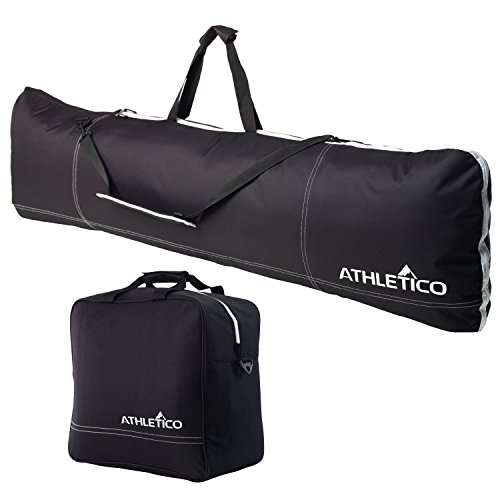
As an Amazon Associate we earn from qualifying purchases at no extra cost to you. Ratings are shown as listed on Amazon.
Quick picks by trip style
- Best all-around travel choice: a padded wheeled snowboard bag around 165–175 cm long, with a full-length zipper and reinforced wheel end.
- Best for frequent flyers: a heavily padded roller bag with internal board straps, compression, and replaceable or protected wheels, such as the Dakine High Roller or Burton Wheelie Gig.
- Best for one board and low weight: a padded single-board bag with a shoulder strap and minimal hardware.
- Best for multiple boards: a long, reinforced bag rated for two or more boards, such as the Dakine High Roller or Db Journey Snow Roller.
- Best for occasional car trips: a padded sleeve or simple coffin-style bag; wheels add cost and weight that may not provide much benefit.
What separates the best snowboard bags
Padded protection
Padding protects the board from conveyor belts, vehicle cargo areas, and contact with bindings or other luggage. Look for padding along the base, nose, tail, and sidewalls rather than a thin layer only on the top panel. A useful target for a travel bag is approximately 8–12 mm of foam in the main panels, with thicker reinforcement around the tips and wheel housing.
A padded bag will not prevent every type of damage. Bindings can create pressure points, especially when two boards are stacked together. Internal straps, a separate binding compartment, or enough depth to place clothing between boards can reduce abrasion. For a single board, remove the bindings if the bag is narrow or if the airline journey involves several connections.
Board capacity and fit
Choose a bag at least 5–10 cm longer than your snowboard. That extra space makes it easier to insert the board without forcing the zipper around the nose or tail. A 159 cm board generally fits comfortably in a 165–170 cm bag; a 170 cm board usually needs a 175–181 cm bag.
Capacity claims can be misleading because “two boards” may mean two bare decks without bindings. For two complete setups, check the bag’s depth and internal layout. A broad bag with 10–15 cm of usable depth is more practical than a narrow model advertised as multi-board capable. Clothing, boots, and outerwear can fill the unused space, but avoid overpacking: a bulging bag places stress on the zipper and seams.
Wheel quality
Wheels are valuable when moving through airports, parking garages, and hotel corridors, but they are also among the first parts to wear. Larger wheels roll more easily over expansion joints and rough pavement. Two wheels are lighter and usually easier to repair; four-wheel spinner systems maneuver well on smooth floors but expose more hardware to impact.
Prioritize wheels that are recessed or protected by a rigid housing. Check whether the wheel assembly is riveted, bolted, or replaceable. A replaceable wheel is worth paying for if you fly several times each season. Inline-style wheels typically handle uneven surfaces better than small spinners, while spinners are more convenient for turning in tight airport spaces.
Carry options
A strong padded shoulder strap is useful for stairs and snow-covered paths, but it should not be the only carry point on a long, heavy bag. The most practical arrangement is a padded haul handle at each end, a central grab handle, and a shoulder strap that can be removed or secured so it does not catch on conveyor equipment.
For a multi-board bag, inspect the handle attachment points. Stitching should be reinforced with box stitching or webbing that continues underneath the bag panel. A comfortable handle cannot compensate for a weak connection at the seam.
Airline-friendly dimensions
There is no universal airline snowboard-bag size. Policies, fees, and sports-equipment rules vary, and some carriers count a snowboard bag as one item while others apply oversized-baggage limits. A bag around 165–181 cm long is a practical compromise for common adult boards, but it is not automatically “airline approved.” Check the operating airline’s current dimensions and weight limit before departure.
A soft bag is easier to compress than a rigid case, which can help with a length or depth limit. However, compression should not force the board into a sharp bend or make the zipper bulge. Weigh the packed bag at home: two boards, bindings, boots, and clothing can quickly exceed a 23 kg baggage threshold.
Comparison of leading snowboard-bag types
| Bag type or example | Typical length options | Practical capacity | Approximate empty weight | Best use |
|---|---|---|---|---|
| Single-board padded sleeve | 150–175 cm | 1 board, usually with bindings removed | 0.8–1.8 kg | Car trips, storage, and budget-conscious riders |
| Padded wheeled single-board bag | 160–181 cm | 1 board plus clothing and small accessories | 2.5–4.5 kg | Frequent resort travel with one setup |
| Dakine High Roller | Commonly offered in roughly 165–181 cm classes | One or more boards, depending on size and binding arrangement | About 4–6 kg, varying by version | Air travel and organized multi-board packing |
| Burton Wheelie Gig | Common adult-board lengths, generally around 156–181 cm | One board with substantial clothing and gear space | About 4–6 kg, varying by size | Travelers wanting a large wheeled main bag |
| Db Journey Snow Roller | Long adult-board sizes, commonly around 165–180 cm | Multiple boards or one board with equipment | About 4–6 kg, varying by version | Premium organization and repeated transport |
Weights and dimensions vary by production year and length. Treat the figures as buying benchmarks, then verify the exact version before ordering. A bag that weighs 5 kg leaves substantially less of a 23 kg airline allowance for boots and clothing than a 2 kg sleeve.
Decision matrix: which snowboard bag fits your situation?
| Your situation | Recommended design | Why | What to avoid |
|---|---|---|---|
| One or two car trips each winter | Padded sleeve or light single-board bag | Low cost, low storage space, and adequate protection in a vehicle | Heavy roller hardware you will rarely use |
| Two or more flights per season | Wheeled bag with 8–12 mm padding and reinforced ends | Reduces carrying effort and protects against baggage handling | Unpadded nylon sleeves and exposed tiny wheels |
| Beginner with one board | Single-board roller with simple compartments | Easy to pack without managing unnecessary capacity | Oversized multi-board bags that become difficult to lift |
| Experienced rider with two setups | Deep multi-board roller with internal straps | Allows a daily board and a powder or spare board in one piece of luggage | Claims based only on deck count, without binding clearance |
| Limited apartment storage | Soft bag with removable shoulder strap and compressible panels | Folds down when empty | Rigid cases and permanently extended handles |
How to pack a snowboard bag without damaging it
- Measure the packed board first. Include the longest point of the nose or tail and allow 5–10 cm of bag clearance.
- Protect the edges. Place clothing or a thin board wrap around exposed edges, particularly when carrying two decks.
- Use the binding space carefully. Remove bindings when the bag is narrow; otherwise position them so their high points do not press directly against the outer fabric.
- Put soft items around hard gear. Jackets, pants, and base layers cushion the board while using space that would otherwise be empty.
- Keep sharp objects separate. Wax scrapers, tools, and crampons can puncture the lining. Use a closed accessory pouch.
- Compress only until the zipper closes naturally. If the zipper needs force, remove gear. Excess tension usually damages zipper teeth or seam tape before the fabric fails.
- Weigh the complete bag. A simple calculation helps: if the airline limit is 23 kg and the empty bag weighs 4 kg, you have 19 kg for boards, bindings, boots, and clothing.
Durability and ownership costs
The wheel housing, zipper sliders, bottom fabric, and handle stitching typically show wear before the padded panels. Dragging a loaded bag across concrete accelerates abrasion at the base. Lift the bag over curbs instead of pulling it sideways, and do not use the shoulder strap as a tie-down point in a vehicle.
After each trip, empty the bag and let it dry fully with the zipper open. Snow trapped inside can keep padding damp and create odors or mildew. Brush off road salt and grit with a damp cloth; avoid aggressive detergents that can weaken coatings. Do not store the bag compressed around a wet board.
For occasional use, a $60–$130 padded sleeve or basic bag may be the best value. A quality wheeled bag commonly falls around $150–$350, while premium multi-board designs can cost more. A $250 bag used for 25 travel days costs about $10 per travel day before replacement parts; a $100 bag used twice costs $50 per trip. That calculation favors a durable roller for frequent flyers and a light sleeve for occasional drivers.
Final buying checklist
- Choose a length 5–10 cm longer than your board.
- Confirm whether the stated capacity includes bindings.
- Look for padding at the base, tips, and sidewalls.
- Prefer protected or replaceable wheels if you fly regularly.
- Check handle stitching and the attachment of the shoulder strap.
- Measure the packed bag and read the operating airline’s current sports-equipment rules.
- Leave enough weight allowance for boots and clothing, not just the snowboard.
For most riders, the best snowboard bags are not the largest models available. A padded wheeled bag that matches your board length, has dependable carry points, and leaves manageable weight for airline travel will protect your equipment better and be easier to live with than an oversized bag packed beyond its practical limits.





Write Your Review
No reviews yet. Be the first to share your experience!