

Key takeaways
- Compare the best shooting sticks and monopods for hunting rifles, from trigger-adjust tripods to clamp heads, with height, weight and yoke advice.
As an Amazon Associate we earn from qualifying purchases.
A shooting stick is the rest you carry to the shot instead of the rest you bolt to the rifle. That distinction matters. A rifle-mounted bipod only helps when you can go prone or find a bench-height surface, while a carried stick, monopod or tripod sets up wherever you stop: standing on a field edge, kneeling in sagebrush, or sitting against a turkey blind. The category climbs a clear stability ladder. A monopod is the lightest and fastest, and it leans on your own body for two of its three support points. Bipod sticks add a second leg and calm most of the side-to-side sway. A tripod stands on its own, holds the rifle with the least input from you, and in clamp-head form can hold it entirely hands-free while you glass. The five rests below span that whole ladder, from a featherweight sitting monopod to a clamp tripod built for long waits over a decoy spread.
Affiliate Disclosure: This article contains affiliate links. If you buy through a link on this page, we may earn a commission at no extra cost to you.
Legs, Locks and Yokes: The Three Choices That Matter
Leg count decides stability, but the lock decides speed. Trigger-activated sticks change height with one squeezed hand, which is why spot-and-stalk hunters love them: the rifle stays shouldered and roughly on target while the legs find the ground. Lever locks and twist locks take a hand off the rifle for each leg, yet they are simple, quiet and easy to service, and they rarely slip once set. Neither system is better in the abstract; they suit different kinds of hunting.
The head is the third choice. A V-yoke or U-yoke cradles the fore-end and lets the rifle lift free instantly, which suits still-hunting and turkey work where shots appear and vanish in seconds. A wide universal rest adds padding and some swivel for tracking. A clamp head grips the rifle itself, trading instant lift-away for a rock-steady hold during long sits. Keep those three axes in mind — legs, locks, head — as you read the picks.
1. Primos Trigger Stick Gen 3 Tall Tripod — The Fast Spot-and-Stalk Tripod

The Trigger Stick’s party trick is right in the name. Squeeze the trigger in the grip and the legs slide to a new height; release it and they lock. On the tall tripod that means a one-handed change anywhere between 24 and 62 inches, covering sitting, kneeling and standing shots without ever putting the rifle down. For a hunter who moves until he finds game, then needs a rest in the next few seconds, nothing else in this roundup deploys as quickly.
The head is a quick-detach V-yoke with an integrated lock. It rotates smoothly for panning across a clearing, and it pops off to reveal a threaded stud, so the same legs can carry a spotting scope or camera on a scouting trip. A leg angle lock helps the tripod settle on slopes and in ruts instead of rocking on one short leg. The camo finish and roughly three-and-a-half-pound carry weight suit it to long walks between setups. If your hunting is mostly mobile — mule deer in open country, coyotes over calling stands, still-hunting whitetails — this is the stick that keeps up.
Specs
- Type: Tripod shooting stick
- Height range: 24 to 62 in
- Weight: About 3.5 lb
- Construction: Aluminum
- Adjustment: One-hand trigger-activated height change
- Yoke: Quick-detach V-yoke with integrated lock, rotating for panning
- Extras: Leg angle lock; yoke removes to expose a threaded mount for optics or cameras
- Model: 65815
2. BOG Adrenaline Switcheroo Tripod, Camo — The Modular Lever-Lock Tripod

BOG built the Adrenaline line around its Switcheroo quick-change system, and the tripod is the fullest expression of it. The Universal Shooting Rest that ships in the box swivels a full 360 degrees and swaps out in seconds for other Switcheroo heads and accessories, so one set of legs can serve a rifle today, a spotting scope tomorrow and a camera next season. Hunters already invested in BOG rests will feel at home immediately.
The legs are three-section aluminum with lever locks — flip, slide, snap shut — and they run from ground-hugging heights up to 68 inches of usable height, the tallest reach in this group. Rubber feet pull off to reveal retractable steel spikes for frozen ground, mud and loose rock, and high-density foam grips give cold hands somewhere kind to hold during setup. The camo version disappears against brush and blind material. Choose the Adrenaline if you want one tripod that adapts to several jobs and several seasons rather than a single-purpose stick.
Specs
- Type: Tripod shooting stick
- Height range: 18 to 68 in usable height
- Construction: Aluminum, camo finish
- Locks: Lever leg locks
- Head system: Switcheroo quick-change mount with Universal Shooting Rest, 360-degree swivel
- Feet: Rubber feet with retractable steel spikes underneath
- Grips: High-density foam
- Model: 1100488
3. BOG DeathGrip Aluminum Tripod — The Hands-Free Clamp Tripod

The DeathGrip replaces the yoke entirely with a clamp. Its head closes on the rifle’s fore-end and stock with non-marring pads and holds the rifle level and pointed where you left it, no hands required. That changes how a hunt feels from a blind or a stand: you can glass with both hands, work a call, or simply wait without your arms tiring, and the rifle is already shouldered-height and roughly aimed when the moment comes.
The aluminum frame carries a bubble level so you can square the head before the shot, and the head pans a full circle and tilts for following game across a field. Legs adjust through three angle positions, from a low prone-friendly splay to a narrow stance for tight blind corners, and the working height runs from near ground level up to standing eye height. It is the heaviest style of rest here and the slowest to reposition, which is exactly the trade a sedentary hunter wants to make. For predator stands, ground blinds and long sits over food plots, the clamp earns its keep.
Specs
- Type: Tripod with clamping head
- Head: DeathGrip clamp with non-marring pads, hands-free rifle hold
- Pan and tilt: 360-degree pan, 25-degree tilt
- Leg angles: 3-position locks at 20, 45 and 85 degrees
- Frame: Aluminum
- Level: Built-in bubble level
- Best for: Blinds, stands and long stationary sits
4. Vanguard Quest T62U — The 3-in-1 Convertible Stick
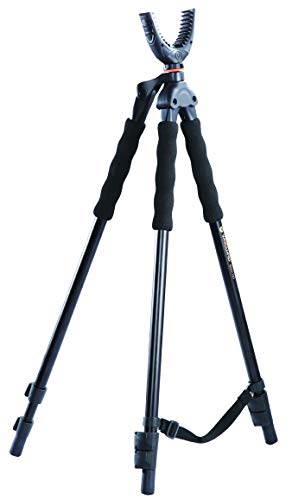
The Quest T62U refuses to pick a leg count. Used whole, it is a tripod. Pull one leg and the remaining pair works as bipod sticks; pull a second and you are carrying a monopod. For a hunter who is not sure which rung of the stability ladder fits his ground — or whose ground changes between the morning ridge and the evening field edge — one convertible stick answers all three questions for the weight of a single rest, about 2.2 pounds.
The head is a rotating U-yoke, 60 millimeters wide, that cradles the fore-end and removes to show a standard quarter-inch thread for optics and cameras. Three-section aluminum legs with flip lever locks reach up to 62 inches for standing shots and fold down to under 28 inches for the walk in. Foam grips and rubber feet keep it quiet and planted. It will not match the Trigger Stick for one-hand speed or the DeathGrip for hands-free steadiness, but as a first shooting stick, or a spare that lives in the truck, its flexibility is hard to argue with.
Specs
- Type: Convertible tripod, bipod and monopod in one
- Height range: Up to 62 in extended, about 27.5 in folded
- Weight: About 2.2 lb
- Legs: Aluminum, 3 sections, 20 mm diameter
- Locks: Flip lever locks
- Yoke: Rotating U-yoke, 60 mm wide, removable to reveal a 1/4 in threaded stud
- Grip and feet: Foam grip, rubber feet
- Model: Quest T62U
5. Allen Company Monopod Turkey Hunting Shooting Stick — The Simple Sitting Monopod

At the bottom of the stability ladder sits the classic monopod, and this Allen stick is its simplest honest form. One aluminum leg adjusts between 14.5 and 34 inches — sitting and low-kneeling heights only — and tops out in a V-shaped rubber cradle that grips the fore-end without marking it. There is no trigger, no clamp and almost nothing to break, and at well under a pound it vanishes into a vest pocket or straps flat to a pack.
That low ceiling is the point. Turkey hunters sit for hours with their backs to a tree, and a short monopod planted between the knees holds the shotgun or rifle at ready height the whole time, taking the shake out of a long wait and the strain out of your arms. The same stick doubles as a walking aid on wet leaves and creek crossings, and it steadies binoculars for a quick look across a field. If most of your shots are taken sitting, this is all the rest you need, and it leaves both hands free for calling.
Specs
- Type: Monopod shooting stick
- Height range: 14.5 to 34 in
- Construction: Aluminum, matte black finish
- Yoke: V-shaped rubber cradle grip, removable
- Weight: About 0.4 lb
- Best for: Sitting shots, turkey hunting, ground blinds
- Model: 2164
How to Choose the Right Shooting Stick
Start with your most common shooting position and work backwards. A rest that cannot reach it is useless no matter how clever its lock is. Ground-blind and turkey hunters live between 15 and 35 inches. Kneeling shots in open country want roughly 30 to 45 inches. Standing shots need a stick that reaches past 55 inches for most adults, and taller hunters should look for maximum heights in the low sixties. Check the minimum height too: a tall tripod that only collapses to 24 inches cannot help you from a low seat.
Next, match leg count to how still you sit. Monopods reward mobile hunters who shoot quickly and move on; their single contact point adds the least stability but also the least fuss, and they double as walking sticks on the hike in and out. Bipod sticks are the middle path, steadying the shot noticeably while staying light and quick to plant. Tripods are for hunters who set up and wait, and clamp-head tripods suit the longest, stillest sits of all.
Then think about the lock you will operate with cold, gloved hands. Trigger systems are the fastest and work one-handed, which matters when the other hand holds the rifle. Lever locks are nearly as quick and shrug off mud. Twist locks are the quietest and simplest, with nothing to snag. Finally, weigh the whole package honestly. A rest left in the truck steadies nothing, so the best stick is the heaviest one you will actually carry all day.
FAQ
Are shooting sticks steadier than a rifle-mounted bipod?
They solve different problems. A mounted bipod is excellent prone or off a flat surface, but it cannot help you standing in tall brush. Shooting sticks and tripods bring the rest up to whatever height the terrain forces on you, which is why western and turkey hunters rely on them.
Can I use a shooting stick as a walking stick?
Monopods and many bipod sticks, yes — that double duty is one of their oldest selling points. Keep the yoke covered or removed so it does not snag brush, and remember that a stick used as a trekking pole will pick up mud that you should wipe off the locks before a hunt.
Which is better for a ground blind, a yoke or a clamp head?
A clamp head, if you sit in one spot for long stretches. It holds the rifle aimed and ready while your hands stay free for calls and optics. A yoke is better when you expect to lift the rifle and reposition often, as in a run-and-gun turkey setup.
Do shooting sticks work for crossbows and shotguns?
Yes. Any of these rests will cradle a crossbow or a turkey shotgun, and clamp heads are popular with crossbow hunters because the weapon stays level during long waits. Just confirm the yoke or clamp width suits your fore-end before the season opens.
How tall should my shooting stick be?
Tall enough that the yoke meets your fore-end with your elbow braced and your eye behind the scope in your natural shooting posture. For standing shots that usually means a maximum height somewhere between 58 and 65 inches; when in doubt, choose the taller stick, since legs can always run shorter.
Conclusion
Every rest in this roundup steadies a rifle better than offhand shooting, and the right one is the one matched to how you actually hunt. Pick the Primos Trigger Stick Gen 3 Tall Tripod for one-hand speed while stalking, the BOG Adrenaline for a modular tripod that swaps heads and reaches tall, and the BOG DeathGrip when the hunt is a long, still wait that calls for a hands-free clamp. The Vanguard Quest T62U covers monopod, bipod and tripod duty in a single light package, and the Allen monopod keeps things beautifully simple for sitting hunters. Decide by position first, leg count second and lock style third, and the stick you carry will be the stick you use.
More from Amazon
Programs that pair well with the guide above. Offers and eligibility are set by Amazon and may change.
Free shipping on eligible items, Prime Video and more. Eligible new members can start with a free trial.
Start a Prime free trialA Prime membership for ages 18-24 with a trial period. Eligibility is set by Amazon.
See Prime for Young AdultsAudiobooks and podcasts to listen to on the go. Eligible new members can start with a free trial.
Try Audible freeAd-free music streaming. Eligible new subscribers can start with a free trial.
Try Music Unlimited freeAs an Amazon Associate we earn from qualifying purchases.










Write Your Review
No reviews yet. Be the first to share your experience!