

Key takeaways
- Compare the best planer boards for trolling walleye and salmon: tattle flags, release clips, port and starboard picks, and boards sized for heavy cranks.
As an Amazon Associate we earn from qualifying purchases.
A planer board does one simple thing: it grabs the water at an angle and pulls your line out to the side of the boat, so the bait runs 50 to 150 feet away from the hull instead of dragging through the prop wash. That distance is not a luxury. In shallow, clear water — spring coho and brown trout in 10 feet of water, walleye spread over a sunlit flat — fish slide away from a passing boat long before a lure running behind the transom reaches them. A bait running off a board never passes under the boat at all. On pressured water, that is often the entire difference between catching and just boating.
The five boards below are all inline models sold on Amazon, and they split along the lines that actually matter: how the release clip behaves when a fish hits, whether the board carries a spring tattle flag, and how much bait weight the hull can pull without lagging. Read the buying notes after the picks before you order — the two most common board mistakes, buying the wrong side and buying too small a board, are both made at checkout, not on the water.
Affiliate Disclosure: This article contains affiliate links. If you buy through a link on this page, we may earn a commission at no extra cost to you. Every product below is sold on Amazon with the identifier shown, so you can verify the exact listing yourself before ordering.
1. Off Shore Tackle OR12 Side Planer with Tattle Flag
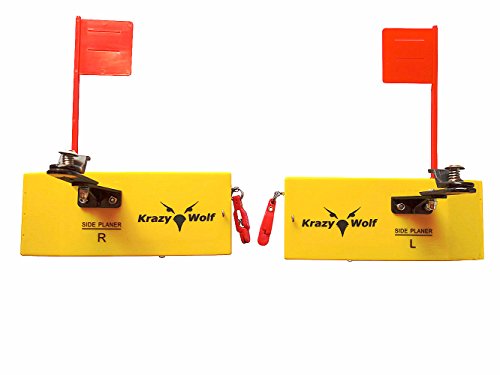
The OR12 is the board the Great Lakes salmon and walleye fleets standardized on, and this listing ships it with the Tattle Flag system fitted — the version most anglers end up converting to anyway. The hull is a 9.5-inch ballasted yellow board that tracks straight at normal trolling speeds and stays on top in a moderate chop, and it pulls genuinely heavy presentations: Off Shore rates it for seven or more colors of lead core and copper lines past 200 feet.
The hardware is the real story. On the bracket sits an OR19 heavy-tension release, adjustable by sliding its spring, and on the tail an OR16 Pro Clip with a center pin. Rigged the standard way, the line sits in the OR19 and behind the OR16’s pin. When a fish strikes, the line pops out of the front release and the board slides back and stops against the pin — you reel the board to the boat, lift it off, and fight the fish on a clean line. The Tattle Flag changes bite detection completely: it is spring-loaded, so a small fish, a weed-fouled crankbait, or a bait dragging bottom pulls the flag down and holds it there. Without it, a two-pound walleye or a clump of zebra mussels can tow behind the boat for an hour unnoticed.
Two honest limits. First, the OR12 is side-specific: the left board planes left and the right board planes right, and they are not interchangeable — more on that below. Second, the stock OR19 is a pinch-style release, and anglers who run braided line often upgrade to a cam-style release because braid can creep in pinch pads.
Specs
- Model: OR12 Side Planer (left and right versions), Tattle Flag fitted
- Length: 9.5 in
- Color: yellow with red flag
- Front release: OR19 heavy-tension adjustable release
- Rear clip: OR16 Pro Clip with center pin
- Flag: spring-loaded Tattle Flag system
- Line capacity: 7+ colors lead core, 200+ ft copper
- Origin: made in USA
2. Church Tackle The Walleye Board, Starboard

Church Tackle built its name on this board, and its signature is a catamaran-style hull with an adjustable keel weight you can slide to rebalance the board for the day’s waves and the weight of the bait behind it. That adjustability is why the Walleye Board holds a line in choppy, upwind trolling where a fixed-ballast board starts porpoising or diving. At roughly 10 by 3.5 inches in fluorescent red, it is sized squarely at the walleye fishery: big enough for deep-diving crankbaits on lead core, small enough to run three per side without a wrestling match at the rod holder.
The clip arrangement differs from Off Shore’s and is worth understanding. An adjustable flex clip grips the line up front, and a spring-loaded retaining pin at the rear keeps the board attached even after the front clip lets go. In practice the board releases at the strike, slides down, and is stopped by the pin, so it comes to the boat with the fish instead of floating free behind you. Church rates the board for monofilament, braided and fused super lines, lead core, and copper — the flex clip’s grip is why braid works here without the slippage that plagues plain pinch pads.
The trade-off is that this is a single-side listing: this ASIN is the starboard (right) board, model 40110, and a full spread needs the matching port board bought separately. It is also not the tool for the heaviest salmon rigs — that is the TX-44’s job, below.
Specs
- Model: 40110, The Walleye Board (starboard/right)
- Dimensions: approx. 10 x 3.5 in
- Hull: catamaran shape, adjustable keel weight
- Clip: adjustable flex clip with spring-loaded retaining pin
- Color: fluorescent red
- Line types: mono, braid, lead core, copper
- Origin: made in USA
3. Yellow Bird Planer Board
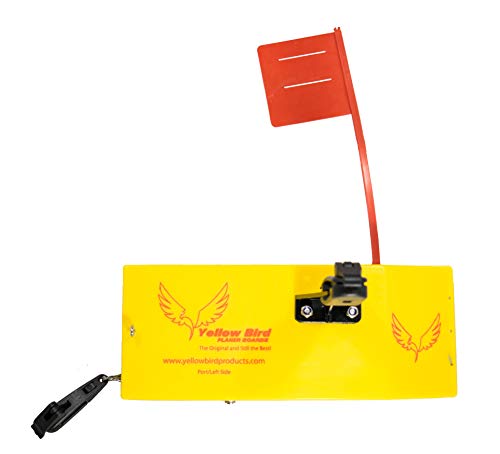
Yellow Bird is the original planer board maker — the company has been building boards for over three decades — and its design philosophy is different from both brands above. The hull is a styrofoam core sealed inside a hard plastic shell, which makes the board light, buoyant, and forgiving when it bangs against the boat or the dock. An adjustable weight lets you tune how hard the board pulls, and a spring-mounted red flag gives you the same trash-and-small-fish warning a tattle flag provides: if the flag is down and staying down, something is wrong behind that board, whether it is a short walleye or a fouled plug.
The release is a pinch-pad style clip, and Yellow Bird sells its boards in port and starboard versions with the side stamped and color-coded on the board itself — red for port, green for starboard on current models — which removes the dockside guessing game when you are rigging in the dark. The design is simple, replacement hardware is widely available, and the same hull family scales from small 5-inch minis up to 12-inch extra-large boards for salmon work.
The honest caveat is capacity. A mid-size Yellow Bird is a walleye and trout board; hang a magnum deep-diving crankbait or a heavy flasher rig behind it and it will lag behind the rest of the spread and stall in turns. Match the board size to the bait, and step up to the 12-inch size for salmon.
Specs
- Brand: Yellow Bird Fishing Products
- Construction: styrofoam core encased in plastic shell
- Weight: adjustable keel weight
- Flag: spring-mounted red flag
- Release: pinch-pad snap release
- Sides: port and starboard versions, color-coded stamping
- Use case: walleye, trout, light salmon presentations
4. Church Tackle TX-44 Super Planer Board

The TX-44 Super is what you buy when the baits get heavy. At about 14 by 4.5 inches it is the largest board in this guide, and Church rates it to support up to a pound of weight — magnum Dipsy Divers, Jet Divers, slide divers, drop weights, full lead core, copper, and wire line. A standard walleye board asked to pull that load does not plane out and hold; it lags, porpoises, and stalls every time the boat turns. The TX-44’s extra hull volume is exactly the fix, which is why it shows up on salmon, striper, and muskie boats rather than inland walleye rigs.
Its vise clip is the other half of the design. Heavy presentations generate steady, hard pull, and a light pinch release either false-trips all day or has to be clamped so hard it will not trip on a fish. The vise clip is built to eliminate accidental releases while still letting go on a genuine strike. Unlike the side-specific boards above, the TX-44 works on either side of the boat — port or starboard — which simplifies spares: one backup board covers both sides of the spread.
Size cuts both ways. A 14-inch board is more drag on the line, more work to clear when a fish hits an inside board, and more storage space in the boat. For walleye crankbaits it is simply more board than the job needs. It earns its place when the spread includes divers, wire, or copper — the presentations that make smaller boards quit.
Specs
- Model: TX-44 Super Planer Board
- Dimensions: approx. 14 x 4.5 in
- Capacity: supports up to 1 lb of weight
- Clip: vise clip, designed to prevent accidental releases
- Sides: reversible — runs port or starboard
- Flag: included
- Use case: salmon, striper, muskie; divers, lead core, copper, wire
5. Opti Tackle Opti-2 493 Medium Planer Board with Corkscrew

Opti Tackle’s boards take a different approach to the line connection: instead of relying only on clips, the 493 Medium uses a corkscrew-style attachment that the line twists into, backed by large rubber-padded clips. The corkscrew holds securely at trolling speed and releases when you need the board off, and the padded jaws are gentle on monofilament. The bright green hull is easy to track against dark water, and the board carries a fixed red flag, with a spring flag conversion possible for anglers who want full tattle-flag behavior.
One detail sets this board apart for a specific crowd: it accepts a light stick, which makes it a genuine night-trolling tool. Night walleye fishing on boards is a major fishery on big water, and a glow stick on the board is how you read your spread in the dark — a board that stops, surges, or drags its light tells you something has happened before the rod ever loads. The medium size keeps it in the walleye class: crankbaits, spinners, and moderate lead core.
Set expectations accordingly. The Opti-2 medium is not a heavy-rig board, and its corkscrew system is a little slower to rig than a plain pinch release when you are resetting lines quickly. For anglers who troll after dark, it fills a niche the other four do not.
Specs
- Model: Opti-2 493 Medium Planer Board
- Attachment: corkscrew line connector with large rubber-padded clips
- Flag: fixed red flag (spring flag conversion available)
- Night use: light stick compatible
- Color: bright green
- Use case: walleye crankbaits and spinners, night trolling
How to Choose: The Four Decisions That Matter
Inline boards or a mast system? Everything above is an inline board: it clips to your own line, one board per rod. A mast system is a different fishery — two large boards on heavy tow lines from a bow mast, with fishing lines clipped to the tow line on releases. Mast systems shine on charter boats running six or more lines for salmon, where a mate manages the gear full-time. For a private boat running two to six rods, inline boards are simpler, cheaper to start, and let each angler fight a fish without the board in the way.
Port and starboard are not interchangeable. A side planer is a wing: its keel and tow point are angled to pull it away from the boat on one specific side. Put a port board on the starboard side and it does not plane out — it dives, crosses under the boat, and tangles the spread. When you buy singles, check the side stamped on the board and buy matched numbers per side. Reversible boards like the TX-44 are the exception, not the rule.
Decide how the board should behave at the strike. With a releasing front clip and a pinned rear clip, the line pops free at the front and the board slides down the line to a stop — you clear it at the boat and fight the fish clean. Rigged to release completely, the board floats free and someone has to go back for it. Most walleye and salmon anglers choose the sliding setup. Either way, a spring tattle flag is close to mandatory: it is the only thing that tells you a board is towing a small fish, a dead bait, or a wad of weeds instead of fishing.
Match board size to bait weight. A board that is too small for its load does not fail dramatically — it lags behind the spread, stalls in turns, and quietly fishes worse all day. Standard 9.5 to 10-inch boards cover crankbaits, spinners, and lead core. Deep-diving magnum cranks, divers, wire, and long copper belong behind a magnum board like the TX-44. When in doubt, size up.
More from Amazon
Programs that pair well with the guide above. Offers and eligibility are set by Amazon and may change.
Free shipping on eligible items, Prime Video and more. Eligible new members can start with a free trial.
Start a Prime free trialA Prime membership for ages 18-24 with a trial period. Eligibility is set by Amazon.
See Prime for Young AdultsAudiobooks and podcasts to listen to on the go. Eligible new members can start with a free trial.
Try Audible freeAd-free music streaming. Eligible new subscribers can start with a free trial.
Try Music Unlimited freeAs an Amazon Associate we earn from qualifying purchases.










Write Your Review
No reviews yet. Be the first to share your experience!