

Key takeaways
- Compare the best laser bore sights for rifles, pistols and shotguns: cartridge, arbor and magnetic types, red vs green lasers, ranges and battery life.
As an Amazon Associate we earn from qualifying purchases.
Mounting a new scope and firing the first group only to find the shots landing off the paper entirely is a slow way to start a range session. A laser bore sight solves the first half of that problem: it projects a laser dot aligned with the bore, so the optic or sights can be adjusted until they point at the same spot. Done properly, the first live rounds land on the target sheet instead of the backstop, and the fine adjustments that follow take a handful of cartridges rather than a whole box.
Three designs dominate the category. In-chamber cartridge lasers are machined to the dimensions of one specific cartridge and sit in the chamber like a live round. Arbor kits slide a tapered shaft into the muzzle and use sized adapters or a self-centering arbor to fit many calibers with one tool. Magnetic models skip the bore entirely and clamp onto the muzzle face with a magnet, making them caliber-independent. The five products below cover all three types.
One point needs to be stated plainly: a bore sight produces a preliminary alignment, not a zero. The laser travels in a straight line; a bullet does not. A bore-sighted rifle will usually group somewhere on the paper at short range, but the point of impact still has to be confirmed and corrected with live fire at the intended distance. Treat every bore sight here as a way to start close, never as a substitute for shooting the rifle.
Safety framing matters just as much. Before any bore sight goes near a firearm, the firearm must be verified unloaded — magazine out, chamber physically and visually checked — and handled as if it were loaded throughout. The laser should never be pointed at eyes; every model below is a low-power Class IIIa or IIIR device, but that assumes the beam is treated with respect. And the bore sight must come out before any live round is chambered, without exception.
Affiliate Disclosure: This article contains affiliate links. If you buy through them, we may earn a commission at no extra cost to you.
1. Wheeler Professional Laser Bore Sighter — Green
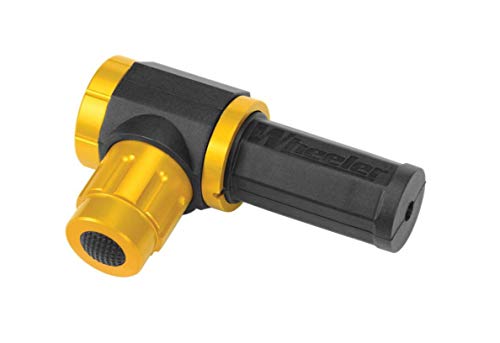
The Wheeler Professional takes the magnetic route. Instead of inserting anything into the barrel, the unit attaches to the muzzle face with a strong magnet and projects its beam down the bore axis. Because nothing enters the barrel and no adapters are involved, the same tool works on rifles, handguns and shotguns of any caliber, provided the muzzle face is flat and ferrous enough for the magnet to grip. That condition is the model’s main limitation: pronged flash hiders, many muzzle brakes and non-steel muzzle devices give the magnet nothing suitable to hold.
The laser is green at 532 nm, the right choice for a tool often used outdoors: the eye is far more sensitive to green than to red, so a green dot stays visible in daylight where a red dot washes out. Wheeler calibrates each unit at the factory, and the housing is machined aluminum with a rubber overmold that protects the muzzle finish. A reflective sighting target is included for indoor or short-range work, along with a molded storage case.
Power comes from a single included CR123A lithium battery, a larger cell than the button batteries most competing designs use. For shooters who sight in several firearms a season, the Wheeler’s speed is the attraction: attach, align, detach, move to the next gun, with no chambering and no adapter swapping.
Specs
- Type: Magnetic muzzle-mount
- Laser: Green, 532 nm, Class IIIR
- Battery: 1 x CR123A lithium (included)
- Construction: Machined aluminum housing with rubber overmold
- Compatibility: Any caliber; rifles, handguns and shotguns with a flat ferrous muzzle face
- Includes: Reflective sighting target, molded storage case
- Limitation: Will not attach to pronged, non-flat or non-ferrous muzzle devices
2. Sightmark .223 Rem / 5.56×45 NATO Boresight (SM39001)

Cartridge-style bore sights take the opposite approach to universality: total dedication to one chambering. The Sightmark SM39001 is a brass case machined to .223 Remington and 5.56×45 NATO dimensions with a red laser built into it. It chambers exactly like a live round, so the laser emitter sits on the bore axis with the same centering the chamber gives a cartridge. For the many AR-15 pattern rifles and .223 bolt guns in circulation, that makes initial alignment quick and repeatable.
The laser is a red 632–650 nm diode with output under 5 mW, placing it in Class IIIa. Sightmark rates the sighting range at 15 to 100 yards with a dot size of about 2 inches at 100 yards — the envelope for getting on paper at 25 yards and walking the zero out with live fire. Power comes from three AG3 button cells, included, with a rated battery life of about one hour — enough for several sessions if the end cap is switched off between uses. The laser activates as the end cap is tightened, a simple system with no external switch to bump.
The limitation is absolute and worth repeating: this tool fits .223 Rem and 5.56 NATO chambers only, and it is useless for any other caliber — a .308 rifle needs the .308 version, a 6.5 Creedmoor rifle needs its own. A carrying case is included.
Specs
- Type: In-chamber cartridge
- Caliber: .223 Rem / 5.56×45 NATO only
- Laser: Red, 632–650 nm, under 5 mW, Class IIIa
- Battery: 3 x AG3 (included)
- Battery life: Approx. 1 hour
- Sighting range: 15–100 yd
- Dot size: 2 in at 100 yd
- Construction: Brass
- Operation: On/off end cap
- Includes: Carrying case
3. Sightmark .300 Winchester Magnum Boresight (SM39006)

The SM39006 applies the same cartridge concept to the chambering that anchors a large share of North American elk, moose and long-range deer rifles: .300 Winchester Magnum. It is a brass, cartridge-shaped laser that chambers in a .300 Win Mag rifle and projects a red dot from the muzzle, letting a freshly mounted scope be aligned before the first full-power round is fired. With magnum cartridges, every avoided sighting shot is also recoil and barrel heat that never happens.
Specifications mirror the rest of Sightmark’s cartridge line: a red 632–650 nm laser under 5 mW in Class IIIa, a sighting range of 15 to 100 yards, a dot size of roughly 2 inches at 100 yards, an on/off end cap, and brass construction. The listing includes a battery pack and a carrying case in the box. Because the laser is factory-centered in a case built to SAAMI chamber dimensions, there is no setup beyond chambering the unit gently and closing the bolt without forcing it.
Everything said about the .223 model applies here with extra emphasis: the SM39006 works in .300 Winchester Magnum chambers and nothing else — not .300 WSM, .300 PRC or .300 Weatherby. A hunter with one .300 Win Mag rifle gets a tool that does its single job precisely; several different magnums would need one cartridge laser each, which is exactly the trade-off the universal designs below exist to solve.
Specs
- Type: In-chamber cartridge
- Caliber: .300 Winchester Magnum only
- Laser: Red, 632–650 nm, under 5 mW, Class IIIa
- Battery: Button-cell battery pack (included)
- Sighting range: 15–100 yd
- Dot size: 2 in at 100 yd
- Construction: Brass
- Operation: On/off end cap
- Includes: Carrying case, battery pack
4. Sightmark Triple Duty Universal Boresight — Red Laser (SM39024)

The Triple Duty Universal takes a third path between the magnetic Wheeler and the single-caliber cartridges. Its self-centering arbor retracts and expands to seat in the muzzle of barrels from .17 to .50 caliber, and listings also cover 20 and 12 gauge shotguns, so one tool handles rifles, pistols and shotguns. The base then attaches magnetically to the muzzle face. Because the arbor is a single self-centering mechanism rather than a box of separate pieces, there are no small parts to lose in the grass at the range — the weakness of many adapter kits.
The laser is red, 632–650 nm, under 5 mW, Class IIIA, with a published sighting range of 15 to 100 yards and a 2-inch dot at 100 yards, matching the cartridge models. Battery life is the compromise: three AG3 button cells deliver roughly one hour of operation, so the unit rewards a deliberate workflow — set the rifle in a rest, align, switch off — rather than being left running on the bench. A battery pack and carrying case are included, and the housing is aluminum.
This is the natural pick for a shooter with a mixed safe who wants one tool that covers everything without the Wheeler’s flat-muzzle requirement. The arbor centers in the bore itself, so pronged muzzle devices and non-magnetic barrels are not a problem; the trade-offs are the shorter battery life and a red dot that is harder to pick up in bright sun than a green beam.
Specs
- Type: Self-centering arbor with magnetic muzzle attachment
- Calibers: .17 to .50 cal, plus 20 and 12 gauge
- Laser: Red, 632–650 nm, under 5 mW, Class IIIA
- Battery: 3 x AG3 (included)
- Battery life: Approx. 1 hour
- Sighting range: 15–100 yd
- Dot size: 2 in at 100 yd
- Construction: Aluminum
- Includes: Battery pack, carrying case
5. CVLIFE Bore Sight Laser Kit with 64 Adapters — Green Laser

The CVLIFE kit is the high-coverage end of the arbor family: a green laser bore sighter, a central arbor, and 64 individually numbered adapters spanning .17 caliber through 12 gauge. Each adapter is engraved with its serial number and the kit’s chart maps numbers to calibers, so selecting the right one is a lookup rather than trial and error. The adapters are hard plastic rather than rubber, which the listing notes are less prone to deforming or sticking in the muzzle.
Green is the headline feature. The Class IIIA laser runs under 5 mW like the others, but green stays visible in daylight far better than red, which matters at an outdoor backstop. Power comes from CR2 batteries — two are included, one runs the unit at a time — and the listing rates operation at about 8 hours per battery, a large margin over the one-hour button-cell designs. A button switch replaces the twist-cap arrangement, and everything packs into an included storage case.
The honest caveats are about precision and parts management. Sixty-four adapters means sixty-four small pieces to keep organized, and a loosely fitting adapter will not center as repeatably as a chambered cartridge or a self-centering arbor. Rotating the unit in the muzzle and watching whether the dot stays put is a worthwhile check with any adapter system. For a shooter maintaining a whole family’s worth of rifles, pistols and shotguns, though, the coverage is hard to argue with.
Specs
- Type: Arbor kit with caliber adapters
- Adapters: 64, individually numbered
- Calibers: .17 to 12 GA
- Laser: Green, Class IIIA, under 5 mW
- Battery: 2 x CR2 included (one used at a time)
- Battery life: Approx. 8 hours per battery (per listing)
- Switch: Button on/off
- Adapter material: Hard plastic
- Includes: Arbor, storage case, adapters and fitting screws
How to Choose
Start with how many firearms the tool has to serve. A single rifle that gets re-scoped rarely is best served by a cartridge laser in its exact chambering: the fit is the most repeatable of any design, with nothing to configure. Several calibers point toward a universal arbor system or the magnetic Wheeler, accepting slightly more setup in exchange for coverage.
Laser color is the second decision. Green (532 nm) is far easier to see in daylight and at longer distances, which is why the Wheeler and the CVLIFE kit use it; red is workable at 25 yards, indoors, or in low light. Outdoors at 50 to 100 yards, green earns its place; in a garage at 15 yards, red is adequate.
Battery type deserves more attention than it usually gets. Button-cell designs (AG3) are compact but deliver around an hour of runtime, and they are easy to leave switched on and find dead. CR2 and CR123A lithium cells last longer and store better. Confirming the switch is off before the tool goes back in its case prevents the most common failure: a dead laser on the day it is needed.
Finally, check the fit conditions honestly. Magnetic models need a flat, ferrous muzzle face. Cartridge models need the exact chambering — similar names are not interchangeable. Arbor kits need the correct adapter and a rotation check that the dot does not wander. And regardless of design, plan the session around the tool’s real purpose: bore sight at 25 yards, fire a confirming group, adjust, then move to the final distance and zero with live ammunition.
FAQ
Does a laser bore sight zero a rifle?
No. It aligns the optic roughly with the bore so the first shots land on the target instead of missing it entirely. Bullet drop and the height of the optic above the bore shift the true point of impact, so the zero must always be confirmed and refined with live fire.
Why does a cartridge bore sight only fit one caliber?
The case is machined to the chamber dimensions of a single cartridge so it centers exactly like a live round. A .223 Rem unit will not chamber in a .308 rifle, and a .300 Win Mag unit will not fit other .300 magnums. The specificity is what makes the design accurate — and single-purpose.
Is green really better than red?
For visibility, yes. The eye perceives green light much more readily, so a green dot remains usable in daylight and at longer ranges where red fades. Red is fine at short range and in low light, and both colors here are low-power Class IIIa or IIIR devices.
What distance should be used for bore sighting?
Most of these tools are rated for 15 to 100 yards. In practice, 25 yards is the common starting point: align the optic to the dot, fire a confirming group, adjust, then move back to the final zero distance and finish with live ammunition.
Can a bore sight be left in while test firing?
Absolutely not. The bore sight must be removed before any live round is chambered — firing with an obstruction in the bore or chamber is dangerous. Build the habit of removing the tool the moment alignment is done, before ammunition comes out of its box.
Conclusion
The best laser bore sight is the one whose fit conditions match the firearms on hand. The Wheeler Professional is the fastest tool for multiple guns with suitable muzzle faces, and its green laser handles daylight work. The two Sightmark cartridge models trade all versatility for the most repeatable fit in their single chambers. The Sightmark Triple Duty covers .17 to .50 caliber with no loose adapters, while the CVLIFE kit maximizes coverage and battery life. Whichever design is chosen, the workflow stays the same: verify the firearm is unloaded, align with the laser, remove the tool, and confirm the zero with live fire. The laser saves the first box of cartridges — it never replaces the last few shots.
More from Amazon
Programs that pair well with the guide above. Offers and eligibility are set by Amazon and may change.
Free shipping on eligible items, Prime Video and more. Eligible new members can start with a free trial.
Start a Prime free trialA Prime membership for ages 18-24 with a trial period. Eligibility is set by Amazon.
See Prime for Young AdultsAudiobooks and podcasts to listen to on the go. Eligible new members can start with a free trial.
Try Audible freeAd-free music streaming. Eligible new subscribers can start with a free trial.
Try Music Unlimited freeAs an Amazon Associate we earn from qualifying purchases.










Write Your Review
No reviews yet. Be the first to share your experience!