

Key takeaways
- Compare the best gun vises for cleaning, maintenance and scope work, from modular polymer stations to a steel bench vise and a rotating vise, with specs.
As an Amazon Associate we earn from qualifying purchases.
Cleaning a rifle on a bench without a vise usually means cradling the stock with one hand, working a rod with the other, and hoping nothing rolls off the edge. A gun vise fixes that problem by holding the firearm still at a useful working height, leaving both hands free for rods, brushes, drivers and scope rings. The same hold matters for maintenance and light gunsmithing: parts can be driven, torqued and fitted without the gun shifting at the wrong moment, and a scope can be mounted and leveled against a stable reference instead of a wobbling one.
Three design families cover most of the market. Modular polymer stations use sliding clamps and supports on a tray-like base, often with molded storage for solvents and small parts. Steel bench vises trade that convenience for rigidity, with padded clamps, leveling systems and finishes that shrug off solvents. Rotating vises add a third option: the clamped firearm can be tilted or turned to reach awkward angles without being taken out of the hold.
Two limits should be understood before any model is chosen. First, a gun vise is a work holder, not a shooting rest. A firearm should never be fired while clamped in a maintenance vise unless that specific model is designed and sold by its maker as a rest as well — one pick below includes such a maker-designed conversion, and it is the exception rather than the rule. Second, polymer stations flex under heavy torque. Routine cleaning, scope mounting and light parts work are their job; barrel-nut and stubborn barrel work belongs in a steel bench vise with proper action blocks, not in a cleaning station.
Affiliate Disclosure: This article contains affiliate links. If you buy through them, we may earn a commission at no extra cost to you.
1. Tipton Best Gun Vise

The Best Gun Vise is Tipton’s modular station, built around a central aluminum channel with components that slide along it and lock wherever the firearm needs them. That layout is the point of the design: the rear clamp, front support and accessory pieces can be repositioned for a bolt-action rifle, a break-open shotgun, an AR-15 or a handgun, rather than forcing every gun into one fixed cradle geometry. The contact components are molded from solvent-resistant nylon polymer, so bore solvents and oils used during cleaning do not attack the station itself.
For cleaning, the supports adjust vertically as well as along the channel, which lets the muzzle sit lower than the breech so solvent drains away from the action instead of into it. Recessed storage pockets on both sides of the base hold patches, jags and small parts within reach, and the footprint of about 33 inches suits a permanent spot on a workbench.
The honest trade-off is rigidity. The polymer components and sliding locks are built for cleaning, scope mounting and general maintenance loads, and they do that work well, but the station is not the tool for high-torque barrel work. Within its intended jobs, though, it is the most configurable design in this group, and the one that adapts to the widest mix of firearms.
Specs
- Model: 181181
- Construction: Solvent-resistant nylon polymer components on a central aluminum channel
- Compatibility: Bolt-action rifles, break-open shotguns, AR-15s and handguns
- Adjustment: Components slide along the channel and lock in position; supports adjust vertically
- Storage: Recessed compartments on both sides of the base
- Footprint: About 33 in long
2. Tipton Ultra Gun Vise

The Ultra Gun Vise is the heavier, scope-work-oriented member of the Tipton line. A rigid steel tube frame carries glass-filled nylon clamps, and the four feet level independently, so the station can be trued on an uneven bench — the detail that matters most when a reticle has to be leveled against the rifle rather than against the benchtop. The clamp pads sit on ball-and-socket joints and are over-molded, articulating to match stock shapes while protecting the finish, and the front and rear clamps adjust for both height and length.
Removable tool and accessory trays keep drivers and ring hardware organized, and the frame can be mounted to a benchtop for a permanent setup, with mounting hardware left to the buyer. The listed compatibility runs beyond rifles and shotguns to muzzleloaders, compound bows and crossbows, which makes it a shared station for mixed hunting gear.
Tipton’s own listing copy draws a line worth repeating plainly: the Ultra is designed for working on a firearm, should never be used as a shooting rest, and should not be used as a bow press despite fitting archery gear for maintenance. At 13.6 pounds it is also the heaviest station here, which helps stability and works against portability in equal measure.
Specs
- Model: 110011
- Frame: Steel tube frame with glass-filled nylon clamps
- Clamp pads: Ball-and-socket articulating, over-molded, non-marring
- Feet: Four independently leveling, non-slip feet
- Adjustment: Front and rear clamps adjust for height and length
- Storage: Removable tool and accessory trays
- Mounting: Benchtop mounting possible (hardware not included)
- Dimensions: 32.5 x 11 x 10.5 in
- Weight: 13.6 lb
- Compatibility: Rifles, shotguns, muzzleloaders, compound bows and crossbows
3. CTK Precision P3 Ultimate Gun Vise

The P3 Ultimate takes the opposite approach to the polymer stations: heavy-duty steel construction with an E-coat finish, made in the USA, and a three-point leveling system with thumb locks for setting the vise true on the bench. The front of the frame carries a rest-style yoke, while the rear carries an actual vise clamp lined with closed-cell PVC foam, a padding chosen because it resists solvents and does not mar finishes. Rifles, pistols and shotguns all fit the layout, and the steel frame gives the P3 a rigidity the tray stations cannot match.
One feature separates it from every other pick here: CTK includes a shooting-rest attachment that converts the vise for sighting work in seconds. That makes the P3 the exception mentioned in the introduction — a model whose maker designs and sells it for both holding and rest duties. The distinction still matters: the conversion is a deliberate, maker-supplied configuration, not a reason to fire any other vise in this list from the bench.
The compromises are weight and storage. At roughly nine pounds of steel it is a bench fixture rather than a portable station, and there are no molded trays or compartments — tools live elsewhere on the bench. For a workshop that wants one rigid steel hold for cleaning, maintenance and scope work, it is the most traditional tool in the group.
Specs
- Manufacturer model: P3UGV1
- Construction: Heavy-duty steel, E-coat finish
- Origin: Made in USA
- Leveling: Three-point leveling system with thumb locks
- Holding: Front rest yoke and rear vise clamp with closed-cell PVC foam padding
- Compatibility: Rifles, pistols and shotguns
- Included: Shooting-rest attachment for conversion to a sighting rest
- Weight: About 9 lb
4. MTM GV-30 Gun Vise
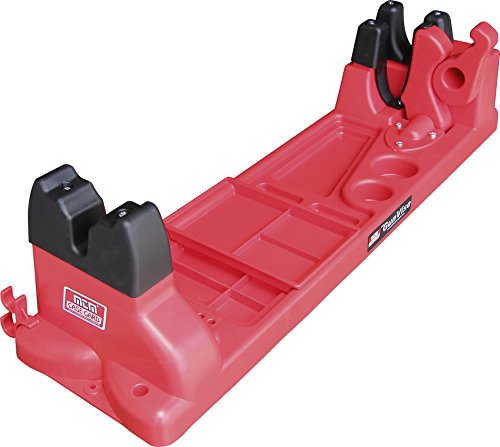
The GV-30 is MTM’s molded cleaning and maintenance center: a single-piece station in chemical- and solvent-resistant polypropylene, made in the USA, that holds a rifle or shotgun in rubber-padded forks. Clamping is handled by one cam-activated lever, which closes a secure, non-marring hold in a single motion — the fastest setup of any pick here, and a genuine convenience for quick cleaning sessions.
The forks offer high and low positions. Level, the gun sits flat for maintenance and scope work; sloped, the muzzle drops so solvent and debris drain forward during cleaning instead of pooling in the action. Storage is molded into the base: compartments of several sizes for patches, brushes, jags and solvent bottles, a slide-out tray, and molded bit holders for driver bits. Four skid-resistant rubber feet keep the station planted, and it can also be bolted down for a fixed bench position.
At about five pounds it is light enough to move between bench, garage and truck without thought. That lightness cuts both ways: the GV-30 is a cleaning and light-maintenance station, and its polymer frame is not built for torque-heavy work. Judged on its own terms — organized, quick, solvent-proof cleaning — it covers the most common jobs in this category with the least fuss.
Specs
- Model: GV-30
- Construction: Chemical- and solvent-resistant polypropylene
- Origin: Made in USA
- Clamp: Single cam-activated lever, non-marring rubber touch points
- Forks: High and low positions (level for maintenance, sloped for cleaning drainage)
- Storage: Molded compartments, slide-out tray and molded bit holders
- Feet: Four skid-resistant rubber feet; free-standing or bolt-down
- Dimensions: 32.5 x 9 x 7.5 in
- Weight: About 5 lb
5. Lyman Revolution Gun Vise

The Revolution is built around a capability none of the other picks offer: once the firearm is clamped, the whole hold can be rotated. The gun can be tilted to the left, to the right, or left upright, which changes the working angle for cleaning rods, action work and bore access without unclamping and repositioning the firearm. For tasks that alternate between the top, side and underside of a gun, that rotation removes a repeated setup step from every session.
Holding is done with padded clamp inserts in different shapes, so the contact points match stocks and receivers without marring them, and the front clamp can be secured or released with one hand. The uprights slide along a horizontal rail, giving continuous length adjustment for rifles, shotguns and handguns of different sizes, and cleaning rod holders are built into both sides of the base.
The rotating mechanism is also the design’s limit: rotation hardware favors access over absolute rigidity, so this is a cleaning, maintenance and scope-mounting vise rather than a torque tool. Buyers whose work is mostly routine upkeep across several different firearms, and who value reach and positioning over maximum clamping force, are the audience Lyman built it for.
Specs
- Type: Rotating gun vise
- Rotation: Clamped firearm tilts left, right or upright
- Clamping: Padded clamp inserts in multiple shapes; one-hand front clamp
- Adjustment: Uprights slide along a horizontal rail for length
- Extras: Cleaning rod holders on both sides of the base
- Compatibility: Rifles, shotguns and handguns
How to Choose the Right Gun Vise
Match the clamp style to the work. Sliding modular clamps (Tipton Best) reconfigure for the widest range of firearms. Articulating padded clamps on leveling feet (Tipton Ultra) suit careful scope mounting. A steel vise clamp (CTK P3) gives the firmest hold. A single cam lever (MTM GV-30) is fastest for routine cleaning, and a rotating hold (Lyman Revolution) wins when access angles matter more than clamping force.
Be honest about torque. Polymer stations are solvent-proof, light and full of storage, but they flex. Cleaning, parts fitting and scope work with a torque driver are fine; barrel nuts and seized barrels are not. That work needs a steel bench vise with action blocks, regardless of which station handles daily cleaning.
Check leveling if scopes are the priority. Reticle leveling is only as good as the surface the rifle is leveled against. Independently leveling feet or a leveling system that can be trued on the bench — as on the Ultra and the P3 — removes the benchtop itself as a source of cant.
Confirm compatibility in the listing. Break-open shotguns need supports that clear a hinged action; AR-pattern rifles benefit from stations that accept mag-well posts or wide front supports; handguns need clamps that close on short frames. Each listing above states its intended firearm types — match them to the guns actually owned.
Decide on storage and mounting. Molded compartments and trays keep solvents, brushes and bits at the bench instead of in a separate box, which matters for frequent short sessions. Bolt-down or benchtop mounting adds stability to any design; free-standing feet keep a station movable between workspaces.
Keep the rest distinction clear. A vise holds a gun for work. Firing belongs on a proper shooting rest or on a model whose maker explicitly designs it for both roles, used in the maker’s rest configuration.
FAQ
Can a gun vise be used as a shooting rest?
In general, no. Maintenance vises are work holders, and at least one maker in this list states in its own listing copy that its vise should never be used as a shooting rest. The exception is a model designed and sold by its maker for both duties, such as the CTK P3 with its included rest attachment, used in that configuration. Everything else should hold guns for cleaning and work only.
Is a gun vise rigid enough for barrel-nut work?
The polymer stations here are not, and they are not sold for that job — they flex under high torque by design trade-off. Barrel work calls for a steel bench vise with the correct action or barrel blocks. A steel gun vise like the P3 is the most rigid option in this group, but dedicated bench-vise hardware remains the right tool for maximum torque.
What matters most in a vise for scope mounting?
A hold that does not shift while rings are torqued, and a way to level the rifle itself: independently leveling feet or a leveling system that can be trued on an uneven bench. Padded, articulating clamp pads also help, since they grip oddly shaped stocks without marring the finish while the optic is aligned.
Will one vise fit rifles, shotguns and handguns?
Most of the picks here are listed for all three, but the fit works differently per design: sliding components, rail-mounted uprights or shaped clamp inserts do the adapting. Break-open shotguns and AR-pattern rifles are the two cases to check most carefully against a listing’s stated compatibility before buying.
Conclusion
For a mixed collection and mostly cleaning work, the Tipton Best Gun Vise adapts to the most firearms with the least reconfiguration. Scope mounting on an imperfect bench points to the Tipton Ultra and its leveling feet, while the CTK Precision P3 serves a fixed workshop that wants steel rigidity — and the only maker-designed rest conversion in the group. The MTM GV-30 covers fast, organized cleaning sessions in the lightest package here, and the Lyman Revolution suits owners who would rather rotate the gun than reposition it. Choose by the work actually done most often, keep torque-heavy jobs on proper bench hardware, and any of the five will hold a firearm steadier than a spare hand ever could.
More from Amazon
Programs that pair well with the guide above. Offers and eligibility are set by Amazon and may change.
Free shipping on eligible items, Prime Video and more. Eligible new members can start with a free trial.
Start a Prime free trialA Prime membership for ages 18-24 with a trial period. Eligibility is set by Amazon.
See Prime for Young AdultsAudiobooks and podcasts to listen to on the go. Eligible new members can start with a free trial.
Try Audible freeAd-free music streaming. Eligible new subscribers can start with a free trial.
Try Music Unlimited freeAs an Amazon Associate we earn from qualifying purchases.










Write Your Review
No reviews yet. Be the first to share your experience!