

Key takeaways
- The best glassware sets for camping and home are tempered, stackable sets in the 250–400 ml range: choose Duralex Picardie for the strongest all-round option, IKEA Pokal for low-cost everyday use, and a heavier barware set such as Libbey Gibraltar…
The best glassware sets for camping and home are tempered, stackable sets in the 250–400 ml range: choose Duralex Picardie for the strongest all-round option, IKEA Pokal for low-cost everyday use, and a heavier barware set such as Libbey Gibraltar when cocktails and entertaining matter more than pack weight.
Our top picks
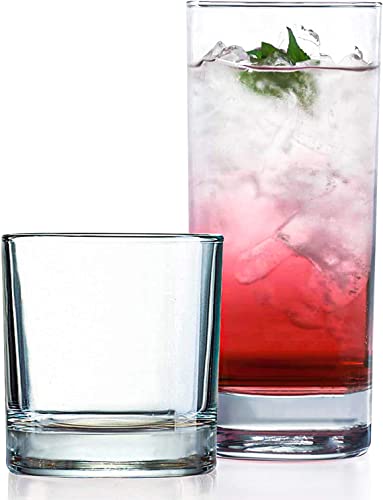

As an Amazon Associate we earn from qualifying purchases at no extra cost to you. Ratings are shown as listed on Amazon.
Quick comparison: the best glassware sets by use
| Set or glass type | Typical pieces | Common capacity | Approx. weight per glass | Best use | Main limitation |
|---|---|---|---|---|---|
| Duralex Picardie tempered tumblers | 4, 6, or 12 | 250, 310, 360, or 500 ml | 170–300 g | Camping, water, juice, wine, hot and cold drinks | Not as light or impact-proof as plastic |
| IKEA Pokal glasses | 6 commonly sold | 270 or 350 ml | 170–220 g | Budget home sets and occasional car camping | Less specialised for rough outdoor handling |
| Libbey Gibraltar tumblers | 4, 8, or larger food-service packs | 296 or 473 ml | 300–450 g | Cocktails, soft drinks, barbecue meals | Bulky and heavy in a backpack |
| Bormioli Rocco Rock Bar tumblers | Usually 4 or 6 | 275–370 ml | 250–350 g | Bar-style drinks and repeated home use | Thick bases reduce nesting efficiency |
| Stemless wine glasses, tempered or thick soda-lime glass | 4 or 6 | 350–470 ml | 250–400 g | Picnics, campsites with tables, wine and desserts | Wide rims and large bowls need more storage space |
Weights and capacities vary by size and production run, so use the figures as buying guidance rather than exact specifications. A four-glass set can weigh anywhere from about 700 g to 1.8 kg, which is a major difference when it travels beyond the car boot.
Our picks by camping situation
Best all-rounder: Duralex Picardie
The Picardie is the most versatile choice for people who want one set for the kitchen, garden, picnic table, and car camping. Its tempered glass is thicker and more resistant to everyday knocks than ordinary thin drinkware, while the faceted shape gives it a secure grip. The 250 ml and 310 ml versions are especially practical: they hold water, squash, beer, or a modest glass of wine without taking up excessive space.
Picardie glasses are also notably stackable. A set of six 250 ml glasses usually occupies much less cupboard space than six stemmed wine glasses or wide cocktail tumblers. They are dishwasher safe, and the simple shape has few grooves where food residue can collect. For tent camping, pack them in a rigid box with a towel between layers; tempered does not mean unbreakable.
Best budget choice for car camping: IKEA Pokal
Pokal is a sensible low-cost option when the glasses will mainly be used at home, in a campervan, or at a campsite reached by car. Its clear, uncomplicated design works for drinks and informal meals, and a six-piece set gives a household enough capacity for several people without buying specialised camping equipment.
Choose the smaller size if cupboard space is tight. The 350 ml version is more flexible for beer, iced drinks, and large servings, but six of them occupy more room in a camping crate. Pokal is better treated as everyday glassware than expedition equipment: use a lidded container, do not let glasses roll loose among cookware, and avoid placing a cold glass directly onto a hot stove or grill surface.
Best for barbecue drinks and cocktails: Libbey Gibraltar
Gibraltar tumblers suit a campsite kitchen, patio, or barbecue where a solid glass feels preferable to lightweight tableware. Their substantial bases and textured exterior make them comfortable for long drinks, mixed drinks, lemonade, and desserts. The larger 473 ml size is useful for ice-heavy drinks, but it is also the least convenient option for carrying.
This is a head-to-head choice against Duralex: Gibraltar generally wins for weight, stability, and bar presentation, while Picardie wins for compact storage and mixed drink-and-meal duties. Neither should be treated as safe to throw loose into a backpack. If the set will be carried more than a few metres from a vehicle, a reusable cup made from stainless steel or a durable polymer is usually more practical.
What matters more than the piece count
Capacity and actual serving size
A four-piece set is not automatically better for camping than a six-piece set. First decide whether each person needs one glass or two. For four people using one glass each, a six-piece set supplies two spares. That matters because outdoor breakage is more likely when glasses are placed on uneven tables, passed around, or washed at a shared sink.
Capacity is also measured to the rim, not to a comfortable serving level. A 310 ml tumbler may hold only 250–275 ml once ice, foam, or a safe gap below the rim is allowed. For ordinary water and juice, 250–360 ml is the most useful range. Larger 450–500 ml tumblers are better for beer and iced drinks but add weight and storage volume.
Glass thickness and break resistance
Tempered glass is preferable to thin decorative glass for outdoor use because it is designed to tolerate more everyday thermal and mechanical stress. Thick rims and reinforced bases also help with handling. However, impact resistance is not the same as shatterproof construction: a glass can still break if dropped onto stone, struck against a metal sink, or exposed to a sudden temperature change.
Look for straight-sided or gently curved tumblers rather than delicate stems, narrow necks, or very thin rims. Stemless wine glasses are easier to carry and less likely to tip, but their broad bowls can be awkward in crowded camp kitchens.
Stackability and storage
Stacking can reduce the cupboard footprint by roughly one-third to one-half compared with individual non-stacking glasses, depending on the design. Before buying, check whether the base of one glass actually fits inside the rim of another. Some glasses appear stackable but leave a large air gap, so a six-piece set still consumes considerable vertical space.
For transport, stack no more than three or four glasses unless the manufacturer specifically designs them for secure nesting. Put a thin tea towel, felt divider, or purpose-made foam sleeve between layers. A hard-sided crate is safer than a soft grocery bag because pressure from cookware can crack the top glass.
Decision matrix
| Your situation | Recommended format | Why | What to avoid |
|---|---|---|---|
| Backpacking or long portages | Do not choose glass; use metal or durable polymer | Even a four-glass tempered set can add 0.7–1.2 kg before protective packaging | Stemware and large 500 ml tumblers |
| First family car-camping set | Six 250–360 ml tempered tumblers | Enough pieces for four people plus two spares; easy to wash and store | Thin supermarket wine glasses |
| Small kitchen or campervan | Four to six stackable 250–310 ml glasses | Reduces cupboard height and limits unused capacity | Wide bowls and thick decorative bases |
| Frequent entertaining at home | Six to eight 350–475 ml bar tumblers | Handles ice, cocktails, beer, and soft drinks with fewer refills | Very small juice glasses |
| Picnics with wine and desserts | Four stemless glasses, preferably tempered | More stable than stemmed glasses and suitable for multiple foods | High stems and thin rims |
Dishwasher safety and ownership realities
Most mainstream tempered tumblers and thick bar glasses are dishwasher safe, but dishwasher safety does not mean unlimited life. Repeated high-temperature cycles can gradually dull printed decoration, loosen bonded labels, and make existing scratches more noticeable. Place glasses between prongs rather than over them, leave space so they cannot strike one another, and use a normal cycle when possible.
The first parts to show wear are commonly the rim, base edge, and any printed pattern. Tiny chips are not merely cosmetic: discard a glass with a sharp rim, visible crack, or deep star-shaped impact mark. Do not keep using a damaged glass because it still holds water.
At camp, rinse sand and grit away before wiping. Abrasive particles trapped in a cloth can scratch the surface, while pouring boiling water into a cold glass can create thermal shock. Let a glass warm or cool gradually, and never use ordinary drinkware directly on a stove, campfire, or hotplate unless it is specifically made for that purpose.
How to pack a glassware set safely
- Choose a rigid plastic or metal crate with a lid and enough clearance for the tallest glass.
- Line the bottom with a folded towel or closed-cell foam sheet.
- Wrap each glass individually, then nest only compatible shapes.
- Fill empty side spaces so the glasses cannot slide when the crate is lifted.
- Keep cookware, fuel bottles, and heavy food containers in a separate compartment.
- At camp, place the glasses on a level table away from the table edge and cooking area.
For a four-person trip, six 310 ml tumblers are often the best compromise: they provide two spares, suit drinks and small desserts, stack efficiently, and remain manageable for car camping. If the trip involves hiking with every item on your back, leave glass at home; the weight and breakage risk outweigh its advantages.



Write Your Review
No reviews yet. Be the first to share your experience!