

Key takeaways
- Compare the best fly tying kits and vises for beginners, from complete starter kits with materials to true rotary vises that hold hooks securely.
As an Amazon Associate we earn from qualifying purchases.
Affiliate Disclosure: This article contains affiliate links. If you buy a kit or vise through a link on this page, we may earn a commission at no extra cost to you. That is how we keep our gear guides free to read.
Tying your own flies is one of the most satisfying parts of fly fishing. The first Woolly Bugger you wrap yourself, however lumpy, fishes with a confidence no store-bought fly can match. But beginners face a confusing first purchase: a complete kit with vise, tools and materials in one box, or a standalone vise?
Here is the honest truth that shapes every pick below: the vise is the kit. A vise that wobbles on its clamp or lets hooks slip mid-wrap will frustrate you far more than any missing tool, and the bargain vises bundled into cheap kits are famous for both faults. Most kit tools are also replaced within a year as your hands learn what they actually need. That does not make kits a bad buy. A kit is the sensible way to learn whether you enjoy tying at all before committing to a standalone vise, and the good ones below pair a workable vise with tools that survive the learning curve.
1. WETFLY Deluxe Fly Tying Kit — Best Budget All-in-One Starter

The WETFLY Deluxe is the classic entry point: everything you need to tie your first flies tonight, packed into one case. It is built around a Super AA vise, a simple and proven clamp-on design that has introduced generations of anglers to tying. Around that vise you get the core hand tools and a starter spread of natural materials, plus hooks and both a book and a DVD that walk you through the fundamentals.
Specs
- 24-piece complete starter kit in a storage case
- Super AA vise with C-clamp mount
- Tools: scissors, hackle pliers, hair stacker, bobbin and bobbin threader
- Materials: hackle, dubbing, marabou, chenille and elk hair
- Hooks included in sizes 8, 12 and 14
- Instruction book and DVD included
Be clear about what you are getting. The materials lean heavily toward wet flies and nymphs, and the quantities are sampler-sized — enough to learn the patterns, not a season’s supply. The vise is a simple screw-jaw clamp model rather than a rotary, so you turn the fly by hand to see the far side. For a first kit at the modest end of the market, that is a fair trade: if tying sticks, you will know exactly which upgrade to buy next.
2. Orvis Premium Fly Tying Kit — Best Complete Kit for Serious Beginners
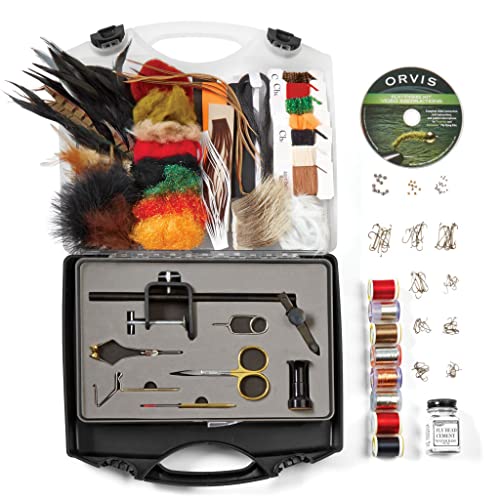
Orvis takes a different approach: instead of a random assortment, the Premium kit is a structured course in a case. It supplies materials for 16 patterns — eight basic and eight guide-proven premium patterns — with enough of everything to tie ten flies of each. The included instructional DVD, filmed by Tim Flagler of Tightline Productions, teaches each pattern step by step along with basic tool technique.
Specs
- Materials for 16 patterns, 10 flies each (160 flies total)
- 8 basic patterns and 8 premium patterns
- Starter vise with C-clamp mount
- Tools: ceramic-lined bobbin, scissors, bodkin, half-hitch tool, hackle pliers, hair stacker and whip finish tool
- Water-based head cement included
- Instructional DVD covering every pattern and tool use
- Hard carrying case
The detail that matters most here is the ceramic-lined bobbin. Beginners blame their hands when thread keeps snapping, but the usual culprit is a rough metal bobbin tube fraying the thread; a ceramic tube removes that problem from day one. The honest limits: the vise is still a starter-grade clamp vise, not a rotary, and once you finish the 16 course patterns you will be buying hooks and thread in the sizes you actually fish. Treat this kit as tuition plus a solid tool set, and it earns its place.
3. Griffin Odyssey Spider Vise — Best First Standalone Vise

If you already know you enjoy tying — or you tried a kit vise and hated the wobble — the Griffin Odyssey Spider is the classic first real vise. It is a true rotary model, meaning the hook shank stays on the axis of rotation as you spin the head, so wraps of hackle, dubbing and ribbing go on evenly instead of lopsided. The cam-operated jaws open and close with a lever rather than endless screw turning, which speeds up production tying noticeably.
Specs
- True rotary design with 360-degree rotation
- Cam-operated jaws with hook range from size 28 to 4/0
- C-clamp mount (pedestal base not included)
- Bobbin cradle included
- Steel and aluminum construction
- Made in the USA
- Lifetime warranty
The trade-offs are real. A few knobs and small fittings are plastic where pricier vises use metal, and the jaws are fixed rather than swappable, so there is no midge or saltwater jaw option later. It is also light — a fine travel vise, but less planted on the bench than a heavy pedestal model when you lean into thread tension.
4. Peak Rotary Vise with Pedestal Base (PRV-G2) — The Buy-It-Once Vise
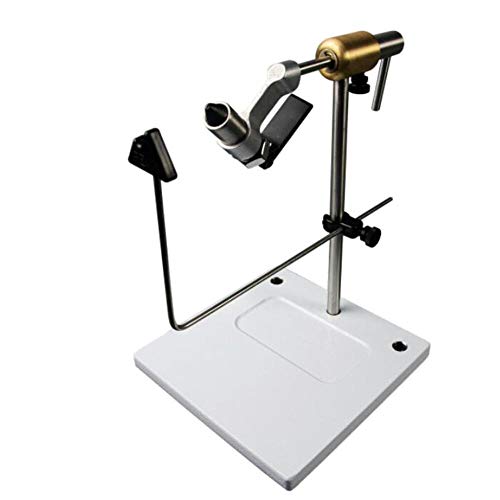
The Peak Rotary is what the “buy once, cry once” crowd is talking about. Everything about it is overbuilt: hardened and tempered tool steel jaws, a body machined from stainless steel, brass, tool steel and aircraft aluminum, and a broad powder-coated pedestal base that simply does not move while you tie. There is no clamp to fit and no wobble to manage — you set it on the bench and tie.
Specs
- True rotary design with adjustable rotation resistance
- Hardened and tempered tool steel jaws
- Hook range from 2/0 down to size 24
- Stainless steel, brass, tool steel and aircraft aluminum construction
- Large pedestal base with non-marking feet
- Integrated hook and bead pocket in the base
- Two accessory post mounting holes
- Adjustable bobbin cradle
- Optional midge and saltwater jaws available
- Made in the USA with a limited lifetime warranty
Because the jaws are hardened tool steel, they grip small hooks without the groove wear that soft jaws develop, and the optional jaw sets let the same vise grow from midges to saltwater patterns. The honest downsides are weight and commitment: this is a bench vise, not something you toss in a travel bag, and it costs more than the kits above before you have bought a single tool. For a beginner certain that tying will stick, though, it removes the vise from the list of things you will ever replace.
5. Griffin Montana Mongoose Vise — Most Versatile Vise

The Montana Mongoose answers the clamp-versus-pedestal question by refusing to ask it: both mounts are in the box. Use the pedestal on your bench at home, then swap to the C-clamp when you tie at a cabin table or a club night. It is a true rotary vise with hardened steel jaws and a set of locking and fine-tension screws that let you dial in exactly how freely the head turns and where it stops.
Specs
- True rotary design with 360-degree rotation
- Hardened steel jaws with hook range from 4/0 to size 28
- Both pedestal base and C-clamp included
- Locking screws and fine tension adjustment
- Bobbin cradle and material clip included
- Bobbin and bobbin threader included
- Padded storage case
- Made in the USA
That extra adjustability is a double-edged sword for a beginner: more screws mean more ways to set the vise up wrong, and your first sessions will involve some fiddling to find the tension you like. Once dialed in, it adapts to nearly any tying situation, and the included extras — cradle, clip, bobbin, threader and case — soften the fact that you still need scissors, hackle pliers and materials separately.
How to Choose the Best Fly Tying Kit or Vise
Start with the vise, not the box. In any kit, the vise does the one job that cannot be faked: holding a hook perfectly still while you pull thread tight against it. Watch for two faults — a clamp or base that rocks, and jaws that let a hook rotate or pop out under firm thread tension. A kit with a mediocre vise and great materials is a worse buy than a kit with a decent vise and modest materials, every time.
Treat kit materials as a sampler, not a supply. Even the generous Orvis kit above is a curriculum: enough hooks, thread and feathers to tie its set patterns and learn. The moment you settle on the three or four flies you actually fish, you will be ordering hooks and thread in those sizes separately. Budget for that refill from the start and a kit’s small material count stops being a disappointment.
Rotary matters once you wrap. For your first dozen flies — simple nymphs and wets — a fixed vise is fine. The moment a pattern asks you to wrap a body, wind hackle evenly or apply dubbing around the shank, true rotary earns its keep: the hook spins on its own axis so materials go on in smooth, even turns. If you expect to tie Woolly Buggers, streamers or any hackled dry, buy rotary now rather than re-buying later.
Kit or separate vise? Decide what you are testing. A complete kit tests whether you enjoy tying, at the lowest total commitment. A standalone vise tests nothing — it assumes you are in. If you have already tied on a friend’s bench or in a class and liked it, skip the kit stage and put the money into a Griffin or Peak vise plus a short list of quality tools.
Do not ignore the bobbin. More beginner frustration comes from thread control than from the vise itself. A bobbin with a rough or burred tube saws through thread mid-fly; a ceramic-lined tube glides instead. Make a ceramic bobbin one of your first tools, and adjust its tension by gently bending the arms rather than muscling the thread.
Clamp or pedestal? A C-clamp needs a table edge of the right thickness but holds the vise rock-solid and travels light. A pedestal sits anywhere and moves from bench to kitchen table freely, but a light pedestal can skate under hard thread pulls. The Mongoose sidesteps the choice by including both.
Frequently Asked Questions
Do beginners really need a rotary vise?
Not for the first handful of flies, but rotary quickly stops being a luxury. Any pattern with a wrapped body or wound hackle is easier and neater on a true rotary vise, and most beginners reach those patterns within their first month. If the budget allows one upgrade over a basic kit vise, rotary is the one to pick.
Is a kit or a separate vise better value for a beginner?
A kit, if you are unsure tying will hold your interest — you get a vise, tools, materials and instruction in one purchase, and even the tools you later upgrade remain as spares. A separate vise is better value if you already know you will tie regularly, because none of your money goes toward a starter vise you will replace within a year.
Why does my thread keep breaking while I tie?
Usually the bobbin, not your technique. A nicked or rough bobbin tube frays thread until it snaps, and a bobbin with its arms squeezed too tight adds drag you fight on every wrap. Switch to a ceramic-tube bobbin, ease the tension, and most thread problems disappear.
How long will the materials in a beginner kit last?
Plan on them covering the kit’s own patterns — roughly the first few dozen flies. They are teaching quantities. Once you know your home-water patterns, restocking hooks and thread in just those sizes is a small, ongoing cost of the hobby.
What hook sizes should a first vise handle?
Look for a jaw range that covers at least size 20 up to size 6, which spans most trout nymphs, dries and small streamers. Every vise in this guide exceeds that, reaching from the mid-20s into saltwater sizes, so hook range should not be the reason you outgrow any of them.
Conclusion
For most beginners, the decision is really about certainty. Unsure whether tying is for you? The WETFLY Deluxe kit gets you tying tonight for the smallest commitment, and the Orvis Premium kit adds a structured course and a better tool set, including that all-important ceramic bobbin. Already sure? Skip the starter stage: the Griffin Odyssey Spider is the affordable true-rotary benchmark, the Peak Rotary is the heavy, stable vise you buy once, and the Griffin Montana Mongoose covers every mounting situation with both bases in the box. Whichever you choose, judge every option by how still it holds a hook — the vise is the kit, and the flies will follow.
More from Amazon
Programs that pair well with the guide above. Offers and eligibility are set by Amazon and may change.
Free shipping on eligible items, Prime Video and more. Eligible new members can start with a free trial.
Start a Prime free trialA Prime membership for ages 18-24 with a trial period. Eligibility is set by Amazon.
See Prime for Young AdultsAudiobooks and podcasts to listen to on the go. Eligible new members can start with a free trial.
Try Audible freeAd-free music streaming. Eligible new subscribers can start with a free trial.
Try Music Unlimited freeAs an Amazon Associate we earn from qualifying purchases.










Write Your Review
No reviews yet. Be the first to share your experience!