

Our Short List of 3
- Construction: die-cast aluminum frame and spool
- Drag: spring-loaded clicker (no disc drag)
- Sizes: 2/3 and 4/5 weight
- Weight: about 2.7 oz (2/3) and 3.0 oz (4/5)

- Construction: CNC-machined aluminum alloy frame and spool
- Drag: multi-disc drag system
- Sizes: 3/4, 5/6, 7/8 and 9/10 weight
- Arbor: large arbor design
- Construction: die-cast aluminum frame and spool
- Drag: Teflon and stainless steel disc drag
- Sizes: 3/4, 5/6 and 7/8 weight
- Weight: about 4.96 oz (3/4)
All 4 Picks at a Glance
| Product | Specs | Action |
|---|---|---|
| Redington ZERO Fly Reel |
| Check price on Amazon |
| Piscifun Sword Fly Fishing Reel |
| Check price on Amazon |
| M MAXIMUMCATCH Maxcatch ECO Pre-Loaded Fly Reel |
| Check price on Amazon |
 Okuma SLV Fly Reel |
| Check price on Amazon |
Key takeaways
- The best fly reels for trout streams and small rivers: ultralight clicker reels, die-cast value picks and a CNC-machined option, with honest drag notes.
As an Amazon Associate we earn from qualifying purchases.
Here is the honest starting point for any trout reel guide: on most trout streams, the reel is mostly a line holder. The large majority of stream trout are hooked within a few rod lengths, played by stripping line in by hand, and never take a single yard of line off the spool against the drag. If that describes your fishing — and for small-stream and small-river trout, it usually does — then paying for a drag system built to stop saltwater fish is money spent on a feature you will rarely use.
That does not make the reel irrelevant. It changes what matters. A large arbor picks line up faster when a fish runs toward you and stores line in looser coils, so it comes off the spool with less memory and fewer tangles. The reel’s weight decides whether the rod balances in your hand or feels tip-heavy over a long day of casting. The frame decides whether the reel survives being dropped on streamside rocks, which is a matter of when, not if. And drag quality still matters in specific situations: a big river brown trout that bolts downstream, and fine tippets, where a drag that grabs before it slips — high start-up resistance — pops light line before the fish ever feels real pressure.
The five reels below are picked for trout streams and small rivers, and they make different honest trades among those priorities. One is an ultralight clicker reel with no drag at all. One is fully CNC-machined. The rest are die-cast value reels, two of which arrive pre-loaded with line. What none of them is: a sealed-drag saltwater reel. Fully sealed drags earn their keep in salt spray and gritty boat decks; in clean trout water they are a nice extra, not a requirement, and at the modest end of the market they are rare anyway.
Affiliate Disclosure: This article contains affiliate links. If you buy through a link on this page, we may earn a commission at no additional cost to you. That income helps keep the site running, and it does not change which products we include or what we say about them.
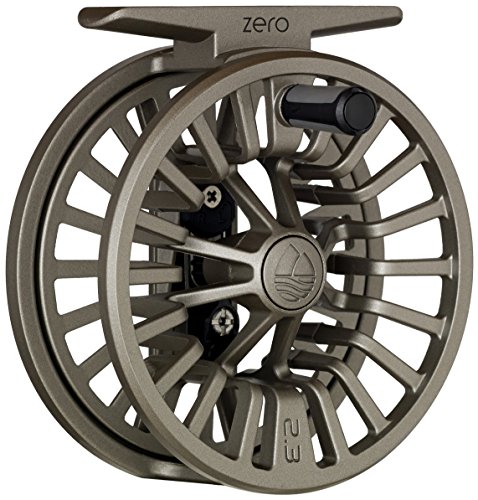
Redington ZERO Fly Reel
- Construction: die-cast aluminum frame and spool
- Drag: spring-loaded clicker (no disc drag)
- Sizes: 2/3 and 4/5 weight
- Weight: about 2.7 oz (2/3) and 3.0 oz (4/5)
The ZERO is the clearest expression of the line-holder argument in this guide. It has no disc drag at all — just a spring-loaded clicker that stops the spool overrunning and adds a little resistance, the same basic arrangement anglers used for a century. For small-stream trout on short rods, that is genuinely enough: you palm the spool rim if a better fish runs, and the rest of the time the reel’s job is to store line and stay out of the way.
What the ZERO does better than anything else here is disappear. The 4/5 size weighs about 3 ounces and the 2/3 about 2.7 ounces, making it one of the lightest reels in its class, thanks to a die-cast frame with a design Redington describes as un-machinable — the thin, skeletal shape can only be cast, not milled. The arbor is large, so line pickup is quick and coils come off loose. Retrieve converts between left and right hand, and the reel is covered by a lifetime warranty.
The honest caveats follow from the same design. A clicker is not a drag: a strong river fish that decides to run will take line as fast as it wants, and your only brake is your palm. And ultralight is not automatically better. Balance matters more than minimum weight — hang a 3-ounce reel on a long, heavier rod and the outfit feels tip-heavy and tiring. The ZERO shines on light 2- to 5-weight rods for creeks and small rivers, which is exactly the fishing this guide is about.
Piscifun Sword Fly Fishing Reel
- Construction: CNC-machined aluminum alloy frame and spool
- Drag: multi-disc drag system
- Sizes: 3/4, 5/6, 7/8 and 9/10 weight
- Arbor: large arbor design
The Sword is the machined option in this lineup, and it shows what stepping up from die-cast actually buys. The frame and spool are CNC-machined from aluminum alloy rather than cast, which means tighter tolerances, a smoother and more rigid spool, and a reel that shrugs off the dents and frame flex that eventually kill cast reels dropped on rock. The finish is anodized rather than painted, so it resists scratches and corrosion better over seasons of wet use.
The drag is a multi-disc system with a proper adjustment knob, smooth enough at low settings to protect light tippets and strong enough at the top end for the biggest trout a small river is likely to hold. This particular listing is the pre-loaded version: the reel arrives with a weight-forward floating line, backing, and leader already installed, which makes it a true ready-to-fish pick for a camper setting up a first trout outfit at the tailgate. The 3/4 size suits small streams; the 5/6 covers general river work.
Two honest notes. A machined reel is heavier than the ZERO and costs more than the die-cast picks here — you are paying for durability and finish, not for catching more fish. And while the anodizing and build tolerate freshwater abuse well, this is not a sealed-drag reel, so dunking it in silty water still calls for a rinse and dry afterward.
Redington Crosswater Fly Reel
The Crosswater takes the opposite approach to the Sword: instead of metal, the frame and spool are molded from a durable polymer composite. That sounds like a downgrade until you think about how trout reels actually die. They get dropped on rocks, stepped on in drift boats, and bounced around truck beds. A composite frame does not dent, does not chip paint, and does not corrode — it flexes a little and keeps fishing. It is also light, at about 5 ounces in the 4/5/6 size.
Unlike the ZERO, the Crosswater has a real disc drag, smooth at the low end where tippet protection happens. The arbor is large, the spool changes easily for a spare line, and the retrieve converts between hands. It comes in two sizes: the 4/5/6, which is the trout size for this guide, and a 7/8/9 aimed at bigger water and species. Pre-spooled versions exist on the listing if you want line included.
The trade-offs are feel and longevity of a different kind. A polymer reel never has the rigid, precise feel of a machined one, and the spool can flex slightly under heavy drag pressure — irrelevant for trout, worth knowing if you plan to stretch it to bigger fish. Warranty coverage is also shorter than the lifetime terms some rivals offer. As a first reel, a backup, or a camp spare that lives in the gear bin, it makes a strong case.
Specs
- Construction: durable polymer composite frame and spool
- Drag: disc drag system
- Sizes: 4/5/6 and 7/8/9 weight
- Weight: about 5 oz (4/5/6)
- Arbor: large arbor design
- Retrieve: convertible left/right hand
- Extras: easy-change spool; pre-spooled versions available
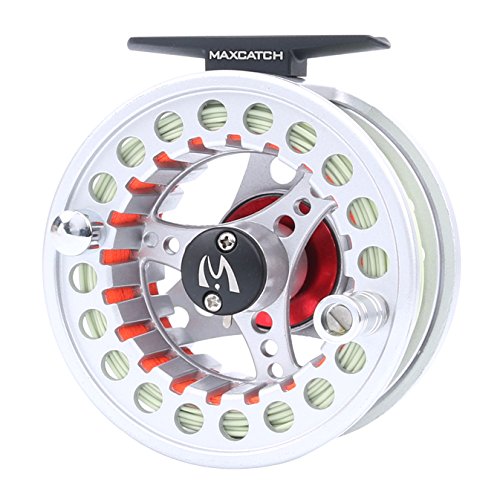
M MAXIMUMCATCH Maxcatch ECO Pre-Loaded Fly Reel
- Construction: die-cast aluminum frame and spool
- Drag: Teflon and stainless steel disc drag
- Sizes: 3/4, 5/6 and 7/8 weight
- Weight: about 4.96 oz (3/4)
The ECO is the budget workhorse of the group, and the reason it earns a place is simple: it arrives ready to fish. The die-cast aluminum reel comes pre-loaded with a weight-forward floating line, backing, and a tapered leader, so a beginner camping near trout water can be casting the same afternoon without a separate trip to rig line and backing. For a first outfit or a loaner rod for a friend at camp, that convenience is the whole point.
Underneath, the specs are respectable rather than fancy. The arbor is large, the drag is a Teflon-and-stainless disc system that is smooth enough for trout work and fine tippets, and the 3/4 size weighs just under 5 ounces with a diameter of about 2.95 inches. Sizes run 3/4, 5/6, and 7/8, all in the same straightforward design, and the retrieve converts for left- or right-hand winding.
Set expectations honestly. Die-cast construction at this level means rougher finishing than the Sword and a drag that is serviceable rather than silky; if you later fish big rivers where fish regularly take line, you will feel the difference in start-up smoothness. The included line is a starter line, fine for learning and small water. Judged as what it is — an inexpensive, complete, ready-to-fish reel for trout streams — it does its job.
Okuma SLV Fly Reel
- Construction: die-cast aluminum frame and spool
- Drag: multi-disc cork and stainless steel drag system
- Sizes: series runs from 2/3 up to 10/11 weight; SLV-56b covers 5/6
- Arbor: super large arbor design
The SLV is the pick for the angler whose small-river trips occasionally turn into something bigger — a lake-run fish moving upriver, or a stocked rainbow in heavy current that actually uses the drag. Its arbor is not just large but super large, the widest in this guide, which gives the fastest line pickup here and the loosest line storage. When a fish runs at you, that pickup speed is the difference between keeping tension and watching slack pile up.
The drag is a multi-disc system using cork and stainless washers, a traditional combination that is smooth, progressive, and easy to service. The frame and spool are die-cast aluminum — the SLV-56b size covers 5/6 lines, and the series runs from small-stream sizes up to heavy ones, so the same design scales if you add a bigger-water rod later. Retrieve converts between hands.
The compromises are weight and refinement. A super-large-arbor die-cast reel carries more metal than the ZERO or the Crosswater, and on a light creek rod it can tip the balance the other way, making the outfit feel reel-heavy — again, balance is the goal, not the lightest number. The drag is not sealed, so gritty water means a rinse at camp. For a general 5-weight river rod, though, this is the most capable all-rounder here.
How to Choose a Fly Reel for Trout Streams
Start with the fishing, not the drag. If your trout water is creeks and small rivers where fish are landed by hand-stripping, a clicker reel like the ZERO or a modest disc drag is honestly sufficient. Reserve drag performance as a deciding factor for bigger rivers, heavier fish, and fine tippets — there, low start-up resistance matters more than maximum drag strength, because the moment that breaks 6X tippet is the first jerk, not the sustained pull.
Choose balance over minimum weight. A reel should balance your rod near the front of the grip with line on the spool. Too light feels tip-heavy; too heavy feels dead in the hand. Ultralight reels suit short, light rods; a mid-weight reel often balances a 9-foot 5-weight better.
Take the large arbor. Every reel here has one, for good reason: faster retrieve, less line memory, fewer tangles. There is no downside for trout fishing beyond a slightly larger reel diameter.
Die-cast vs machined, honestly. Die-cast reels (and the Crosswater’s composite frame) are cheaper and entirely adequate for trout; they lose on long-term toughness and finish. CNC-machined reels like the Sword are more rigid, better finished, and survive years of drops — worth it for a reel you plan to fish hard for a decade, unnecessary for a starter or spare.
Don’t pay extra for sealing you don’t need. Sealed drags protect against salt and grit. In clean trout streams, an unsealed disc or clicker with a rinse-and-dry habit lasts for years. Spend the difference on line instead — line quality affects casting far more than reel drag does on small water.
Frequently Asked Questions
Do I really need a disc drag for trout?
Usually, no. Most stream trout never pull line off the reel, and a clicker reel with a palming rim handles the exceptions. A smooth disc drag becomes worth having on bigger rivers, with larger fish, or when you fish fine tippets and need the drag to start moving without a jerk.
What size reel should I match to a 5-weight rod?
A reel in the 4/5, 5/6, or 4/5/6 class — the middle sizes in this guide. Then check balance with line loaded: the outfit should feel neutral in hand, not tip- or butt-heavy. Size ratings vary a little between brands, so the balance check matters more than the label.
Is a large arbor worth it on a small-stream reel?
Yes. It picks up slack faster when a fish runs toward you, and line stored in wide coils has less memory, so it tangles less and shoots cleaner. Even on a tiny creek reel, there is no real downside.
Can I use one of these reels in saltwater?
These are freshwater picks. None has a fully sealed drag, and several have finishes not intended for salt exposure. An occasional rinsed-off outing will not destroy one, but regular saltwater use calls for a sealed-drag reel built for it.
Left-hand or right-hand retrieve — which should I choose?
Most anglers cast with their dominant hand and reel with the other, so right-handed casters usually wind with the left hand. All five reels here convert between the two, so you can switch as your preference settles.
Conclusion
For trout streams and small rivers, the best reel is the one that balances your rod, stores line on a large arbor, and survives being dropped — drag strength is a distant fourth for most of this fishing. Pick the ZERO if you want the lightest possible small-stream setup and are happy palming the spool. Pick the Sword if you want one machined reel that lasts. The Crosswater and the pre-loaded ECO are the sensible first reels and camp spares, and the Okuma SLV is the choice when your river sometimes produces fish that genuinely test a drag. Match the reel to the water you actually fish, and every pick here will do its job without pretending to be something it is not.
More from Amazon
Programs that pair well with the guide above. Offers and eligibility are set by Amazon and may change.
Free shipping on eligible items, Prime Video and more. Eligible new members can start with a free trial.
Start a Prime free trialA Prime membership for ages 18-24 with a trial period. Eligibility is set by Amazon.
See Prime for Young AdultsAudiobooks and podcasts to listen to on the go. Eligible new members can start with a free trial.
Try Audible freeAd-free music streaming. Eligible new subscribers can start with a free trial.
Try Music Unlimited freeAs an Amazon Associate we earn from qualifying purchases.
Write Your Review
No reviews yet. Be the first to share your experience!