

Key takeaways
- Compare the best biscuit joiners on fence range, biscuit sizes, dust control and power source for flush panels, cabinets, face frames and mitres.
As an Amazon Associate we earn from qualifying purchases.
A biscuit joiner does one job: it plunges a small spinning blade into the edge of two boards and cuts matching crescent-shaped slots. A compressed beech biscuit drops into each slot with glue, swells as the glue cures, and pulls the two faces flush while the joint sets. For edge-gluing panels, aligning a tabletop, or registering cabinet parts before clamping, nothing else works as fast.
The five joiners below cover the full spread of the class: three corded shop standards, one cordless model for site work, and one complete starter kit. Each pick is labelled by power source, because that choice shapes everything else — a corded tool never runs flat mid-glue-up, while a cordless tool earns its keep on installed cabinets and face frames where dragging a cord across finished work is a nuisance.
Affiliate Disclosure: This article contains affiliate links. If you buy through a link on this page, the site may earn a commission at no extra cost to you. That is how the site stays free to read.
The Picks at a Glance
- DEWALT DW682K — the corded benchmark: rack-and-pinion fence, preset stops, decades of shop use behind the design.
- DEWALT DCW682B — the cordless option on the 20V MAX platform, sold as a bare tool.
- Porter-Cable 557 — the fence champion, tilting to 135 degrees and cutting small face-frame biscuits with a second, smaller blade.
- Makita PJ7000 — the lightest corded pick, with the fastest blade speed of the group.
- WEN JN8504 — a complete kit with case and starter biscuits for a first joiner.
1. DEWALT DW682K — Best Corded Biscuit Joiner for Most Shops

The DW682K is the tool most woodworkers picture when the class comes up, and its design explains why. The dual rack-and-pinion fence moves both sides of the fence together, so the fence stays parallel to the blade instead of skewing the way single-post fences can. Preset depth stops click through the standard biscuit sizes, and an extra M setting plunges to maximum depth when a joint needs it.
Retractable anti-slip pins bite the workpiece face and keep the tool from skating sideways at the start of the plunge — a small feature that matters most on wide panels, where a slipped slot means a scrapped board. The fence tilts from 0 to 90 degrees and carries a locating notch for referencing 45-degree mitres off an outside corner. A 6.5-amp motor turning the blade at 10,000 RPM is comfortably enough for hardwoods; biscuit slots are shallow cuts, and this class rewards control rather than raw power.
Specs
- Power source: Corded
- Motor: 6.5 A
- No-load speed: 10,000 RPM
- Blade: 4 in carbide-tipped
- Fence tilt: 0–90 degrees, with 45-degree locating notch
- Biscuit sizes: #0, #10, #20, plus M maximum-depth setting
- Dust collection: Dust bag and vacuum port
- Weight: 6.6 lb
- Fence: Dual rack-and-pinion with retractable anti-slip pins
2. DEWALT DCW682B — Best Cordless Biscuit Joiner

The DCW682B takes the same joining system off the cord. It runs on DEWALT’s 20V MAX battery platform with a brushless motor, an electric brake that stops the blade quickly between cuts, and a paddle switch that works equally well in either hand — a genuine advantage when a cabinet carcass forces an awkward reach.
It keeps the dual rack-and-pinion fence from the corded tool, with tool-free depth, height and bevel adjustments, and the same #0, #10 and #20 depth settings plus a maximum setting that plunges to 25/32 in. Dust handling is the best thought-out here: a dust bag for quick work, an angled port, and an AirLock-compatible connection for a 35 mm extractor hose. At 5.5 lb without a battery it is the lightest tool in this roundup, though a fitted battery narrows that gap.
The catch is in the name: this is a tool-only listing. No battery, charger or biscuits are included, so it makes the most sense for a shop already running 20V MAX batteries.
Specs
- Power source: Cordless, DEWALT 20V MAX platform (tool only)
- Motor: Brushless
- No-load speed: 8,000 RPM
- Blade: 4 in
- Fence tilt: 0–90 degrees
- Biscuit sizes: #0, #10, #20, plus maximum-depth setting
- Max cutting depth: 25/32 in at maximum setting
- Dust collection: Dust bag, angled port and AirLock-compatible extractor port
- Weight: 5.5 lb (tool only)
- Fence: Dual rack-and-pinion, tool-free adjustments
3. Porter-Cable 557 — Best for Mitres and Face Frames

Most biscuit joiner fences stop at 90 degrees, which limits them to square work and simple mitres referenced off a corner. The Porter-Cable 557 tilts from 0 to 135 degrees, and that extra travel is the whole point of the tool: it lets the fence register against the inside face of an acute mitre, so picture frames, angled cabinet work and odd-geometry joints can be slotted without building a jig first.
The 557 also covers a biscuit size the rest of this list cannot. Alongside the standard 4 in blade for #0, #10 and #20 biscuits, the kit includes a 2 in blade that cuts slots for FF (face-frame) biscuits — smaller biscuits sized for narrow face-frame rails where a #0 slot would blow out the edge. A 7-amp motor is the strongest corded motor here, and the pivoting fence plate handles stock from either side of the fence. The trade-off is weight: at 7.5 lb it is the heaviest of the corded full-size picks, noticeable across a long run of panel slots.
Specs
- Power source: Corded
- Motor: 7 A
- No-load speed: 10,000 RPM
- Blades: 4 in standard blade plus 2 in blade for FF biscuits
- Fence tilt: 0–135 degrees
- Biscuit sizes: #0, #10, #20 and FF (face-frame)
- Dust collection: Dust bag and vacuum adapter
- Weight: 7.5 lb
- Fence: Pivoting fence plate system
4. Makita PJ7000 — Lightest Corded Pick
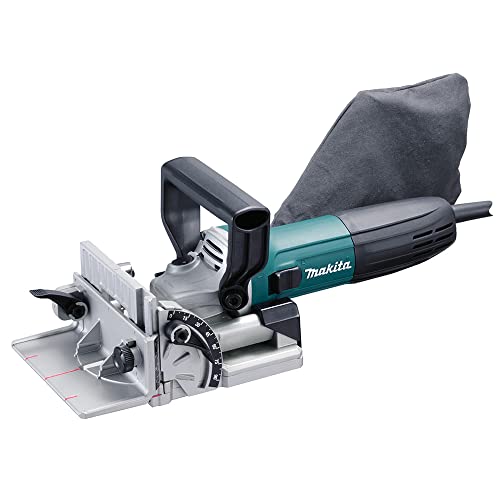
The PJ7000 is the precision-first corded option. At 5.5 lb it is easy to guide one-handed against a fence, and its 5.6-amp motor spins the blade at 11,000 RPM — the highest blade speed in this group, which leaves a clean slot wall in plywood and melamine where slower tools can fuzz the cut edge.
The cast aluminium fence pivots through 0 to 90 degrees with positive stops at the common angles, and the depth settings cover the three standard biscuit sizes. A rotatable dust nozzle points the bag or a vacuum hose away from the work instead of straight into it. There is no second blade and no face-frame setting, so narrow-rail work belongs to the Porter-Cable above; what the Makita offers instead is the most refined handling of the corded group for everyday panel and carcass work.
Specs
- Power source: Corded
- Motor: 5.6 A
- No-load speed: 11,000 RPM
- Blade: 4 in (100 mm)
- Fence tilt: 0–90 degrees
- Biscuit sizes: #0, #10, #20
- Dust collection: Dust bag on a rotatable nozzle
- Weight: 5.5 lb
- Fence: Cast aluminium pivot fence
5. WEN JN8504 — Best Starter Kit
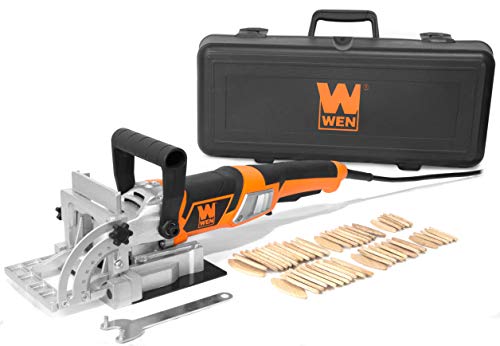
The JN8504 is built around a simple idea: everything needed for a first biscuit project in one case. The kit includes the joiner, a blow-mould carrying case, a detachable dust bag and 50 starter biscuits — a mix of #20, #10 and #0 sizes — so the first panel glue-up can happen the day the box opens.
On paper the motor is the biggest here at 8.5 amps, turning a 4 in carbide-tipped blade at 10,000 RPM, with preset stops for the three standard biscuit sizes and a fence that adjusts from 0 to 90 degrees with variable height settings. In practice the extra motor size is not the headline; the weight is. At 11.6 lb as listed, the WEN is far heavier than the Makita or the cordless DEWALT, which steadies the plunge but tires the arms on a long run of slots. For occasional panel work and a first set of cabinets, that trade is easy to accept.
Specs
- Power source: Corded
- Motor: 8.5 A
- No-load speed: 10,000 RPM
- Blade: 4 in carbide-tipped
- Fence tilt: 0–90 degrees
- Biscuit sizes: #0, #10, #20 preset stops
- Dust collection: Detachable dust bag
- Weight: 11.6 lb (as listed for the kit)
- Included: Carrying case and 50 biscuits (24 #20, 16 #10, 10 #0)
How to Choose a Biscuit Joiner
Be honest about what a biscuit does
A biscuit joint is an alignment system first and a strength upgrade second. The biscuit keeps two faces flush while the glue cures and adds a modest amount of long-grain glue surface across the joint line. That is genuinely useful — it is why tabletops stay flat through clamping — but a biscuit is not a structural tenon. It does not replace dowels, loose tenons or screws where a joint carries real load, such as chair rails, bed frames or a workbench apron. Treat biscuits as a way to make panel and carcass glue-ups faster and flatter, and they will not disappoint; ask them to hold a joint together on their own and they will.
Fence range: 90 degrees is enough, until it is not
For square panels, carcasses and tabletops, a 0–90 degree fence covers everything, and fence accuracy matters more than range: a rack-and-pinion fence that stays parallel to the blade produces slots that line up on both boards. The 135-degree fence on the Porter-Cable 557 only becomes important for mitred and angled work, where the fence needs to lean past vertical to register on the inside of an acute joint.
Biscuit sizes
Three sizes cover nearly all work: #0 for thin stock and small frames, #10 as the general-purpose middle, and #20 for thick panels and tabletops. Every joiner here cuts all three. Face-frame (FF) biscuits are the exception — they suit rails too narrow for a #0, and of these five tools only the Porter-Cable 557 cuts them, using its smaller 2 in blade.
Dust collection
Biscuit joiners make a surprising amount of dust for such a small cut, and a packed slot throws off depth. A dust bag is adequate for a few slots; for a full panel run, a vacuum port that fits a shop extractor keeps the fence face and depth stop clean. The cordless DEWALT’s AirLock port is the most complete answer here.
Corded or cordless
In a fixed shop, corded tools are lighter in the hand, never need a charged battery mid-glue-up, and include the three most proven designs in the class. Cordless earns its place on installed work — slotting a face frame or cabinet side that cannot come to the bench — and for anyone already invested in the battery platform, since the tool-only listing assumes batteries are on hand.
A note on safety records
Each model in this guide was checked against the CPSC recall database before inclusion. None of the five carries a recall. The only plate joiner recall on file is a 1995 Porter-Cable programme covering the older model 556 in specific serial ranges for a cord-plug fault; the 557 listed here is a different model and is not part of it. As with any plunge-cutting tool, let the blade reach full speed before plunging and keep the fence face flat on the work until the cut finishes.
Bottom Line
For most shops, the DEWALT DW682K remains the safe centre of the class: accurate fence, full size range, no battery questions. Choose the DCW682B if the work happens away from the bench and 20V MAX batteries are already on the shelf. The Porter-Cable 557 is the specialist pick for mitres and face frames, the Makita PJ7000 the lightest and cleanest-cutting corded tool, and the WEN JN8504 the easiest way to start, with case and biscuits in the box.
More from Amazon
Programs that pair well with the guide above. Offers and eligibility are set by Amazon and may change.
Free shipping on eligible items, Prime Video and more. Eligible new members can start with a free trial.
Start a Prime free trialA Prime membership for ages 18-24 with a trial period. Eligibility is set by Amazon.
See Prime for Young AdultsAudiobooks and podcasts to listen to on the go. Eligible new members can start with a free trial.
Try Audible freeAd-free music streaming. Eligible new subscribers can start with a free trial.
Try Music Unlimited freeAs an Amazon Associate we earn from qualifying purchases.










Write Your Review
No reviews yet. Be the first to share your experience!