

Key takeaways
- Compare the best bench vises for workshops and garages by jaw width, opening, throat depth, iron type, pipe jaws and swivel base before you buy.
As an Amazon Associate we earn from qualifying purchases.
A bench vise is the third hand every workshop and garage eventually needs. It holds a mower blade steady for sharpening, grips pipe while fittings are wrenched loose, and keeps flat bar still under a file or hacksaw. The right vise disappears into the job; the wrong one flexes, slips, or cracks the first time real torque goes through the handle.
The five vises below span the working range of the class, from a 4-inch general-purpose model for a home bench to an 8-inch ductile-iron shop vise for fabrication work. Each pick is labelled by jaw width and body material, because those two figures decide more than anything else: jaw width sets the size of work the vise can grip, and the iron it is cast from decides how much abuse it survives.
Affiliate Disclosure: This article contains affiliate links. If you buy through a link on this page, the site may earn a commission at no extra cost to you. That is how the site stays free to read.
The Picks at a Glance
- Wilton 11104 — the compact 4-inch pick: gray cast iron, a 120-degree swivel base and a lifetime warranty in a 16 lb package.
- Yost 750-DI — the multi-jaw 5-inch pick: ductile iron with bench jaws, pipe jaws and V-jaws in one rotating head.
- Forward DT08125A — the value 5-inch pick: 60,000 PSI ductile iron with a head and base that both rotate 360 degrees.
- Wilton 11106 — the 6-inch garage standard: cast iron, double lockdowns and a large anvil for everyday metalwork.
- Wilton Tradesman 1780A — the 8-inch heavy pick: ductile iron, a deep 4-3/4 inch throat and an enclosed spindle.
1. Wilton 11104 — Best Compact Bench Vise for Home Benches
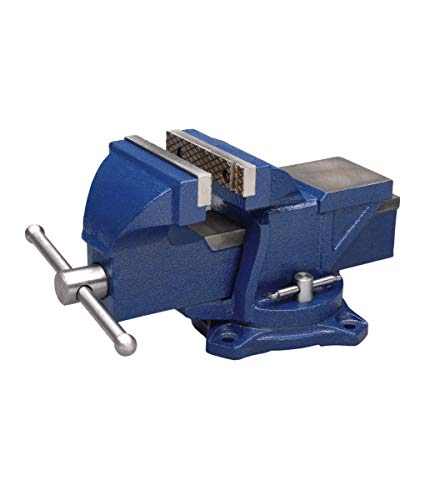
The 11104 is the smallest vise in Wilton’s General Purpose line, built around a gray cast iron body rated at 30,000 PSI tensile strength. For bike parts, mower blades, small engines and household repairs, four-inch jaws are the right scale: the vise takes up little bench, weighs 16 lb, and clamps with the authority of a larger tool.
The jaws open 3 inches with a 2-1/4 inch throat — the honest limit of this size class. Grooved steel jaw inserts grip without slipping and unbolt for replacement when the serrations dull. Behind the jaws sits a flat anvil area for light flattening and shaping. The base swivels 120 degrees and locks down at two points, enough rotation for most bench layouts without the play that looser bases develop. There are no pipe jaws on this model, so round stock sits in the serrated main jaws only. Wilton backs the line with a lifetime warranty, which is rare at this size.
Specs
- Jaw width: 4 in
- Max jaw opening: 3 in
- Throat depth: 2-1/4 in
- Body material: Gray cast iron, 30,000 PSI tensile strength
- Swivel base: 120 degrees, double lockdown
- Pipe jaws: No
- Anvil: Yes, flat work surface behind the jaws
- Jaw inserts: Grooved steel, replaceable
- Weight: 16 lb
- Mounting: Bolt-down base (mounting hardware not included)
- Warranty: Lifetime
2. Yost 750-DI — Best Multi-Jaw Bench Vise for Mixed Work

The 750-DI is built for benches where the work changes daily. Its castings are 65,000 PSI ductile iron — roughly twice the tensile strength of the gray iron in budget vises, and far less likely to crack under hammer blows or heavy handle torque. The head carries three separate jaw systems and rotates to bring each one into working position: serrated bench jaws for flat stock, pipe jaws rated from 1/8 inch to 3-1/2 inches, and V-jaws that hold round bar vertically.
The main jaws are 5 inches wide, open 5 inches, and the 4 inch throat depth is the deepest in this size class, so tall workpieces sit properly between the jaws instead of teetering at the top. All three jaw sets are hardened steel and replaceable. The base swivels a full 360 degrees and locks down, and a broad anvil sits behind the main jaws. The trade-offs are weight and complexity: at just under 60 lb it needs a stout bench and through-bolts, and a rotating head has more interfaces than a fixed one.
Specs
- Jaw width: 5 in
- Max jaw opening: 5 in
- Throat depth: 4 in
- Body material: Ductile iron, 65,000 PSI tensile strength, with hardened steel jaws
- Swivel base: 360 degrees with lockdown
- Pipe jaws: Yes, 1/8 in to 3-1/2 in capacity, plus V-jaws for vertical round stock
- Anvil: Yes
- Jaw inserts: Three replaceable hardened steel jaw sets (bench, pipe, V-jaw)
- Weight: 59.4 lb
- Mounting: Bolt-down base (mounting hardware not included)
3. Forward DT08125A — Best Value Ductile Iron Bench Vise
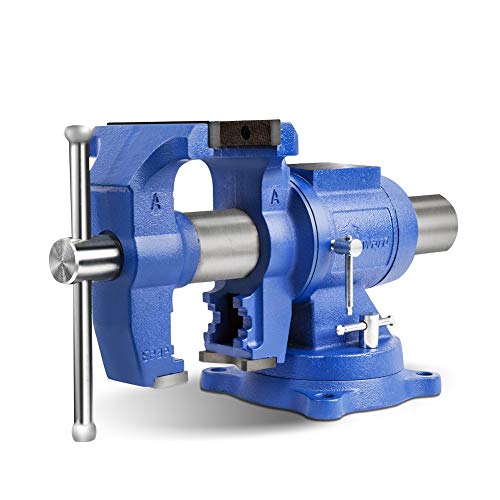
Forward builds this 5-inch vise from ductile iron rated at 60,000 PSI. Both the base and the head rotate 360 degrees, so a workpiece can be turned to almost any angle without unclamping — useful when a part needs filing on several faces or a pipe needs to stand vertical in the V-jaws.
The main jaws open a full 5 inches, matching the jaw width, with a 2.6 inch throat. Built-in pipe jaws handle stock from about 3/5 inch to 2-1/2 inches, and the flat anvil behind the jaws covers light shaping work. Forward states a clamping force of 5,500 lb; as the guide below explains, makers publish these figures without a shared test standard, so treat it as a within-brand guide, not a cross-brand verdict. At 33 lb the vise is manageable to mount, and the base takes four bolts through 9/16 inch holes.
Specs
- Jaw width: 5 in
- Max jaw opening: 5 in
- Throat depth: 2.6 in
- Body material: Ductile iron, 60,000 PSI tensile strength
- Clamping force: 5,500 lb (maker-stated; no shared industry test standard)
- Swivel base: 360 degrees; head also rotates 360 degrees
- Pipe jaws: Yes, approx. 3/5 in to 2-1/2 in capacity, plus V-jaws
- Anvil: Yes
- Weight: 33 lb
- Mounting: 4-bolt base, 9/16 in holes (mounting hardware not included)
4. Wilton 11106 — Best 6-Inch Bench Vise for Most Garages

The 11106 is the size most garage owners end up wishing they had bought first. Six-inch jaws, a 5 inch opening and a 3 inch throat cover the bulk of real work — exhaust pipe, angle iron, trailer parts — without the footprint of an 8-inch vise. The body is 30,000 PSI gray cast iron, and the design is a long-running one: double lockdowns on a 120-degree swivel base, grooved steel jaw inserts, and a large anvil work surface behind the jaws.
Gray cast iron is the honest compromise: strong and durable for clamping, filing, sawing and bending, but more brittle than ductile iron, so it asks for restraint with cheater bars and sledge work. Within those limits the 11106 is a vise that gets handed down: it weighs about 39 lb, mounts with ordinary bolts, and carries the same lifetime warranty as the rest of the General Purpose line. There are no pipe jaws, which is the main reason to step sideways to the Yost or Forward above if pipe work is routine.
Specs
- Jaw width: 6 in
- Max jaw opening: 5 in
- Throat depth: 3 in
- Body material: Gray cast iron, 30,000 PSI tensile strength
- Swivel base: 120 degrees, double lockdown
- Pipe jaws: No
- Anvil: Yes, large work surface
- Jaw inserts: Grooved steel, replaceable
- Weight: 39 lb
- Mounting: Bolt-down base (mounting hardware not included)
- Warranty: Lifetime
5. Wilton Tradesman 1780A — Best Heavy-Duty 8-Inch Bench Vise

The Tradesman line is Wilton’s professional series, and the 1780A is its largest bench model. The body is ductile iron, the jaws are 8 inches wide and open 6-3/4 inches, and the throat runs 4-3/4 inches deep — dimensions that swallow thick plate, large fittings and wide stock that simply will not fit the smaller vises here. Serrated steel jaw inserts are machined and replaceable, and pipe jaws are cast in below the main jaws for round work.
Two design details separate the Tradesman from general-purpose vises. The spindle runs enclosed, sealed against the grinding dust and metal chips that wear out exposed screws, and the slide is precision-machined so the jaw travels without the slop that makes fine work frustrating. The base swivels 360 degrees. At 88 lb this is a bolt-it-and-leave-it tool: it needs a heavy bench, through-bolts with backing, and a plan for getting it onto the benchtop. For a fabrication or farm shop that will use it daily for decades, that is exactly the point.
Specs
- Jaw width: 8 in
- Max jaw opening: 6-3/4 in
- Throat depth: 4-3/4 in
- Body material: Ductile iron
- Swivel base: 360 degrees
- Pipe jaws: Yes, cast in below the main jaws
- Anvil: Yes
- Jaw inserts: Serrated steel, precision-machined and replaceable
- Spindle: Enclosed design, sealed against dust and chips
- Weight: 88 lb
- Mounting: Bolt-down base (mounting hardware not included)
- Warranty: Lifetime
How to Choose a Bench Vise
Start with jaw width, then check opening and throat. Jaw width is the number in the model name, but it is not the whole story. A 6-inch vise that opens only 5 inches cannot grip a 5-1/2 inch workpiece, and throat depth decides how far down a tall piece sits between the jaws. Four inches suits hobby benches, five is the all-round home-shop size, six is the garage standard, and eight is for fabrication, thick plate and large pipe.
Cast iron vs ductile iron is the strength decision. Gray cast iron, typically rated around 30,000 PSI tensile strength, is rigid and durable for ordinary clamping but brittle: it can crack under heavy hammering or a cheater bar on the handle. Ductile iron at 60,000 PSI and above flexes slightly instead of cracking, which is why the heavy-duty and multi-jaw picks above use it. Forged steel sits above both where it is offered. Match the material to the work honestly — a vise used for filing and assembly never needs ductile iron; a vise used for bending bar stock and pressing bearings does.
Read clamping force numbers with care. Makers publish clamping force figures, but there is no shared industry test standard behind them, so a force number only compares meaningfully within one maker’s range. Jaw width, opening, throat depth and body material are the figures that can be compared across brands.
Swivel bases and rotating heads trade rigidity for angles. A 120-degree base covers most bench layouts and usually locks down tighter than a full 360-degree base. Rotating heads, like the ones on the Yost and Forward picks, add pipe and V-jaw positions at the cost of extra moving interfaces. Double lockdowns are worth having either way.
Mounting decides how strong the vise really is. Every vise here bolts down, and mounting hardware is generally not included. Through-bolts with large washers and nuts hold far better than lag screws, the fixed jaw should overhang the bench edge slightly so long stock can hang vertically, and the bench itself must be heavy or anchored.
A note on recalls: the CPSC recall database was checked for bench vises and for each maker named here before publication, and no recalls cover any of the five models or their families.
Bench Vise FAQ
What size bench vise is best for a home garage?
A 5- or 6-inch vise covers nearly everything a home garage produces, from mower blades to exhaust pipe. Choose 5 inches if bench space is tight, 6 inches if automotive and equipment work is routine.
Can a bench vise hold pipe and round stock?
Yes, with the right jaws. Serrated flat jaws grip small round stock insecurely; dedicated pipe jaws or V-jaws, like those on the Yost 750-DI and Forward DT08125A, are the proper tool, each with a stated capacity range to stay within.
Is ductile iron worth choosing over cast iron?
For hammering, bending and high handle torque, yes — ductile iron tolerates shock that can crack gray cast iron. For holding work during filing, sawing and assembly, cast iron serves for decades.
How should a bench vise be mounted?
Bolt it through the benchtop near an edge, fixed jaw slightly overhanging so long pieces can hang down, using through-bolts with washers and nuts rather than lag screws.
Bottom Line
For most garages, the Wilton 11106 hits the balance: 6-inch jaws, honest cast iron construction and a lifetime warranty. Benches that see pipe and round stock as often as flat work should take the Yost 750-DI and its three jaw systems, while the Forward DT08125A adds ductile iron and a rotating head. The Wilton 11104 keeps small benches capable; the Tradesman 1780A is the buy-once answer for heavy fabrication. Match the jaw width and the iron to the work, bolt it down properly, and a bench vise becomes the longest-serving tool in the shop.
More from Amazon
Programs that pair well with the guide above. Offers and eligibility are set by Amazon and may change.
Free shipping on eligible items, Prime Video and more. Eligible new members can start with a free trial.
Start a Prime free trialA Prime membership for ages 18-24 with a trial period. Eligibility is set by Amazon.
See Prime for Young AdultsAudiobooks and podcasts to listen to on the go. Eligible new members can start with a free trial.
Try Audible freeAd-free music streaming. Eligible new subscribers can start with a free trial.
Try Music Unlimited freeAs an Amazon Associate we earn from qualifying purchases.










Write Your Review
No reviews yet. Be the first to share your experience!