

Key takeaways
- ED glass: Reduces colour fringing around dark birds against bright skies. It is helpful, but ED glass alone does not guarantee a great image.
- Phase-corrected roof prisms: Important in modern roof-prism binoculars because they preserve contrast and resolution.
- Fully multi-coated lenses: Improve light transmission and reduce reflections. Look for this wording rather than simply “coated optics.”
- Close focus: Around 2 metres or less is useful for butterflies, nearby birds, and garden feeders.
- Eye relief: Aim for about 15–18 mm if you wear glasses. Twist-up eyecups should stay in their selected positions.
- Waterproof and nitrogen-filled construction: Helps prevent internal fogging during changing weather, but it does not make the binoculars indestructible.
- Open-bridge or magnesium construction: Can improve grip and reduce weight, while polycarbonate bodies may offer good value and impact resistance.
The best birding binoculars for most people are 8×42 models: they provide a wide, steady view, enough light for dawn and woodland, and a manageable balance of magnification, lens size, and weight.
Our top picks
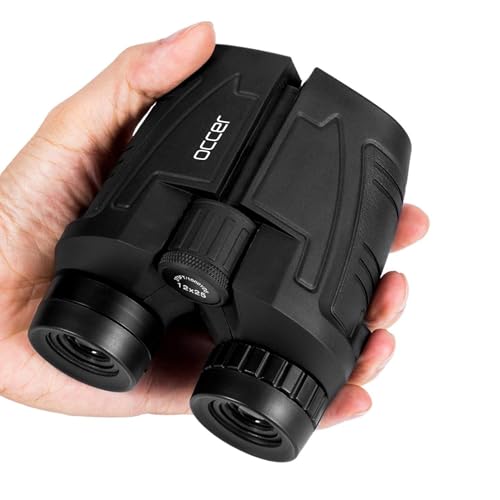

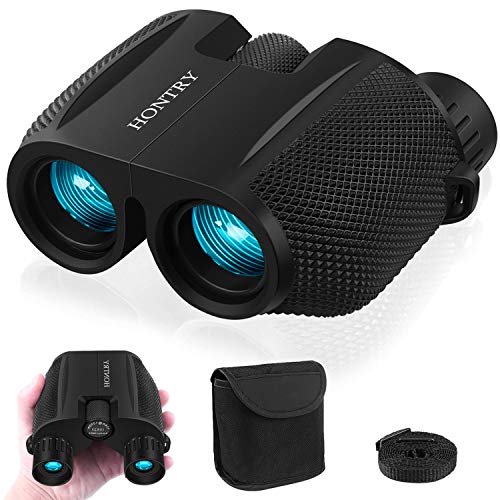
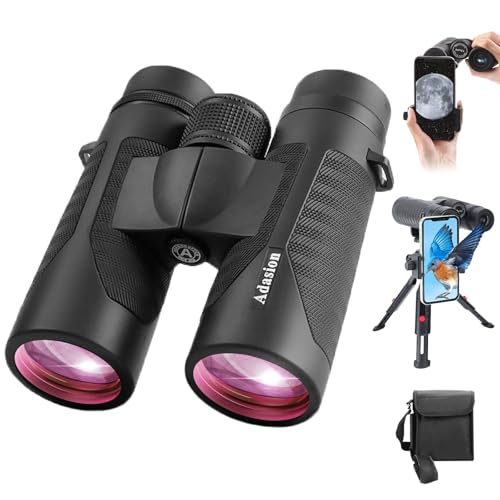
As an Amazon Associate we earn from qualifying purchases at no extra cost to you. Ratings are shown as listed on Amazon.
Best Birding Binoculars for Clear Views and Comfort
Choosing binoculars for birds is less about buying the highest magnification and more about matching the optical format to how and where you bird. An 8×42 binocular has 8x magnification and 42 mm objective lenses; a 10×42 shows more detail at distance but usually has a narrower field of view and is harder to hold steady. Smaller 8×32 models are lighter and easier to carry, while premium 8×42 binoculars deliver better edge sharpness, focus feel, and low-light performance at a much higher price.
Quick picks by birding situation
| Birding situation | Recommended format or model type | Why it fits | Typical market range |
|---|---|---|---|
| First binoculars, mixed habitats | 8×42 roof prism, such as Vortex Diamondback HD 8×42 or Nikon Monarch M5 8×42 | Wide enough view, useful brightness, forgiving handholding | About $200–$350 |
| Lightweight hiking and travel | 8×32 roof prism | Often 450–600 g, with less neck and pack strain | About $150–$900 |
| Long sessions and open-country birds | 10×42 roof prism | Extra reach for shorebirds, raptors, and distant waterfowl | About $250–$2,500 |
| Frequent, serious birding | Premium 8×42, such as Swarovski NL Pure 8×42 or Zeiss SFL 8×40 | Excellent contrast, broad fields, refined focus, and durable construction | About $1,500–$3,500 |
| Strong value with a wide view | Kowa BD II XD 8×42 or Celestron Nature DX ED 8×42 | Useful field of view and ED glass without premium pricing | About $200–$700 |
8×42 versus 10×42 versus 8×32
8×42: the safest all-purpose choice
For a beginner, 8×42 is usually the easiest format to learn with. The lower magnification makes it simpler to find a moving warbler, keep a perched bird in view, and follow flight. A typical 8×42 has an exit pupil of 5.25 mm, calculated by dividing 42 by 8. That generous light beam is useful in shaded forest and during the first or last hour of daylight.
The trade-off is weight. Many mid-priced 8×42 binoculars weigh approximately 650–750 g. They occupy more space than compact binoculars and can feel tiring when carried on a casual walk without a strap or harness.
10×42: more detail, less forgiveness
Ten-power binoculars can separate feather markings at greater distances, especially across wetlands, grassland, and reservoirs. Their 4.2 mm exit pupil is still practical for daytime birding. However, hand tremor is magnified too, and a bird may be harder to locate because the field of view is commonly narrower.
For example, a typical 8×42 may show about 7.5–8.5 degrees of view, equivalent to roughly 131–149 metres at 1,000 metres. A typical 10×42 may show about 6.0–6.8 degrees, or approximately 105–119 metres at 1,000 metres. That difference matters when a bird flies into a dense shrub and you need to reacquire it quickly.
8×32: the comfort specialist
An 8×32 binocular often weighs 450–650 g and can be much more pleasant for hiking, travel, and all-day events. Its 4 mm exit pupil is adequate in daylight, but the smaller objectives collect less light in deep shade. A good 8×32 may still provide a broad view of around 7.5–8.5 degrees, so it can be excellent for woodland in daylight.
Choose 8×32 when portability determines whether you will actually carry the binoculars. Choose 8×42 when dawn, dusk, dense canopy, or general-purpose use is more important than saving a few hundred grams.
Head-to-head: useful binoculars at different budgets
Vortex Diamondback HD 8×42
This is a practical entry-level roof-prism option with phase-corrected prisms, waterproof construction, and a generally forgiving 8x view. The weight is around 600–650 g depending on the current version and supplied accessories. It suits beginners who want a versatile binocular with a strong service and warranty reputation, though premium models usually deliver a cleaner image at the edges and a smoother focus mechanism.
Nikon Monarch M5 8×42
The Monarch M5 8×42 is a balanced mid-range choice, commonly weighing around 630 g and offering a field of view close to 8 degrees. Its ED glass helps control colour fringing on high-contrast subjects such as birds against bright sky. It is a good fit for regular birders who want a noticeable optical step up from basic binoculars without entering luxury pricing.
Celestron Nature DX ED 8×42
The Nature DX ED 8×42 typically offers a broad field of view and a relatively accessible price. It can make a sensible first purchase for woodland and general nature observation. Its body and focus controls are not as refined as those on premium binoculars, and individual models can differ in edge performance, but the format provides the key beginner-friendly traits: 8x magnification, 42 mm objectives, and a wide view.
Zeiss SFL 8×40 and Swarovski NL Pure 8×42
These premium binoculars demonstrate what extra budget buys. The Zeiss SFL 8×40 uses smaller objectives than a conventional 8×42, reducing weight while retaining a generous field of view. The Swarovski NL Pure 8×42 is known for a particularly wide view, high contrast, and an ergonomic design. Depending on configuration, premium models may weigh roughly 640–850 g, so “premium” does not automatically mean “light.” The benefits are more consistent edge clarity, colour neutrality, focus precision, build quality, and long-term serviceability.
What the field-of-view number really changes
Field of view is one of the most important specifications for birds, yet it is easy to overlook. Manufacturers may state it in degrees or as metres at 1,000 metres. To convert degrees approximately, multiply the angular field by 17.45. Thus, an 8-degree binocular covers about 140 metres at 1,000 metres.
A wide field helps with three tasks: finding a bird quickly, tracking a bird in flight, and scanning a flock. A narrower field can still be preferable when distant detail is the priority, but it demands better pointing technique. If you are new to binoculars, prioritise a field of at least about 7.5 degrees for an 8x model, provided the image remains sharp enough for your needs.
Optical and physical features worth paying for
- ED glass: Reduces colour fringing around dark birds against bright skies. It is helpful, but ED glass alone does not guarantee a great image.
- Phase-corrected roof prisms: Important in modern roof-prism binoculars because they preserve contrast and resolution.
- Fully multi-coated lenses: Improve light transmission and reduce reflections. Look for this wording rather than simply “coated optics.”
- Close focus: Around 2 metres or less is useful for butterflies, nearby birds, and garden feeders.
- Eye relief: Aim for about 15–18 mm if you wear glasses. Twist-up eyecups should stay in their selected positions.
- Waterproof and nitrogen-filled construction: Helps prevent internal fogging during changing weather, but it does not make the binoculars indestructible.
- Open-bridge or magnesium construction: Can improve grip and reduce weight, while polycarbonate bodies may offer good value and impact resistance.
Ownership realities: keeping binoculars clear and reliable
Dust and grit usually cause more everyday trouble than rain. Do not wipe dry particles across the objective lenses. First use a blower, then a soft lens brush, and only afterward a clean optical cloth or lens tissue with a small amount of suitable lens cleaner. Avoid household glass cleaner, tissues, clothing, and repeated rubbing.
The parts most likely to wear first are eyecup mechanisms, strap connectors, focus-wheel coverings, and protective lens caps. A loose eyecup can change eye relief; a stiff or gritty focus wheel can make it difficult to follow a bird. Store binoculars dry, leave them uncapped until surface moisture has evaporated, and use the case for long-term storage rather than sealing damp equipment inside it.
A harness can make a 700 g binocular feel more comfortable than a narrow neck strap, especially on long walks. For occasional garden use, however, a lighter 8×32 may be the better investment because it is easier to keep beside a window or carry spontaneously.
Bottom line
Buy an 8×42 roof-prism binocular if you want one dependable instrument for most birding. Select an 8×32 when low weight and portability will determine how often you use it. Move to 10×42 for distant birds in open habitats only if you can accept a narrower view and more demanding handholding. For frequent birders, premium 8×40 or 8×42 binoculars can justify their cost through better ergonomics, optical consistency, and long-term service rather than magnification alone.





Write Your Review
No reviews yet. Be the first to share your experience!