

Key takeaways
- Neutral shoes: The sole is comparatively flat. They are comfortable for beginners, slabs, cracks, and long routes, and encourage precise footwork without forcing the toes into a powerful position.
- Moderate downturn: The toes point slightly downward, helping on overhangs while retaining useful edging and comfort. This is the most versatile performance category.
- Aggressive downturn: The shoe curves strongly under the toes. It can improve toe engagement on steep terrain and small footholds, but usually sacrifices comfort and is unnecessary for most first-time climbers.
- Asymmetry: The toe points toward the big toe. Moderate asymmetry can concentrate force on small edges; high asymmetry may feel powerful but is less forgiving for wide feet or extended wear.
The best climbing shoes are the ones that match your climbing discipline, foot shape, and tolerance for discomfort—not necessarily the most aggressive or expensive pair.
Quick picks by climbing situation
| Climber or route type | Best starting choice | Fit and shape | Why it works | Typical 2026 price |
|---|---|---|---|---|
| First pair, indoor or outdoor beginner | La Sportiva Tarantulace | Moderate shape, neutral downturn, lace-up | Adjustable fit, comfortable flat platform, durable rubber | $80–$110 |
| Beginner wanting fast adjustments | Scarpa Origin | Neutral, relatively flat | Soft upper and hook-and-loop closure make it easy to put on and remove | $90–$120 |
| Indoor bouldering and steep gym problems | La Sportiva Solution Comp | Strong downturn, asymmetric toe, highly sensitive | Powerful toe engagement and precise heel for modern bouldering | $190–$220 |
| Sport climbing on small edges | Scarpa Vapor V | Moderate downturn and moderate asymmetry | Balances edging support, sensitivity, and all-day usability | $170–$200 |
| Long multi-pitch routes | La Sportiva TC Pro | Mostly neutral, supportive midsole | Comfort and edging stability reduce fatigue over many pitches | $200–$240 |
| Wide feet or high-volume toes | Butora Endeavor Wide | Neutral, wider last | Roomier forefoot without requiring an oversized shoe | $100–$130 |
What separates the best climbing shoes?
Fit comes before downturn
A climbing shoe should feel snug everywhere, with no dead space around the heel, arch, or toe box. Your toes may be gently curled, but sharp pain, numbness, or pressure on one toe is a sign that the shape is wrong. A smaller size cannot fix a last that does not suit your foot.
Our top picks


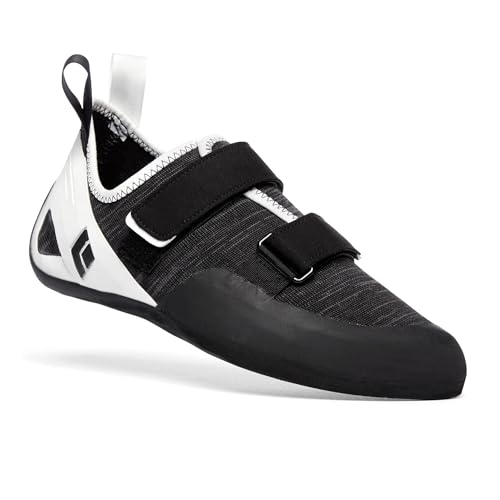

As an Amazon Associate we earn from qualifying purchases at no extra cost to you. Ratings are shown as listed on Amazon.
Street-shoe sizing is only a starting point. Depending on the brand, upper material, and intended use, climbers may wear the same size as their street shoe, size down slightly, or size up in a performance model. Synthetic uppers usually stretch less than leather, while unlined leather can relax noticeably with use. Try shoes at the end of the day, when feet are slightly larger, and test both feet while standing.
For a first pair, aim for secure comfort after five to ten minutes of wear. Advanced climbers may accept a tighter fit for short bouldering attempts, but a painful shoe rarely improves technique or makes a long session productive.
Downturn and asymmetry
- Neutral shoes: The sole is comparatively flat. They are comfortable for beginners, slabs, cracks, and long routes, and encourage precise footwork without forcing the toes into a powerful position.
- Moderate downturn: The toes point slightly downward, helping on overhangs while retaining useful edging and comfort. This is the most versatile performance category.
- Aggressive downturn: The shoe curves strongly under the toes. It can improve toe engagement on steep terrain and small footholds, but usually sacrifices comfort and is unnecessary for most first-time climbers.
- Asymmetry: The toe points toward the big toe. Moderate asymmetry can concentrate force on small edges; high asymmetry may feel powerful but is less forgiving for wide feet or extended wear.
Closure systems
Laces offer the most precise adjustment and can accommodate uneven foot volume. They are a strong choice for beginners, crack climbing, and multi-pitch routes, although they take longer to remove between attempts.
Hook-and-loop straps are convenient for bouldering and gym sessions. A two-strap design is quick and adjustable, while a single strap often prioritizes simplicity and flexibility. Check that the straps do not press into the ankle when heel-hooking.
Slip-on shoes provide excellent sensitivity and a low-profile feel, but the fit must be exceptionally accurate. They are often less suitable for beginners because there is little adjustment range.
Best climbing shoes by experience level
Beginners: choose comfort and feedback
The La Sportiva Tarantulace, Scarpa Origin, and Evolv Defy are sensible first-pair categories because they use relatively flat profiles, forgiving uppers, and enough rubber for indoor walls and easy outdoor routes. Their neutral shape lets you learn to place your feet accurately instead of depending on an aggressive toe box.
Expect to pay roughly $80–$130. Spending more on a steeply downturned shoe rarely compensates for poor fit or undeveloped technique. A beginner may also prefer a shoe that can be worn for an entire session rather than one that must be removed every few minutes.
Bouldering: prioritize sensitivity and heel-toe control
Bouldering involves short, powerful movements, smearing, toe hooks, heel hooks, and steep wall climbing. Shoes such as the La Sportiva Solution Comp, Scarpa Drago LV, and Tenaya Mundaka suit climbers who already understand how a tight performance fit should feel.
Soft rubber and a flexible midsole let the foot conform to volumes and small irregularities. The trade-off is reduced support when standing for a long time on tiny vertical edges. Aggressive downturn and a precise heel can help on steep problems, but these shoes are not automatically better on slabs or long routes.
Sport climbing: look for balance
Sport climbing rewards a shoe that can edge on small holds, smear on polished sections, and remain wearable through multiple attempts. The Scarpa Vapor V, La Sportiva Katana, and Tenaya Oasi occupy useful moderate-performance territory, although their fit differs significantly by brand and foot shape.
A moderately downturned shoe with medium-stiff rubber is often the best compromise. It supports edging without making slabs awkward, and it gives more useful feedback than a heavily padded beginner model. For redpoint attempts, a tighter fit may be reasonable; for a full day of climbing, leave enough room to avoid distraction from pressure.
Multi-pitch: comfort is performance
On a long route, the best climbing shoes are rarely the most aggressive ones. The La Sportiva TC Pro is designed around edging stability, crack compatibility, and extended wear. Other neutral or lightly downturned lace-up shoes can work equally well if they fit your foot.
Choose a supportive sole, a secure heel, and an upper that does not create hot spots. You may need to stand in the shoes for hours, belay in them, and walk between pitches. A shoe that is slightly less powerful but comfortable can improve the entire day more than a highly aggressive model that forces frequent removals.
Rubber, edging, and durability compared
| Feature | What to look for | Main benefit | Trade-off |
|---|---|---|---|
| Harder rubber, about 4–5 mm | Firm edging platform | Stability on small footholds and longer wear | Less sensitivity and poorer adaptation to rounded volumes |
| Medium rubber, about 3.5–4.5 mm | Balanced compound and thickness | Versatility for sport climbing and mixed indoor use | Not the absolute best at either sensitivity or durability |
| Soft rubber, about 2.5–4 mm | Flexible sole and sensitive toe | Smearing, toe hooks, volumes, and steep boulders | Faster wear and less support on tiny edges |
Rubber brand names are not a complete performance specification. Vibram compounds such as XS Edge and XS Grip2, along with proprietary compounds from major manufacturers, are tuned for different balances of friction, stiffness, and durability. A hard compound may edge confidently but feel less sticky on a smooth volume; a soft compound may grip well but deform sooner.
The toe patch and rand matter as much as the sole. Climbers who frequently toe-hook should inspect the rubber coverage over the upper. Climbers who jam cracks should seek a protected rand and a shape that does not create painful pressure across the forefoot.
A practical fit and ownership plan
- Try at least two shapes. Compare a neutral shoe with a moderate downturn rather than comparing only sizes of the same model.
- Check the heel. Raise your heel and flex your toes. The heel should stay seated without a large pocket of air or painful pinching.
- Test edging. Stand on a narrow foothold for several seconds. The shoe should support you without making one toe collapse painfully.
- Test smearing. Place the forefoot flat on a volume. Excessive stiffness or a severely downturned toe can feel unstable on slabs.
- Rotate pairs if possible. Remove shoes between attempts and let them dry naturally. This reduces odor and helps the upper and adhesive last longer.
- Watch the rand, not only the sole. Resole shoes before the rubber wears through into the rand. Waiting too long can turn a routine resole into a more expensive rebuild or make the shoe unsuitable for repair.
As a rough ownership calculation, a $100 beginner shoe used twice weekly for six months costs about $0.64 per climbing session before replacement, assuming 52 sessions. A $210 performance shoe used once weekly for the same period costs about $4.04 per session. The cheaper shoe is not automatically better value if it causes pain or wears rapidly, but expensive shoes make more sense when their specialized performance is used regularly.
Common buying mistakes
- Buying an aggressive shoe before developing the ankle and toe control needed to use it.
- Choosing a size based only on the number printed inside the shoe.
- Assuming soft rubber is always stickier or hard rubber is always better for edging.
- Ignoring foot volume: a narrow shoe can feel long enough but still crush the forefoot.
- Wearing climbing shoes while walking around the gym, which accelerates sole wear.
- Using a heavily downturned model for multi-pitch climbing simply because it is marketed as high performance.
For most people, the best climbing shoes are a comfortable neutral pair for learning and longer routes, followed—if needed—by a more specialized moderate or aggressive pair for bouldering and steep sport climbing. Fit the shoe to the terrain you climb most often, and treat comfort, rubber choice, and durability as performance characteristics rather than compromises.






Write Your Review
No reviews yet. Be the first to share your experience!