
Our Top Picks

As an Amazon Associate we earn from qualifying purchases


A camping battery pack has one job: keep your lights, phones, camera gear and maybe a fridge or CPAP running far from the nearest wall outlet, without the noise and fumes of a gas generator. The catch is that “best” depends entirely on how you camp. A walk-in tent camper needs something light enough to carry in one hand, while a family basecamp with a 12V fridge needs four times the capacity and a much stronger inverter.
This guide compares five portable power stations that are all currently sold on Amazon US, spanning 268Wh to 1,070Wh. Every pick uses a lithium iron phosphate (LiFePO4) battery, the chemistry that now dominates this category because it tolerates thousands of recharge cycles and handles heat better than older lithium-ion packs. The picks are ordered by size, and the sections below explain how to match capacity, output, weight and recharging speed to your style of trip, based on the manufacturers’ published specifications.
Quick Picks
Our Short List of 3
- Strength: Highest AC output per pound in this group, so it runs real appliances, not just phones
- Strength: Very fast recharging, plus a wireless pad that suits a phone-and-lantern campsite
- Trade-off: 268Wh is the least capacity here, so a fridge drains it in hours rather than days
- Trade-off: Only two AC outlets, which fills up quickly at a family campsite
- Strength: Lightest and most compact pick here, easy to carry to walk-in sites
- Strength: Two 140W USB-C ports charge modern laptops at full speed, in both directions
- Trade-off: No AC outlet at all, so anything with a household plug is off the table
- Trade-off: No wall charger is included in the box, and the 300W ceiling is shared across all ports

- Strength: The best balance here of capacity, output and carry weight for a typical car camper
- Strength: 70-minute full recharge makes it easy to top up between trips or at a powered site
- Trade-off: Not expandable, so 768Wh is a hard ceiling for fridge-plus-everything weekends
- Trade-off: Boost mode runs heating appliances, but at a heavy cost in runtime
All 5 Picks at a Glance
| Product | Specs | Action |
|---|---|---|
| BLUETTI EB3A |
| Check price on Amazon |
| Anker SOLIX C300 DC |
| Check price on Amazon |
| EcoFlow RIVER 2 Pro |
| Check price on Amazon |
 EcoFlow DELTA 2 |
| Check price on Amazon |
 Jackery Explorer 1000 v2 |
| Check price on Amazon |
How to Choose the Best Camping Battery Pack
Start with watt-hours, not watts
Capacity in watt-hours (Wh) decides how long things run; output in watts decides what you can plug in at all. A rough estimate is easy: multiply a device’s watt draw by the hours you will run it. A 5W LED lantern for six hours needs about 30Wh. A 50W CPAP for eight hours needs about 400Wh. A 12V camp fridge drawing an average of 40W across a full day needs close to 960Wh. Then add a margin, because inverters waste roughly 10–15% of the stored energy as heat when producing AC power, so the usable figure is always lower than the headline capacity.
Check AC output and surge rating
Every appliance has to fit under the station’s continuous AC rating, and anything with a motor needs headroom for its start-up surge. A 600W station handles laptops, fans, small projectors and most CPAP machines with ease, but an electric kettle, hair dryer or space heater will trip it instantly. If camp cooking on electric power matters to you, look at the 1,500W–1,800W class. Some models offer a boost mode that lets resistive heating appliances run above the rated output by reducing voltage; it works for kettles, but it drains the battery very quickly.
Weigh the carry honestly
Portable is a relative term. The smallest stations here weigh about 6–10 lb and can ride in a tote or be carried to a walk-in site. The 1kWh models weigh 24–27 lb, which is fine from a car boot to a picnic table and miserable on a long trail. If your campsite is more than a short walk from the vehicle, capacity per pound matters more than total capacity, and two smaller packs can be easier to manage than one large one.
Plan how you will recharge
There are three ways back to full: a wall outlet before you leave, a 12V car socket while driving, and a solar panel at camp. Wall charging speed varies enormously, from about 70 minutes to several hours for a full charge, and it decides whether a station is practical for spontaneous trips. Car charging is slow, typically around 100W, so it tops up rather than refills. Solar input limits matter too: a station capped at 100W of solar will never refill a big battery in one sunny day, while 400–500W of input can genuinely sustain a fridge on a multi-day stay.
Battery chemistry and cycle life
All five picks use LiFePO4 cells, rated between roughly 2,500 and 4,000 charge cycles before capacity fades to 70–80% of new. For a camper who recharges after every trip, that is decades of weekends. Cycle ratings are also a useful honesty check: a station that still quotes a low cycle count is usually using older cell technology, whatever the marketing says.
Count ports the way you actually camp
List the things you charge at the same time on a typical evening: two phones, a headlamp, a camera battery, a lantern. Most campers need more USB ports than AC outlets. Note the difference between the DC-only design in this roundup, which skips AC outlets entirely in exchange for very fast USB-C charging, and full stations that mix AC outlets, USB-C, USB-A, a 12V car socket and barrel-style DC outputs for routers and CPAP converters.
The Five Picks in Detail
BLUETTI EB3A
- Strength: Highest AC output per pound in this group, so it runs real appliances, not just phones
- Strength: Very fast recharging, plus a wireless pad that suits a phone-and-lantern campsite
- Trade-off: 268Wh is the least capacity here, so a fridge drains it in hours rather than days
- Trade-off: Only two AC outlets, which fills up quickly at a family campsite
The EB3A is the smallest full-featured station here: 268Wh of LiFePO4 capacity paired with a 600W inverter (1,200W surge), which is unusually strong output for a unit weighing 10.1 lb. It has nine outputs in total, including two AC outlets, a 100W USB-C port, two USB-A ports, a 12V car socket, two DC5521 barrel outputs and a 15W wireless charging pad on top. Its headline trick is charging speed: Bluetti rates it for a 0–80% refill in about 30 minutes when wall and solar input are combined, and solar input goes up to 200W. The battery is rated for more than 2,500 cycles, and a UPS mode lets it double as home backup between trips.
Skip it if: you need multi-day fridge power or plan to run anything over 600W.
Anker SOLIX C300 DC
- Strength: Lightest and most compact pick here, easy to carry to walk-in sites
- Strength: Two 140W USB-C ports charge modern laptops at full speed, in both directions
- Trade-off: No AC outlet at all, so anything with a household plug is off the table
- Trade-off: No wall charger is included in the box, and the 300W ceiling is shared across all ports
The C300 DC takes a different approach: it deletes the AC inverter entirely. What remains is a 288Wh LiFePO4 pack, about 6.2 lb and small enough to stand beside a water bottle, with seven DC outputs: two two-way USB-C ports rated at 140W each, plus 100W and 15W USB-C ports, two USB-A ports and a 120W car socket, sharing 300W in total. Recharging is through those same USB-C ports, reaching about 80% in an hour with a dual-cable setup, and it accepts up to 100W of solar. Anker backs it with a three-year warranty. For a camper whose entire kit charges over USB-C, this is the lightest way to carry nearly 300Wh.
Skip it if: you need to plug in a CPAP machine, fridge or any appliance with a standard wall plug and no DC alternative.
EcoFlow RIVER 2 Pro
- Strength: The best balance here of capacity, output and carry weight for a typical car camper
- Strength: 70-minute full recharge makes it easy to top up between trips or at a powered site
- Trade-off: Not expandable, so 768Wh is a hard ceiling for fridge-plus-everything weekends
- Trade-off: Boost mode runs heating appliances, but at a heavy cost in runtime
The RIVER 2 Pro is the middleweight all-rounder: 768Wh, an 800W inverter with a boost mode up to 1,600W for resistive loads, four AC outlets and eleven outputs in total, including a 100W USB-C port. At 17.2 lb it is a comfortable one-person carry from car to tent. Its standout figure is charging speed: EcoFlow’s X-Stream system refills it fully from a wall outlet in about 70 minutes, the fastest full recharge in this roundup relative to capacity, and solar input accepts up to 220W. The LiFePO4 pack is rated for 3,000 cycles to 80% capacity, app control is built in, and the Amazon listing includes a five-year service term.
Skip it if: you already know you will outgrow 768Wh, or you want to add an expansion battery later.
EcoFlow DELTA 2
- Strength: Runs almost any single campsite appliance, including a kettle or coffee maker, without complaint
- Strength: Expansion batteries and 500W solar input make it a genuine multi-day basecamp hub
- Trade-off: 27 lb before you add a panel or expansion battery, so it stays close to the vehicle
- Trade-off: Far more capacity than a phones-and-lights camper will ever use
The DELTA 2 steps up to 1,024Wh and a 1,800W inverter (2,700W surge, with a boost mode beyond that), feeding six AC outlets and fifteen outputs overall, including two 100W USB-C ports. It is the only pick here built to grow: add-on batteries can raise capacity to 2,048Wh or 3,072Wh. Recharging is rapid for its size, reaching about 80% in 50 minutes from a wall outlet, and solar input goes up to 500W, enough to keep pace with a fridge on a sunny multi-day stay. At 27 lb it is firmly car-camping equipment, and the battery is rated for more than 3,000 cycles.
Skip it if: your site is a long walk from the car, or your loads stop at phones, lights and a laptop.
Jackery Explorer 1000 v2
- Strength: Most capacity and the longest cycle rating in the roundup, in a relatively light shell
- Strength: 1,500W output covers kettles, power tools and most single appliances at a basecamp
- Trade-off: Only three AC outlets, and fewer ports overall than the DELTA 2
- Trade-off: No expansion option, and the fastest charging mode has to be switched on in the app
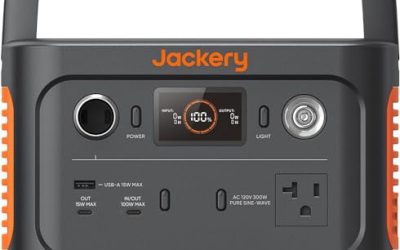
Jackery’s Explorer 1000 v2 carries the most capacity in this group, 1,070Wh, with a 1,500W inverter (3,000W surge), three AC outlets, 100W and 30W USB-C ports, a USB-A port and a 12V car port. Despite the extra watt-hours it weighs 23.8 lb, a few pounds less than the DELTA 2, thanks to a simple, handle-forward design. Wall charging takes about 1.7 hours, and an emergency fast-charge mode selected in the app cuts that to roughly one hour. Solar input accepts up to 400W across two panel inputs, and Jackery rates the LiFePO4 pack for 4,000 cycles to at least 70% capacity, the longest cycle rating here.
Skip it if: you need many outlets for a group campsite, or you plan to expand capacity in the future.
Which One Fits Your Situation
Two nights in a tent with phones, lights and a camera
Take the EB3A if you also want one AC outlet for a fan or laptop brick, or the C300 DC if everything you own charges over USB-C and you want the lightest bag. Either covers a weekend of small devices several times over.
CPAP therapy at a drive-up site
The RIVER 2 Pro is the sweet spot: 768Wh runs a typical 40–60W CPAP through the night with the heated humidifier turned off, and using a 12V DC converter instead of the AC brick stretches runtime further by skipping inverter losses. For two nights without recharging, step up to the DELTA 2 or Explorer 1000 v2.
Family basecamp with a 12V fridge
Choose between the DELTA 2, if you value its six outlets, 500W solar input and expansion path, and the Explorer 1000 v2, if you want slightly more capacity in a lighter unit. Pair either with the largest solar panel its input allows and the fridge can run indefinitely in decent sun.
Walk-in, paddle-in or bike-supported camping
The C300 DC is the only pick here that treats weight as the priority. At about 6.2 lb it disappears into a pack or dry bag, and its car socket still covers 12V accessories when you are back at the vehicle.
Common Mistakes
- Buying on AC watts alone: a big inverter on a small battery runs a kettle beautifully, once, and then goes flat
- Forgetting inverter losses: budget roughly 85% of the rated watt-hours as usable when running devices on AC power
- Running a space heater from a small pack: a 1,500W heater empties even a 1kWh station in well under an hour
- Mismatching the solar panel: check the station’s maximum solar input and voltage range before buying a panel it cannot use
- Charging a frozen battery: LiFePO4 packs should not be charged below freezing, so bring the station into the tent or vehicle on cold nights
- Storing it flat or full for months: follow the maker’s storage guidance and leave the pack partially charged between seasons
FAQ
How many watt-hours do I need for a weekend of camping?
Add up your devices: watts multiplied by hours of use, per day. Phones, lights and a camera usually total under 100Wh a day, so even the smallest pick here lasts a weekend. Add a CPAP and the figure jumps to roughly 400Wh a night. Add a fridge and you are planning around 1,000Wh a day unless solar tops the battery up.
Can a camping battery pack run a CPAP all night?
Yes, with the right size and settings. A typical CPAP drawing 40–60W uses about 320–480Wh across eight hours. Turning off the heated humidifier and heated tube cuts that dramatically, and a 12V DC converter avoids inverter losses. On those settings a 768Wh station covers one night comfortably, and a 1kWh station can cover two.
Can I recharge a power station while driving?
Yes. All five picks accept 12V car charging, but expect around 100W, so a three-hour drive adds roughly 300Wh. That is a useful top-up for the smaller stations and a slow partial refill for the 1kWh models. Solar on the roof or at camp is the faster off-grid option.
Can I take a camping battery pack on a plane?
No. Airlines limit spare lithium batteries in cabin baggage to 100Wh, or up to 160Wh with airline approval. Every station in this roundup starts at 268Wh, so they are ground-transport gear only.
How long will the battery last before it wears out?
The LiFePO4 packs here are rated between about 2,500 and 4,000 full cycles before capacity drops to 70–80% of the original figure. A camper who takes twenty trips a year would need more than a century of weekends to reach the lowest of those ratings, so calendar aging, heat and storage habits will matter long before cycle count does.
Will one of these run an electric kettle or a heater?
The DELTA 2 and Explorer 1000 v2 can run a kettle, and the RIVER 2 Pro can manage many heating appliances in its boost mode, but boiling water is one of the most expensive things you can do with stored energy. A heater is worse: at 1,500W it drains a 1kWh battery in well under an hour. A gas stove and warm layers beat a battery for heat, every time.
More from Amazon
Programs that pair well with the guide above. Offers and eligibility are set by Amazon and may change.
Free shipping on eligible items, Prime Video and more. Eligible new members can start with a free trial.
Start a Prime free trialA Prime membership for ages 18-24 with a trial period. Eligibility is set by Amazon.
See Prime for Young AdultsAudiobooks and podcasts to listen to on the go. Eligible new members can start with a free trial.
Try Audible freeAd-free music streaming. Eligible new subscribers can start with a free trial.
Try Music Unlimited freeAs an Amazon Associate we earn from qualifying purchases.





Write Your Review
No reviews yet. Be the first to share your experience!