
Key takeaways
- Compare 10 gauge and 12 gauge generator cords by load, length, voltage drop and handling, with matched Amazon picks for camps, RVs and home backup use.
Gauge looks like a small detail on a spec sheet, but it decides what a generator cord can honestly do. A 10 gauge cord is built around 30 amp service: whole-house inlets, larger RVs, and several heavy loads sharing one run. A 12 gauge cord tops out around 20 amps, which still covers a surprising amount of real life — a single circuit’s worth of lights, refrigeration, tools, or one RV appliance at a time. Buy by the load and the distance, not by habit.

This comparison is for campers choosing between a lighter cord for a small inverter generator and a heavier one for a mid-size machine, RV owners matching a cord to a 20 or 30 amp inlet, and homeowners setting up backup power. The four cords below come from their Amazon listings — two on each side of the gauge line — so the trade-offs are concrete rather than theoretical.
Quick Picks
As an Amazon Associate we earn from qualifying purchases at no extra cost to you.
| Product | Best for | Key spec from title |
|---|---|---|
| Vockjour 25FT 30 Amp Generator Cord | 10 gauge pick for a 30 amp house or RV inlet | 10 gauge STW, L14-30P to L14-30R, 7,500 watts |
| PlugSaf 25FT 30 Amp Generator Extension Cord | 10 gauge pick when you want length options | 10 gauge STW, L14-30 twist lock, 125/250V |
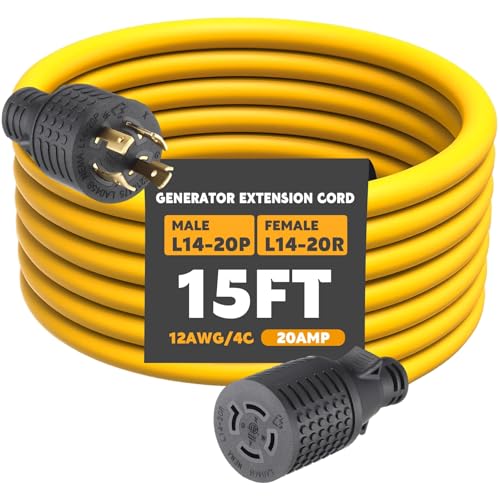
| Tellegloww 15 ft 20 Amp Generator Extension Cord | 12 gauge pick with a true locking generator plug | L14-20P to L14-20R, 12 gauge STW, 5,000 watts |
| Parkworld NEMA 5-20 Extension Cord 16FT | 12 gauge pick for one 20 amp household-style circuit | 5-20P to 5-20R, 12 gauge, 2,500 watts |
How to Choose
Match gauge to the breaker, not the wish list
Every cord in this comparison is limited by its plug and rating before the copper even matters. Ten gauge cords here carry L14-30 connectors and a 30 amp, 125/250 volt rating, which is the standard pattern for feeding a transfer switch or a larger RV. Twelve gauge cords carry 20 amp connectors — an L14-20 locking pair on the Tellegloww, a straight 5-20 pair on the Parkworld — and cannot legally or physically plug into that 30 amp world without adapters. Start at the generator outlet and let it pick your gauge family.
Count the length, because distance eats voltage
Voltage drop grows with every foot of cable, and thinner wire gives up voltage faster. Over a short 15 or 16 foot hop, a 12 gauge cord feeding a 20 amp load performs respectably. Stretch that same load across a long run to a tent, a shed, or the far side of a campsite and the far end sees less voltage, which makes motors run hotter and work harder. This is why 10 gauge earns its keep on longer runs even at moderate loads, while 12 gauge stays sensible when the generator can park close.
Weigh the cord you will actually carry
Copper is heavy, and gauge is copper. A 10 gauge four-conductor cord is noticeably stiffer and heavier to coil than a 12 gauge three-conductor one, especially in cold weather when jackets firm up. At a campsite, that difference decides whether the cord lives in the rig ready to use or gets left home as ballast. Campers with small inverter generators, whose outlets are 20 amp at most, gain nothing from hauling 10 gauge; homeowners feeding a house inlet gain nothing from saving weight with 12.
Price the whole chain, including adapters
A cord only works as a system. If your generator offers an L14-30 outlet and your loads are a few household plugs, a 12 gauge cord alone will not connect at all — you would need a fan-out or adapter arrangement, and every adapter is another connection to keep dry and seated. Conversely, a 10 gauge locking cord is money wasted on a small generator with only 5-20 outlets. Compare the full chain from outlet to load on both sides before deciding which gauge is genuinely cheaper for your setup.
Safety Notes
Respect ampacity as a pairing of gauge and length: 12 gauge suits up to 20 amp service on the short runs listed here, while 30 amp service calls for 10 gauge, and longer runs argue for stepping up a size rather than pushing a thinner cord harder. Never join two cords to fake a longer one, never bury a connection in wet grass or snow, and fully uncoil any cord before loading it — a coiled cord traps heat. If a plug feels warm under load, stop and downsize the load, not the safety margin.
The 4 Best Options
Vockjour 25FT 30 Amp Generator Cord
On the 10 gauge side, this is the reference pattern: a four-prong L14-30 locking connection at both ends, 30 amp 125/250 volt service, and a heavy STW jacket with a stated temperature range reaching -40 degrees C. It represents what 10 gauge buys you — a single cord that can feed a house inlet or a transfer switch at full generator output, with voltage held steadier at the far end than any 12 gauge cord of the same length could manage.
Specs
- Length: 25 feet
- Connectors: NEMA L14-30P to L14-30R, twist lock, 4 prong
- Rating: 30 amp, 125/250 volt, up to 7,500 watts
- Wire: 10 gauge copper, STW jacket
- Stated temperature range: -40 degrees C to 105 degrees C per listing
- Color: Yellow
Best for: Campers and homeowners whose generator and inlet are both 30 amp L14-30.
Watch out for: It cannot connect to a 20 amp L14-20 or 5-20 outlet at all; the plug family, not the gauge, decides compatibility.
ASIN: B0FQ55QRZ6
PlugSaf 25FT 30 Amp Generator Extension Cord
PlugSaf’s 10 gauge entry mirrors the same L14-30 pattern and adds choice: the listing offers several lengths, which matters because the honest way to handle a longer distance is one longer 10 gauge cord, not two shorter ones joined together. The molded twist-lock ends and yellow jacket suit semi-permanent backup setups at home and heavier campsite rigs alike, where the cord may stay deployed for days through changing weather, repeated coiling, and the occasional tire crossing the driveway. That staying power, more than any single specification, is what the heavier gauge is really for.
Specs
- Length: 25 feet (other lengths listed)
- Connectors: NEMA L14-30P to L14-30R, twist lock
- Rating: 30 amp, 125/250 volt, 7,500 watts
- Wire: 10 gauge, STW jacket
- Model number: KR6462
- Color: Yellow
Best for: A 30 amp run where 25 feet is not quite enough and a single longer cord is the right answer.
Watch out for: Longer lengths get heavy fast in 10 gauge; confirm you can coil, carry, and store the size you pick.
ASIN: B0C23XW6KR
Tellegloww 15 ft 20 Amp Generator Extension Cord
This is the 12 gauge cord that still behaves like a generator cord rather than a household lead: a four-prong L14-20 twist-lock plug at each end, 250 volt service, and a 5,000 watt ceiling that covers many mid-size inverter generators at full output. At 15 feet it keeps the generator a sensible distance from a tent or trailer without giving up much voltage, and it coils into a fraction of the space a 10 gauge cord demands.
Specs
- Length: 15 feet
- Connectors: NEMA L14-20P to L14-20R, twist lock, 4 prong
- Rating: 20 amp, 250 volt, 5,000 watts
- Wire: 12 gauge (4×12), STW jacket
- Model number: 4000058
- Brand: Tellegloww
Best for: Inverter and mid-size generators with an L14-20 outlet, used at camp or with an RV.
Watch out for: Twenty amps is a hard ceiling — a heater, microwave, and air conditioner together will exceed it even though each fits alone.
ASIN: B0F4DMZ6Q2
Parkworld NEMA 5-20 Extension Cord 16FT
The lightest option here skips locking plugs entirely: straight 5-20 ends, the same pattern as a heavy household outlet, in a 16 foot 12 gauge cord rated for a single 20 amp circuit. That makes it the natural partner for a small generator’s standard outlet and one serious load — a fridge, a sump pump, a power tool — rather than a distribution system. The T-blade female end also accepts ordinary 5-15 plugs, which adds flexibility for mixed gear.
Specs
- Length: 16 feet
- Connectors: NEMA 5-20P to 5-20R (T-blade, also accepts 5-15R plugs per listing)
- Rating: 20 amp, 125 volt, 2,500 watts
- Wire: 12 gauge, 3 conductors
- Listing note: UL Listed shown in the product information
- Brand: Parkworld
Best for: One 20 amp load fed from a small generator’s household-style outlet, at camp or at home.
Watch out for: It is a 125 volt cord only; it cannot serve 250 volt equipment or an L14-style inlet of either gauge family.
ASIN: B08LVNC8BC
Which One Fits Your Situation
Feeding a house through a transfer switch
Go 10 gauge, without much debate. A transfer switch inlet is a 30 amp L14-30 device, the runs tend to be the longest in this comparison, and the loads — furnace, fridge, well or sump pump — stack up quickly. The Vockjour covers the standard 25 foot span; step to a longer PlugSaf if the generator pad sits farther away.
Powering an RV or a larger campsite
Match the inlet on the rig. A 30 amp RV service wants the 10 gauge cords; a smaller trailer or a tent camp running lights, a fan, and device charging from an inverter generator is honestly served by the Tellegloww, which is lighter to pack and easier to coil in the cold. The deciding question is the outlet on your generator, not the size of your ambitions.
One heavy tool or appliance at a time
The Parkworld is enough, and its simplicity is the point. A single 20 amp circuit for a job-site tool, a chest freezer during an outage, or a block heater overnight does not need locking plugs or four conductors. Keep the run short, keep the connection dry, and rotate loads instead of stacking them.
A long run across a yard or field
Length flips the answer toward 10 gauge even for moderate loads, because voltage drop — not the breaker rating — becomes the limit. If the load must sit far from the generator, choose the longer single 10 gauge cord. If you can move the generator closer instead, a short 12 gauge cord becomes the lighter, simpler, perfectly respectable choice.
Common Mistakes
- Assuming a 12 gauge cord can feed a 30 amp inlet because an adapter exists to make the plugs meet.
- Judging a cord by wattage alone and ignoring the amp and voltage figures that actually define it.
- Joining two shorter cords to reach a distant load instead of buying one cord of the right length and gauge.
- Running a cord fully loaded while it is still coiled, which traps heat in the middle of the coil.
- Choosing 10 gauge for a small inverter generator whose outlets max out at 20 amps, then fighting the stiff, heavy cable at every camp.
Frequently Asked Questions
Is 10 gauge always better than 12 gauge?
No — it is better only where its capacity is usable. A 10 gauge cord carries 30 amp service and holds voltage better over distance, but it is heavier, stiffer, and locked into the L14-30 plug family. On a 20 amp generator outlet, a 12 gauge cord delivers everything the machine can offer, in a package that is easier to carry, coil, and store.
How much voltage drop should I expect on a long run?
Drop grows with length and load together: a lightly loaded cord loses little, while a cord near its amp limit at the end of a long run can shed enough voltage that motors strain and lights dim. The practical fix is not a formula but a choice — shorten the run, lighten the load, or step up to 10 gauge when the distance is fixed and the load is real.
Can I use a 12 gauge cord with a 30 amp generator?
Only within the 12 gauge cord’s own limits, and only where the plugs genuinely match. Many 30 amp generators also provide 20 amp outlets, and a 12 gauge cord on one of those outlets is a sound setup for a single circuit of loads. What you cannot do is feed a 30 amp inlet or a 30 amp combined load through it, adapter or not.
Which gauge suits an RV?
Follow the RV’s inlet. Trailers with 30 amp service pair with the 10 gauge L14-30 or TT-30 cords built for that pattern, while smaller rigs and tent campers running a few appliances from an inverter generator are well matched by a 12 gauge cord like the Tellegloww or Parkworld. When in doubt, read the inlet’s stamped rating — it settles the question in one look.
More from Amazon
Programs that pair well with the guide above. Offers and eligibility are set by Amazon and may change.
Free shipping on eligible items, Prime Video and more. Eligible new members can start with a free trial.
Start a Prime free trialA Prime membership for ages 18-24 with a trial period. Eligibility is set by Amazon.
See Prime for Young AdultsAudiobooks and podcasts to listen to on the go. Eligible new members can start with a free trial.
Try Audible freeAd-free music streaming. Eligible new subscribers can start with a free trial.
Try Music Unlimited freeAs an Amazon Associate we earn from qualifying purchases.




Write Your Review
No reviews yet. Be the first to share your experience!