

Key takeaways
- The best relay testers plug a suspect relay in, cycle it under load and give a plain pass or fail for 4-pin and 5-pin relays on 12V and 24V systems.
As an Amazon Associate we earn from qualifying purchases.
A relay is a small electrically operated switch, and it fails in ways that fool simple checks. A relay can click when its coil is energized and still have pitted, burned contacts that drop voltage or open up under load. That is why swapping relays around the fuse box, or listening for a click with a jumper wire, so often leads to a wrong diagnosis. A dedicated relay tester removes the guesswork: you pull the relay out of the vehicle, plug it into the tester, connect the tester to a battery, and the unit energizes the coil and cycles the switch contacts repeatedly while loading them, then reports a plain pass or fail.
A relay tester is a different tool from a circuit tester. A circuit tester probes a live circuit in the vehicle to find power, ground and signal faults at the socket; it never takes the relay itself out of the equation. A relay tester does the opposite job: it judges the relay alone, off the car, so a bad relay is not confused with a wiring fault. It is also not an OBD2 scanner, which reads fault codes from the vehicle’s computers and cannot tell you whether a specific relay’s contacts are worn. The five testers below cover the main approaches: simple 12V go/no-go units, dual-voltage 12/24V kits with adapters, a load-testing pro kit that grades contact voltage drop, a combined battery and relay tester, and a compact unit sold with a relay puller for stubborn fuse-box work.
Affiliate Disclosure: This article contains affiliate links. If you buy through these links, we may earn a commission at no extra cost to you.
How to Choose a Relay Tester
Start with voltage. Most passenger cars and light trucks use 12V relays, but many heavy trucks, agricultural machines and some commercial vehicles run 24V relays, and a 12V-only tester gives no valid result on a 24V relay. If you work on a mixed fleet, a dual-voltage tester saves buying twice. Next, check pin coverage. The common automotive relays are 4-pin (single normally open contact) and 5-pin (changeover contact) designs, and every tester here can be set or auto-detects for both. Coverage beyond that comes from adapters: shielded or skirted relays and newer compact relay types used on fuel pumps and other powered devices need adapter leads or extra receptacles, which is where the kit versions earn their keep.
The most important difference is how hard the tester works the contacts. Basic units energize the coil and check that the contacts open and close consistently over repeated cycles, with the switch contacts loaded enough to expose excessive resistance. Better units apply a real working load and monitor voltage drop across the contacts, so a relay that switches but wastes voltage is flagged as marginal instead of passed. Finally, consider how the result is reported: a simple green and red LED pair is fast to read, while testers with diagnostic trouble codes or a three-color result give a hint about why the relay failed, which helps when the same circuit keeps eating relays.
1. Electronic Specialties 193 Relay Buddy 12/24 Pro Test Kit

The Relay Buddy 12/24 Pro Test Kit is the dual-voltage option for workshops that see both cars and 24V equipment. The tester can be set to 4-pin or 5-pin relays and tests both 12V and 24V relays using the vehicle battery for power, so there are no internal batteries to run flat. During each test session it operates the relay several times and watches for consistency in every cycle; if any single cycle fails, the red LED lights and one of three diagnostic trouble codes points to the likely cause, such as a selector setting error or a contact closed when it should be open. The switch contacts are loaded during the test to detect excessive resistance, which is the check that catches relays that click but do not carry current properly.
Because it is the kit version, it adds five relay adapters to the standalone tester: three adapters for testing shielded relays and two for the newer relay types commonly used on fuel pumps and other powered devices. Everything packs into a blow mold case, which keeps the adapters with the tester instead of loose in a toolbox drawer. For a shop that diagnoses intermittent electrical faults across cars, trucks and machinery, this is the most complete single purchase in the group.
Specs
- Relay voltage: 12V and 24V
- Pin configurations: 4-pin and 5-pin, selectable
- Result display: Green LED for good, red LED for bad, plus 3 diagnostic trouble codes
- Test method: Repeated cycling with switch contacts loaded to detect excessive resistance
- Power source: Vehicle battery (12V or 24V)
- Kit contents: Tester, 5 relay adapters, blow mold case
- Warranty: 1 year on material and workmanship
2. Electronic Specialties 190 Relay Buddy
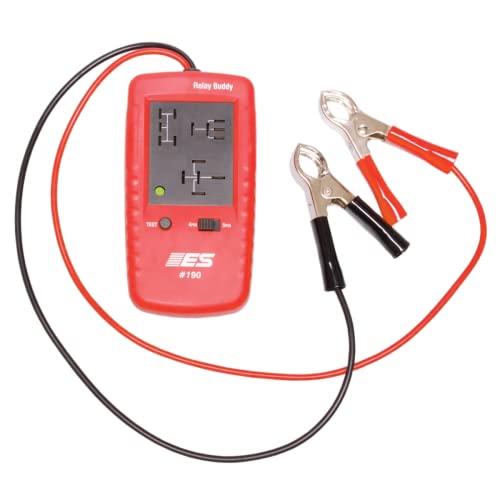
The original Relay Buddy is the straightforward 12V tester for passenger cars and light trucks. It is settable to 4-pin and 5-pin relays, draws its power from the vehicle battery, and runs the relay through repeated cycles (ten cycles per test) while checking both the control side and the switch contacts. A green light means the relay passed every cycle; a red light means at least one cycle failed, which is exactly the behavior needed to expose intermittent relays that work once and then misbehave when warm or under vibration.
There are no adapters and no trouble codes here, and it only covers 12V relays, so it is not the tool for 24V truck work or for shielded relay types. What it offers instead is speed and simplicity in a small housing: at 8 ounces it lives happily in a top drawer, and the whole test is one connection and one button press. For a home mechanic or a small shop that only deals with standard 12V relays, it covers the core job without paying for fleet features.
Specs
- Relay voltage: 12V
- Pin configurations: 4-pin and 5-pin, selectable
- Result display: Green LED for good, red LED for bad
- Test method: Cycles the relay 10 times per test, checking coil and switch contacts
- Power source: Vehicle 12V battery
- Item weight: 8 ounces
- Dimensions: 7 x 5 x 3 inches
3. Electronic Specialties 195 Super Relay Buddy Pro Kit

The Super Relay Buddy line takes a harder line on contact condition. Where the standard testers load the contacts lightly, the Super Relay Buddy applies a full 7 amp load during its automated test sequence and monitors the voltage drop across the relay. The result is three-way: green for pass, red for fail, and yellow for caution, shown when the voltage drop is excessive but the relay is still functioning. That middle verdict is genuinely useful, because a relay with rising contact resistance is a breakdown scheduled for later, and this is the only tester in the group that grades it instead of giving a binary answer.
The standalone Super Relay Buddy tester (model 194) covers seven different 12V relays through five receptacles, using a 4-pin/5-pin selector switch. This Pro Kit version (model 195) adds adapters for shielded or skirted relays and extends coverage to ten different relay types. It runs from the vehicle battery, needs no internal batteries, and weighs about a pound, so it suits both bench work and mobile diagnosis. The trade-off is voltage: it is a 12V-only tester, so 24V relays still need a dual-voltage unit like the 193 kit above.
Specs
- Relay voltage: 12V
- Relay coverage: 10 different relay types with included adapters (7 on the base tester)
- Pin configurations: 4-pin and 5-pin, selectable
- Test load: Full 7A load applied during the automated test sequence
- Result display: Green (pass), red (fail), yellow (caution for excessive voltage drop)
- Measurement: Voltage drop across the relay monitored during the test
- Power source: Vehicle battery, no internal batteries
4. KONNWEI KW371 Battery and Relay Tester

The KW371 takes a different approach: it is a 2-in-1 tool that combines a battery tester with a relay tester in one handheld unit. On the battery side it covers 6V, 12V and 24V systems, with a cranking amps range of 10 to 2000 CCA and a capacity range of 5 to 220 Ah, and it runs battery health, cranking and charging system checks with a graphical waveform display. On the relay side it diagnoses 4-pin and 5-pin automotive relays, so one tool answers the two most common questions in a no-start diagnosis: is the battery doing its job, and is the relay doing its job?
The unit is powered from the vehicle battery, so it needs no batteries of its own, and it offers 18 language options on its display. The compromise is depth: the relay function is a diagnostic check rather than a loaded, adapter-supported test of the kind the Electronic Specialties kits perform, and there is no relay puller in the box. It makes the most sense for owners and small workshops that want one mid-range diagnostic tool for both batteries and relays rather than two dedicated instruments.
Specs
- Functions: Battery tester and relay tester in one unit
- Battery systems: 6V, 12V and 24V
- Battery test range: 10 to 2000 CCA, 5 to 220 Ah capacity
- Battery checks: Battery health, cranking test, charging test, waveform display
- Relay coverage: 4-pin and 5-pin automotive relays
- Display: Graphical waveform display, 18 language options
- Power source: Vehicle battery, no separate batteries required
- Warranty: 1 year
5. Sound Troubleshooting Relay Tester with Relay Puller

This compact kit pairs a dedicated 12V relay tester with the tool that gets the relay out in the first place: a relay puller. Anyone who has tried to wiggle a tightly seated relay out of a crowded fuse box with fingertips or pliers will understand the appeal. The tester itself is a simple handheld unit with battery clips for direct connection to a 12V battery, a working range of 11V to 15V, and automatic detection of the relay pin position, so there is no selector switch to set wrong. It runs the relay through several cycles and reports with the simplest readout in the group: a green LED for a good relay and a red LED for a bad one.
The listing notes that the tester prefers relays with a coil resistance above 20 ohms and is not intended for use with all BMW relays, so check your relay type before relying on it for European applications. It is also strictly a 12V tool with no display beyond the two LEDs. Within those limits, it is a practical glovebox or roadside kit: tester, puller and clips in a package that weighs 14 ounces.
Specs
- Relay voltage: 12V (working range 11V to 15V)
- Pin configurations: 4-pin and 5-pin, automatic pin detection
- Result display: Green LED for good, red LED for bad
- Kit contents: Relay tester, relay puller, battery clips
- Recommended coil resistance: Above 20 ohms
- Item weight: 14 ounces
- Package dimensions: 9.53 x 5.67 x 1.57 inches
How a Relay Tester Test Works
Whatever model you choose, the workflow is the same. First, note the relay’s pin count and voltage from its housing diagram, and remove the relay from the vehicle; a relay still plugged into its socket can give misleading results. Set the tester to match, or let an auto-detecting unit read the pin layout. Plug the relay into the tester, connect the tester’s leads to a battery of the correct voltage, and start the test. The tester energizes the coil, cycles the contacts repeatedly under load, and watches every cycle. A single failed cycle is enough to fail the relay, which is the point: intermittent contact faults that a one-time click test misses show up under repeated cycling. If the relay fails, replace it and then recheck the circuit it feeds, because a relay that failed from overload may have been killed by the component it switches rather than by old age.
Relay Tester vs. Circuit Tester vs. OBD2 Scanner
These three tools answer three different questions. A relay tester answers: is this relay good or bad, tested on its own under load? A circuit tester answers: is power, ground and signal reaching the socket in the vehicle? An OBD2 scanner answers: what fault codes has the vehicle’s computer stored? A dead fuel pump can be caused by any of the three areas, which is why the efficient order is to test the relay on a relay tester, then probe the socket with a circuit tester if the relay passes, and use the scanner for the faults that live in the control system. Buying a relay tester does not replace the other two; it closes the gap that neither of them can cover, because neither a probe nor a scanner can load a relay’s contacts and grade their condition.
Frequently Asked Questions
Can a relay tester find an intermittent relay fault?
Yes, that is its main advantage over a click test. The tester cycles the relay repeatedly and fails it if any cycle is unsuccessful, so a relay that only drops out when warm or under vibration has repeated chances to show the fault.
Do I need a 24V relay tester for a car?
No. Cars and light trucks use 12V relays. The 24V coverage on dual-voltage testers is for heavy trucks, agricultural and commercial equipment that run 24V electrical systems.
What is the difference between 4-pin and 5-pin relays?
A 4-pin relay has a single normally open contact that closes when the coil is energized. A 5-pin relay adds a normally closed contact, so it switches a circuit between two outputs. Most testers are settable or auto-detecting for both.
Why does a relay click but still fail the test?
The click only proves the coil works. The contacts can be pitted or burned so they resist current or open under load. Testers that load the contacts and watch voltage drop or resistance catch exactly this failure.
Can I test a relay with a multimeter instead?
You can apply battery voltage to the coil and check contact continuity, which covers the basics. It does not load the contacts the way a dedicated tester does, so a weak relay can pass a multimeter check and still fail in service.
More from Amazon
Programs that pair well with the guide above. Offers and eligibility are set by Amazon and may change.
Free shipping on eligible items, Prime Video and more. Eligible new members can start with a free trial.
Start a Prime free trialA Prime membership for ages 18-24 with a trial period. Eligibility is set by Amazon.
See Prime for Young AdultsAudiobooks and podcasts to listen to on the go. Eligible new members can start with a free trial.
Try Audible freeAd-free music streaming. Eligible new subscribers can start with a free trial.
Try Music Unlimited freeAs an Amazon Associate we earn from qualifying purchases.


Write Your Review
No reviews yet. Be the first to share your experience!