

Key takeaways
- Compare the best arbor presses for bearings, bushings and broaching, with tonnage, throat depth and work height for each pick, plus hand-press limits.
As an Amazon Associate we earn from qualifying purchases.
An arbor press is the simplest press in the shop: a cast-iron frame, a hand lever, a pinion gear, and a ram with rack teeth cut along one side. Pull the lever and the pinion walks the ram straight down onto the work, which sits on a slotted anvil plate. There is no motor, no pump and no fluid. That simplicity is exactly why the tool survives in modern workshops. For pressing small bearings and bushings in or out, staking parts, setting rivets, straightening small shafts and pushing a broach through a keyway, an arbor press gives controlled, repeatable force with genuine feel — you can sense a bearing start to move, and you can stop before you crack a housing.
This guide covers hand-lever arbor presses in the half-ton to 2-ton range, including one ratchet-leverage model. Every pick below states its rated tonnage, throat depth and maximum work height, because those three numbers decide whether a given job physically fits in the press.
Affiliate Disclosure: This article contains affiliate links. If you buy through these links, we may earn a commission at no additional cost to you. This helps support our work and allows us to continue providing detailed tool guides.
Arbor Press vs. Hydraulic Shop Press: An Honest Distinction
These are different tools, and choosing between them starts with force. A hydraulic shop press uses a bottle jack or cylinder to multiply force, and even small bench models start around 6 tons, with floor models running far higher. An arbor press is limited by its lever ratio and your own pull on the handle. Benchtop arbor presses are typically rated between half a ton and 3 tons, and that rating is a genuine ceiling, not a suggestion. Sliding a length of pipe over the handle to gain leverage — the classic cheater-bar move — does not turn a 1-ton arbor press into a 5-ton press. It overloads a cast-iron frame that can crack, and it voids any claim the rating ever offered.
So be clear about what a hand press cannot do. It will not press a large, corroded wheel bearing out of a hub, free a seized kingpin, or straighten anything substantial. Jobs like those belong to a hydraulic press. What the arbor press does better than any hydraulic press is small work done by feel: seating a bearing squarely without brinelling the races, pressing a bushing to an exact depth, or feeding a keyway broach through a bore in controlled increments. If your work is mostly parts under a couple of inches across, the arbor press is faster to set up, easier to control and always ready — there is no jack to pump and no seals to weep.
What to Look for in an Arbor Press
Rated tonnage. Force requirements climb fast with interference fits and corrosion. A clean, lightly oiled bushing may seat with a few hundred pounds of force, while a dry, rusty bearing of the same size can demand the full rating of the press. Buy one size up from the work you expect, and treat anything that does not move under a firm, full pull as a job for hydraulics, heat or penetrating oil — not for a longer handle.
Throat depth. This is the distance from the centerline of the ram to the back of the frame. It caps the size of part you can center under the ram: as a rule, the largest round part you can press is roughly twice the throat depth across. A press with a 3.2-inch throat handles parts up to about 6 inches in diameter, which covers most small bearings, bushings and pulley hubs.
Work height. The maximum ram-to-table distance must fit your part plus the tooling stacked under and over it — a bearing, a support plate and a driver add up quickly. Check this number against your tallest expected job, and remember that a rotating slotted anvil lets shafts and studs pass through the table, which effectively extends what fits.
Ram and anvil details. A square steel ram resists twisting under off-center loads. A bore in the end of the ram accepts punches and drifts for staking and riveting work. A multi-position anvil plate with slots of different widths supports parts at different heights and lets pins and shafts drop through as they are pressed out.
Single lever vs. ratchet leverage. A plain lever press moves the ram one stroke per pull, and the lever springs back when you let go. A ratchet-leverage press holds the ram where you leave it and lets you reposition your grip mid-stroke. That matters most for broaching, where the broach must stay engaged with the work while you reset the handle, and for tall setups where a single lever arc cannot complete the travel.
Mounting. Every press here works best bolted to a bench or stand. Small presses can sit unbolted for very light craft work, but the rated tonnage assumes the base cannot tip or walk under a full pull.
1. VEVOR Arbor Press, 1 Ton (Model AP-1)

The VEVOR AP-1 is the sensible default for a home shop: a full ton of rated force in a compact cast-iron frame that still leaves room on the bench. The 5.9-inch working stroke and 5.9 inches of work height cover the stacked tooling of most small bearing and bushing jobs, and the 3.2-inch throat centers parts up to roughly 6 inches across. The ram end is bored 0.4 inch to accept punches and drifts, and the press ships with three drifts — flat, pointed and round — so basic staking and pressing work can start immediately. The four-position anvil plate rotates to present different slot widths, letting shafts pass through as bearings are pushed off them. At about 24 pounds it is light enough to move, but bolt it down to use the full rating safely.
Specs
- Capacity: 1 ton max pressure
- Max working stroke / work height: 5.9 in (150 mm)
- Throat depth: 3.2 in (81 mm)
- Ram length: 8.9 in (225 mm); ram bore: 0.4 in (10 mm)
- Anvil plate diameter: 3.5 in (90 mm), four-position slotted plate
- Construction: cast iron frame
- Footprint: 9.5 x 6.7 x 11.4 in (240 x 170 x 290 mm)
- Net weight: 24.5 lb (11.1 kg)
- Included tooling: flat, pointed and round drifts
2. VEVOR Arbor Press, 0.5 Ton (Model AP-0)

The AP-0 is the AP-1’s smaller sibling, built for light, precise work rather than stubborn press fits: jewelry and leather stamping, small pins, electronic and model work, and seating small bushings that go in with modest force. The half-ton rating is honest light-duty capacity, and the frame keeps the same 3.2-inch throat depth as the 1-ton model, so part diameter is rarely the limit — force is. Work height is 4.6 inches with a 4.7-inch stroke, which suits flat and low-profile parts. At 16.5 pounds it is genuinely a desktop tool that can live on a craft bench and be put away in a cabinet. Choose it when control matters more than force; choose the 1-ton model if bearings are the main job.
Specs
- Capacity: 0.5 ton max pressure
- Max working stroke: 4.7 in (119 mm); max work height: 4.6 in
- Throat depth: 3.2 in (81 mm)
- Ram length: 7.1 in (180 mm); ram bore: 0.4 in (10 mm)
- Anvil plate size: 3.5 in (90 mm)
- Construction: cast iron frame
- Footprint: 9.3 x 6.3 x 10.4 in (235 x 160 x 263 mm)
- Net weight: 16.5 lb (7.5 kg)
- Included tooling: flat, pointed and round drifts
3. HHIP 8600-0130 Pro-Series Arbor Press, 0.5 Ton

HHIP’s Pro-Series half-ton press comes from the machinist-supply side of the market rather than the craft side, and it suits toolroom habits: a rigid cast-iron frame, an 11-inch overall height, and the kind of plain, serviceable construction meant to be bolted to a bench and used daily. The half-ton capacity places it in the same light-duty class as the VEVOR AP-0 — small bearings, bushings, pins, staking and assembly work — but the Pro-Series frame is the pick for buyers who prefer industrial-supplier build quality and parts support over included accessories. It is a compact press: plan work around small parts, and step up to a 2-ton model below if your bearings run large or corroded.
Specs
- Capacity: 0.5 ton
- Overall height: 11 in
- Construction: cast iron frame, Pro-Series build
- Type: single-lever rack-and-pinion bench press
- Manufacturer: ABS Import Tools Inc (HHIP)
- Model: 8600-0130
4. HHIP 8600-0033 Heavy-Duty Arbor Press, 2 Ton

This is the step up for real bearing and bushing work. The 8600-0033 doubles the capacity of the 1-ton class to a full 2 tons, and just as importantly it adds room: 8.47 inches of clearance over the table and a 12-inch maximum work diameter, so taller stacks of tooling and larger housings fit without improvisation. The cast-iron frame stands 18 inches tall on a 16 x 6 inch bench-mountable base, and the precision-machined steel pinion keeps ram travel true, which is what keeps bearings going in square instead of cocked. The four-position steel anvil rotates to change support height and slot width quickly. For pressing bearings and bushings in small machinery, gearboxes and farm equipment, this is the most capable single-lever press in this guide.
Specs
- Capacity: 2 tons
- Work height (clearance over table): 8.47 in
- Throat capacity: 12 in max work diameter
- Overall press height: 18 in
- Anvil: 4-position steel anvil plate
- Drive: rack-and-pinion, precision-machined steel pinion
- Construction: solid cast iron frame
- Base: 16 x 6 in, bench-mountable
- Model: 8600-0033
5. HHIP 8600-3301 Ratchet Type Arbor Press, 2 Ton
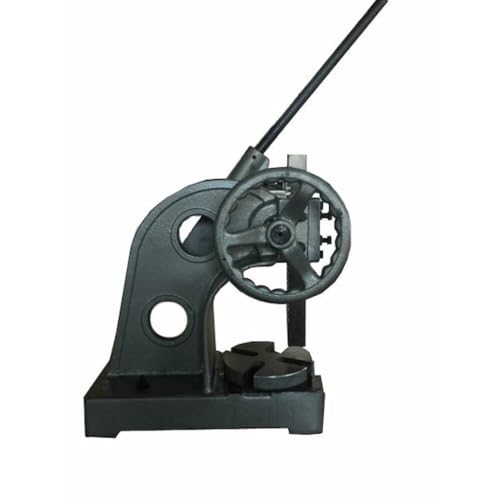
The ratchet model solves the single-lever press’s one real ergonomic flaw. On a plain press, the lever’s arc limits each stroke, and letting go lets the ram relax. The 8600-3301’s ratchet leverage holds the ram exactly where you stop, so you can reposition the handle and continue the same press stroke — essential when broaching a keyway, where the broach must stay seated in the bore and shimmed progressively, and just as useful on any tall setup where one pull cannot finish the travel. Capacity matches the heavy-duty lever model at 2 tons, in a cast-iron frame from HHIP’s Pro-Series line. If broaching is even an occasional job — keyways in pulleys, gears and hubs — this is the press in the guide built for it.
Specs
- Capacity: 2 tons
- Type: ratchet-leverage arbor press (ram holds position between strokes)
- Construction: cast iron frame
- Best suited for: broaching keyways, tall setups, progressive pressing
- Manufacturer: ABS Import Tools Inc (HHIP)
- Model: 8600-3301
How to Choose Among These Five
Start with the work, not the tool. If your pressing is light assembly, stamping and small pins, either half-ton press is enough, and the choice is between the VEVOR AP-0’s included drifts and desktop manners and the HHIP 8600-0130’s industrial build. If small bearings and bushings are the core job, the VEVOR AP-1 at 1 ton is the balanced pick, with the caveat that corroded parts can exceed it. If you regularly press larger bearings or need the work height for stacked tooling, go straight to the 2-ton HHIP 8600-0033. And if broaching keyways is on your list at all, the ratchet-leverage HHIP 8600-3301 is the only mechanism here that does it properly.
Whichever press you choose, respect the ceiling. An arbor press that will not move a part under a firm full pull is telling you the job needs heat, penetrating oil, a puller, or a hydraulic press. Listen to it — that feedback through the handle is the tool’s main advantage, and the reason a century-old design still earns its bench space.
More from Amazon
Programs that pair well with the guide above. Offers and eligibility are set by Amazon and may change.
Free shipping on eligible items, Prime Video and more. Eligible new members can start with a free trial.
Start a Prime free trialA Prime membership for ages 18-24 with a trial period. Eligibility is set by Amazon.
See Prime for Young AdultsAudiobooks and podcasts to listen to on the go. Eligible new members can start with a free trial.
Try Audible freeAd-free music streaming. Eligible new subscribers can start with a free trial.
Try Music Unlimited freeAs an Amazon Associate we earn from qualifying purchases.
Write Your Review
No reviews yet. Be the first to share your experience!