

Key takeaways
- UV resistance: Important in sunny climates because ultraviolet exposure weakens fabric and fades decals, seals, and exterior plastics. A UV-treated fabric and a light-colored top can reduce heat buildup.
- Breathability: Helps moisture escape after rain or temperature changes. Ventilation panels are especially useful in humid regions.
- Wind control: Look for multiple straps, buckle points, elasticized hems, and reinforced corners. A zipper alone does not keep a cover stable.
- Snow and ice: A cover can protect from contamination but is not a structural roof. Remove excessive accumulation if the cover manufacturer permits it, and never assume a cover replaces roof maintenance.
- Seam construction: Seams and corners often fail before the large fabric panels. Reinforcement in those areas is more valuable than a high layer count by itself.
The best RV covers are breathable, water-resistant covers sized to your RV’s actual body length, with reinforced corners, adjustable tensioning, and access panels that match how often you use the vehicle.
A cover protects an RV from ultraviolet light, bird droppings, tree sap, dust, and repeated wet-dry cycles, but the wrong cover can cause its own damage. An undersized cover strains seams and leaves exposed areas; an oversized cover can flap against the finish. The right choice depends on your RV type, storage location, local weather, and whether you need to enter the RV while it remains covered.
Our top picks
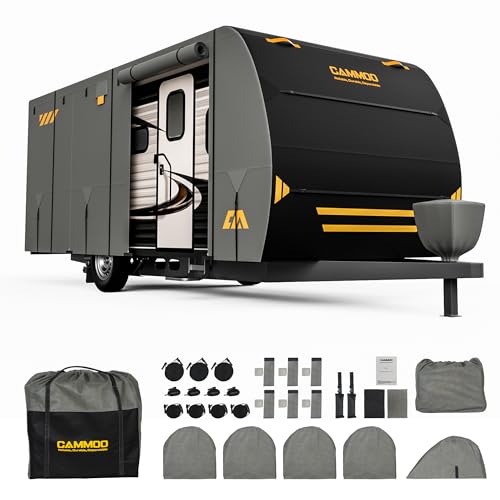

As an Amazon Associate we earn from qualifying purchases at no extra cost to you. Ratings are shown as listed on Amazon.
Quick picks by storage situation
| Storage situation | Best cover type | Material and features to prioritize | Typical market range |
|---|---|---|---|
| Outdoor storage in strong sun | Premium motorhome or travel-trailer cover | Multi-layer polypropylene or polyester, UV-resistant coating, breathable panels, reinforced corners | $180–$450 |
| Cold, snowy winter storage | Heavy-duty breathable cover with roof reinforcement | Water-resistant top, sealed or reinforced seams, multiple straps, snow-load awareness | $220–$500 |
| Covered storage with dust and pollen | Lightweight breathable cover | Polypropylene or polyester, soft inner surface, easy installation, fewer heavy straps | $100–$280 |
| Frequent weekend use | Cover with zippered entry panels | Access doors on the entry side, buckle straps, storage bag, quick-release system | $150–$400 |
| Lowest-cost occasional protection | Basic universal RV cover | Correct size, breathable fabric, elasticized hem, included straps | $80–$180 |
Best RV covers by material
Polypropylene: the practical all-rounder
Woven polypropylene is common in mid-range RV covers because it is light, breathable, and generally less expensive than heavier coated fabrics. It works well for seasonal outdoor storage where the main threats are sun, dust, rain, and light snow. Many covers use several layers on the roof and upper surfaces, where exposure is greatest.
Polypropylene is not automatically waterproof. Most RV covers are designed to shed rain while allowing some trapped moisture to escape. That balance is preferable to an airtight tarp, which can hold condensation against the RV roof and sidewalls. Look for breathable panels rather than assuming that a thicker fabric is always better.
Polyester: stronger handling and better abrasion resistance
Polyester covers are often chosen for frequent installation, windy locations, or owners who want a tougher outer fabric. A coated polyester cover can offer strong water resistance, although breathability varies by design. The fabric itself matters less than the complete construction: roof layers, seam treatment, corner protection, and the quality of the tie-down system.
Polyester can be a good choice for a travel trailer stored beside trees or in an exposed lot, but avoid covers with a rough interior or poorly finished seams. A cover that repeatedly rubs on a slide-out edge, mirror, gutter, or awning hardware may wear the RV’s finish even if the outer fabric is durable.
Universal versus fitted covers
Universal covers accommodate a range of RV lengths and are usually the most affordable. Their advantage is flexibility, but excess fabric increases the chance of wind movement. Fitted covers cost more and may have a better silhouette, yet they still need accurate measurement; “fitted” does not mean every model suits every roof profile, ladder, air conditioner, or slide-out.
Products such as ADCO RV covers and Classic Accessories OverDrive covers are examples of established cover lines with different size ranges and feature packages. Check the current manufacturer size chart rather than choosing by brand name alone.
How to choose the correct size
Measure the RV body from the rearmost body panel to the frontmost body panel, excluding the hitch, tow vehicle, and removable accessories. Include permanently mounted rear ladders, spare-tire carriers, or roof equipment only if the manufacturer’s instructions tell you to include them. Measure the height from the ground to the highest fixed roof point, then compare both measurements with the cover chart.
For a travel trailer, the listed length may refer to the box length rather than the overall hitch-to-bumper length. This is one of the most common sizing mistakes. For a fifth wheel, check whether the chart distinguishes the lower body from the raised front section. For a Class A or Class C motorhome, account for mirrors and roof-mounted air conditioners according to the cover maker’s instructions.
A useful sizing example
Suppose the RV’s body length is 28 feet 4 inches, or 340 inches. A cover range of 27–30 feet normally provides a better target than a 30–33-foot cover. The larger cover may be easier to install, but it leaves 20 to 56 inches of additional material compared with the measured body length. That excess can balloon in wind, drag across the sides, and make tensioning less effective.
Do not size down to eliminate loose fabric. A cover should reach low enough to protect the sidewalls while leaving clearance for vents, wheels, and the lower body. If your measurement sits at the top or bottom edge of a size range, contact the manufacturer and confirm how the chart defines length.
Weather resistance: what matters beyond “waterproof”
- UV resistance: Important in sunny climates because ultraviolet exposure weakens fabric and fades decals, seals, and exterior plastics. A UV-treated fabric and a light-colored top can reduce heat buildup.
- Breathability: Helps moisture escape after rain or temperature changes. Ventilation panels are especially useful in humid regions.
- Wind control: Look for multiple straps, buckle points, elasticized hems, and reinforced corners. A zipper alone does not keep a cover stable.
- Snow and ice: A cover can protect from contamination but is not a structural roof. Remove excessive accumulation if the cover manufacturer permits it, and never assume a cover replaces roof maintenance.
- Seam construction: Seams and corners often fail before the large fabric panels. Reinforcement in those areas is more valuable than a high layer count by itself.
In very windy areas, a roof-only cover or a custom shade structure may be safer than a loose full-body cover. No fabric cover should be installed over a wet, dirty RV or over sharp protrusions that have not been padded.
Access features worth paying for
If the RV remains covered between trips, zippered entry panels can save substantial time. A passenger-side access door is useful when you need to retrieve supplies; an entry-side panel lets you unlock the main door without removing the entire cover. Panels around slide-outs can be helpful, but they also add zippers and seams that may require more care.
For occasional use, a simple cover with front and rear access may be enough. Frequent users should prioritize color-coded straps, integrated buckle systems, elasticized hems, and a storage bag large enough to accept the cover without aggressive folding. Tiny straps and a tightly packed storage sack may appear minor at purchase but become daily annoyances.
Decision matrix: match the cover to your ownership pattern
| Your priority | Recommended specification | Why | What to avoid |
|---|---|---|---|
| Lowest purchase cost | Basic breathable polypropylene with elastic hem | Provides broad protection without premium access hardware | Thin tarps that trap condensation or have no wind restraints |
| One installation each year | Heavier multi-layer cover with reinforced corners | Fewer installation cycles reduce the inconvenience of extra weight | Complex panels you will not use |
| Monthly or weekend use | Entry-side zipper, buckle straps, and a manageable weight | Allows access without repeated full removal | Oversized covers that require several people to control |
| Very windy storage | Close size match, multiple tension straps, reinforced attachment points | Reduces flapping and abrasion | Loose fit, exposed sharp hardware, or bungee-only restraint |
| Humid or rainy climate | Breathable fabric with roof vents and water-resistant top | Balances rain shedding with moisture release | Non-breathable plastic sheeting placed directly on the RV |
Installation and maintenance that extend cover life
- Wash and dry the RV. Dirt trapped under a cover can act like fine abrasive material. Let the roof and sidewalls dry fully before covering.
- Protect protrusions. Pad mirror arms, gutter corners, sharp ladder edges, and antenna bases. Retract slide-outs and awnings unless the cover is specifically designed around them.
- Install from the roof only when safe. Use the manufacturer’s method; many covers can be positioned with a throw-over technique from the ground. Avoid walking on an RV roof unless it is rated for foot traffic.
- Secure every strap. Straps should be snug, not cutting into the fabric. Keep buckles away from painted surfaces and prevent loose ends from whipping in the wind.
- Inspect after the first windy or rainy day. Check corners, slide-out edges, roof vents, and areas where straps contact the cover.
- Clean and dry before storage. Use the care instructions, usually mild soap and water rather than bleach or harsh solvents. Store the cover dry to limit mildew and odor.
The parts most likely to wear first are corner reinforcements, zipper tracks, elastic hems, strap attachment points, and fabric touching a sharp accessory. A small tear should be repaired with a compatible cover-repair patch before the next windy period. Replacing a damaged cover is usually less expensive than repairing sun-faded decals or water intrusion caused by an ignored failure.
Final buying advice
For most outdoor-stored RVs, choose a breathable, UV-resistant cover with a close size range, reinforced corners, and enough straps for your wind exposure. Spend more on fit and construction before paying for extra zippers. If you use the RV often, access panels can justify the premium; if it sits under a roof, a lighter cover may be the better value. The best RV covers are not necessarily the thickest—they are the ones that stay stable, release moisture, and fit the vehicle without rubbing.



Write Your Review
No reviews yet. Be the first to share your experience!