

Key takeaways
- Choose automatic shutoff and use the timer every session.
- Place the blanket on a flat, dry surface with no sharp objects underneath.
- Inspect the power cord, connector and controller for heat damage or fraying.
- Do not sleep inside the blanket, fold it while powered on or cover the controller with bedding.
- Drink water normally, avoid alcohol before use and stop if you feel dizzy, nauseated, unusually weak or unwell.
- Start at a low temperature for 15–20 minutes rather than beginning at the maximum setting.
- Ask a healthcare professional before using one if you are pregnant, have a condition affected by heat, have reduced heat sensation or take medication that affects hydration or temperature regulation.
The best infrared sauna blankets for home relaxation are the HigherDOSE Infrared Sauna Blanket for a polished, easy-to-use option, the Sun Home Saunas Heatwave for higher maximum heat, and a lower-cost far-infrared blanket from a reputable manufacturer if price and occasional use matter most.
Our top picks


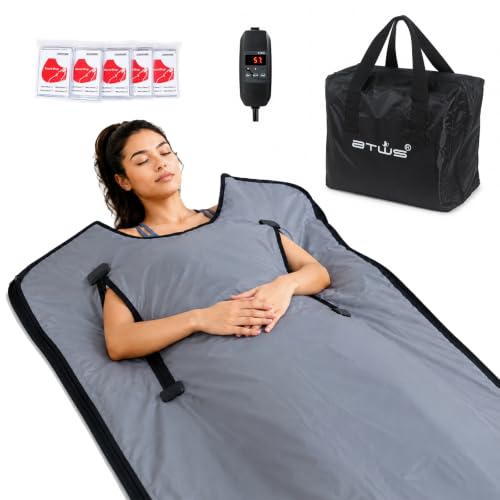
As an Amazon Associate we earn from qualifying purchases at no extra cost to you. Ratings are shown as listed on Amazon.
Best infrared sauna blankets by situation
| Situation | Best fit | Why it makes sense | Typical price range |
|---|---|---|---|
| First blanket or occasional use | Entry-level far-infrared blanket | Lower cost, simple controller, usually 120–150°F maximum | $180–$350 |
| Frequent home relaxation | HigherDOSE Infrared Sauna Blanket | Established design, multiple heat zones, washable absorbent insert and straightforward controls | $600–$800 |
| Preference for stronger heat | Sun Home Saunas Heatwave | High heat setting, broad coverage and a substantial multi-layer construction | $500–$700 |
| Small apartment or limited storage | Lightweight folding blanket under 15 lb | Fits in a closet or under-bed storage more easily than a sauna tent | $180–$450 |
| Uncertain whether you will use one regularly | Midrange blanket with a clear return policy | Reduces the risk of paying for advanced zones or features that remain unused | $300–$550 |
Our top choices, compared head-to-head
HigherDOSE Infrared Sauna Blanket: best overall for a refined ownership experience
The HigherDOSE blanket is a strong choice for someone who wants a recognizable, well-finished product rather than the lowest possible price. Its far-infrared heating system is arranged in several body zones, allowing heat to be distributed from the upper body toward the legs instead of being concentrated in one small area. The control unit offers multiple heat settings and a timed session, which is more useful than a large collection of modes that are difficult to interpret.
The blanket is typically listed at about 71 inches long and 31 inches wide, although the usable interior is smaller once the side flaps are folded around the body. That size suits many adults, but very tall users should check the current dimensions before buying. It folds for storage, though its layered construction makes it heavier and less compact than a thin electric throw.
Its exterior includes a water-resistant material, while an absorbent insert helps protect the interior from sweat. That insert is important: cleaning the blanket itself repeatedly with excess water can shorten the life of wiring, seams and the controller connection. The trade-off is price. You are paying for materials, design refinement and a more complete accessory package, not a dramatically different type of infrared heating.
Sun Home Saunas Heatwave: best for users who prioritize maximum heat
The Heatwave is aimed at buyers who want a hotter session and a more substantial blanket. Its advertised maximum is around 158°F, with adjustable heat zones and a timer. In practical use, maximum temperature is less important than whether the blanket reaches a comfortable, even warmth without requiring you to remain at the top setting.
Its multi-layer construction can feel more insulated and durable than budget models, but also makes it heavier to move. The dimensions are suitable for a typical adult lying down, with enough wraparound material to retain heat. As with any blanket, the fit depends on body shape and clothing: thick clothing creates pressure points and can reduce the sensation of even heating.
This is a better match for frequent users who have a permanent or semi-permanent setup location. If you must carry it up stairs after every session, a lighter model may be the more practical choice, regardless of the headline temperature.
Budget far-infrared blankets: best value when expectations are realistic
Budget blankets commonly use carbon-fiber heating elements, a PVC or polyurethane-coated outer surface, and three to five heating zones. Typical dimensions are 68–72 inches long by 28–32 inches wide, with weights between 8 and 15 pounds. Temperature ranges often run from approximately 95°F to 150°F, and timers commonly span 30–60 minutes.
These products can work well for occasional relaxation, but quality varies more widely. Before buying, look for a controller that displays both temperature and time, an automatic shutoff, a detachable power cord, insulated internal wiring and a published warranty. A very low price is less attractive if the blanket has no replacement controller or if the return process is unclear.
What specifications actually matter?
| Feature | Useful target | Why it matters at home |
|---|---|---|
| Temperature range | 95–150°F for general use; up to about 158°F for high-heat preference | A broad low setting is useful for gradual sessions; maximum temperature is not a quality guarantee |
| Heating zones | At least 3; 5 or more is preferable | More zones can improve consistency from shoulders through legs |
| Dimensions | About 68–72 by 28–32 inches | Fits most beds or mats while remaining foldable; taller users should measure first |
| Weight | 8–15 lb for easy storage; 15–25 lb for heavier premium builds | Determines whether you will actually put it away after each session |
| Timer | 30–60 minutes with automatic shutoff | Prevents an unattended blanket from running indefinitely |
| Outer material | Water-resistant polyurethane, PVC or similarly wipeable coating | Allows sweat to be cleaned without soaking the electrical layers |
| Power | Roughly 100–200 watts | Low household energy demand, but the plug and cable still need careful handling |
Controls, portability and cleaning
A good controller should let you set temperature and session length without forcing you to use a phone app. A wired controller is usually preferable because it remains available inside the blanket and does not depend on Bluetooth, charging or software updates. Separate zone controls are useful if your feet feel cold while your torso is already warm, but they add cost and complexity.
Portability is determined by more than the folded dimensions. Check the packed weight, whether the power cable detaches, and whether the blanket can be rolled without creating a sharp crease. Store it loosely rolled or folded along its existing seams. Avoid placing heavy objects on top of it, since repeated compression can damage heating elements.
For cleaning, unplug the unit and let it cool completely. Remove any washable liner, wipe the interior and exterior with a lightly damp cloth and a mild cleaner, then allow every surface to dry before storage. Do not machine-wash the electrical blanket, immerse it, spray cleaner into the controller socket or use bleach. A towel liner or dedicated sauna blanket insert reduces sweat buildup and is usually easier to wash.
Running-cost calculation
Most infrared blankets draw approximately 100–200 watts. At 150 watts, a 45-minute session uses:
0.15 kW × 0.75 hours = 0.1125 kWh.
At an electricity rate of $0.20 per kWh, that is about 2 cents per session, or roughly $5.40 for 20 sessions. The purchase price, replacement liners and your time spent setting it up are more significant ownership costs than electricity. A $600 blanket used 100 times costs about $6 per use before electricity; used only 20 times, it costs about $30 per use. Frequency of use should therefore guide the budget more than wattage.
Safety features and common mistakes
- Choose automatic shutoff and use the timer every session.
- Place the blanket on a flat, dry surface with no sharp objects underneath.
- Inspect the power cord, connector and controller for heat damage or fraying.
- Do not sleep inside the blanket, fold it while powered on or cover the controller with bedding.
- Drink water normally, avoid alcohol before use and stop if you feel dizzy, nauseated, unusually weak or unwell.
- Start at a low temperature for 15–20 minutes rather than beginning at the maximum setting.
- Ask a healthcare professional before using one if you are pregnant, have a condition affected by heat, have reduced heat sensation or take medication that affects hydration or temperature regulation.
How to choose the best infrared sauna blanket for you
Measure your usable floor or bed space first, then select a blanket that can remain flat without blocking walkways. For one or two sessions per month, an entry-level model with reliable safety controls is sufficient. For several sessions each week, prioritize a washable liner, replaceable or detachable controls, even heating and a warranty over extra marketing features. Choose a higher-temperature model only if you know you prefer intense heat; otherwise, adjustable low settings and easy cleaning will have a greater effect on long-term satisfaction.
For most households, the HigherDOSE is the balanced premium pick, the Sun Home Heatwave suits users who specifically want higher heat, and a carefully selected budget far-infrared blanket is the sensible choice for occasional use. The best option is the one whose size, setup time and cleaning routine make regular use easy—not simply the blanket with the highest temperature number.





Write Your Review
No reviews yet. Be the first to share your experience!