

Key takeaways
- 6 inches: Fastest and most efficient for panfish and smaller game fish. It can be restrictive for large trout, pike, lake trout, or fish wearing bulky rigs.
- 8 inches: The best general-purpose diameter for most anglers. It provides useful fish clearance without the energy penalty of a 10-inch bit.
- 10 inches: Best when large fish or wide tip-up openings matter more than portability and battery life.
The best ice auger for most anglers is a 40-volt electric model with an 8-inch bit: it delivers fast, clean holes without gas fumes, while a manual auger remains the lightest and most affordable choice for occasional use.
Your decision mainly comes down to how many holes you drill, how thick the ice becomes, and whether you value minimum weight or maximum speed. Gas augers still make sense for guides, permanent shelters, and very thick ice, but modern electric augers are quieter, easier to start, and usually simpler to maintain.
Our top picks


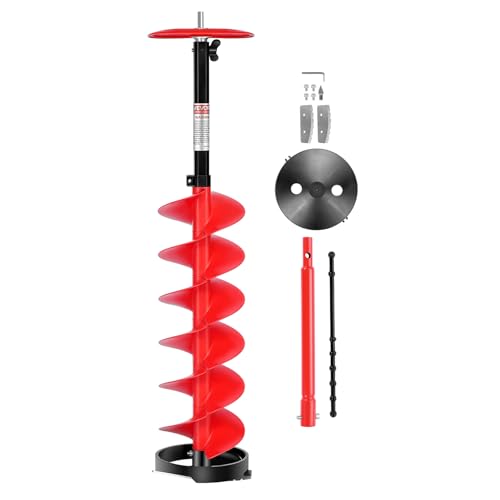
As an Amazon Associate we earn from qualifying purchases at no extra cost to you. Ratings are shown as listed on Amazon.
Best ice augers by situation
| Situation | Best choice | Why it fits | Main compromise |
|---|---|---|---|
| Occasional trips and tight budget | Manual 6- or 8-inch auger | Low purchase cost, no fuel or charging, typically 6–10 lb | Slowest option, especially through thick ice |
| Most mobile anglers | 40V electric auger | Fast drilling, clean operation, roughly 20–40 holes per charge in common conditions | Battery and charger add cost and weight |
| Many holes or a permanent shelter | Gas auger | Rapid refueling and strong performance through thick ice | Heavier, louder, and more maintenance-intensive |
| Portable shelter with limited room | Compact electric or manual auger | No fuel storage and easier transport inside a sled or vehicle | Battery capacity can be limiting in extreme cold |
| Large fish and tip-ups | 8- or 10-inch electric or gas auger | More room for fish, hooks, and flared fins | Larger bits cut more slowly and consume more energy |
Head-to-head comparison: gas, electric, and manual
| Auger type | Typical drilling speed | Common weights | Typical hole sizes | Practical ice thickness | Ownership considerations |
|---|---|---|---|---|---|
| Manual | About 30–60 seconds through 12–18 inches of ice | 6–11 lb | 6, 7, 8, and 10 inches | Up to roughly 24–30 inches for a fit angler with sharp blades | Lowest cost; blades and pivot points need occasional attention |
| Electric | About 5–15 seconds through 12–18 inches | 17–30 lb with battery | 6, 8, and 10 inches | Commonly 24–36 inches, depending on motor and battery | Quiet and clean; battery capacity falls in severe cold |
| Gas | About 5–12 seconds through 12–18 inches | 25–35 lb fueled | 6, 8, 9, and 10 inches | Usually 30–48 inches with suitable shaft length | Fast refueling; requires fuel care, spark-plug service, and winter storage |
These are useful planning ranges rather than guarantees. Ice hardness, blade sharpness, operator technique, bit diameter, and the length of the shaft all change the result. A 10-inch hole can require substantially more torque and battery power than an 8-inch hole because it removes about 56 percent more ice volume for the same thickness.
Best electric ice augers
StrikeMaster Lithium 40V Lite or Lite-Flite
StrikeMaster’s 40V Lithium line is a strong all-around choice for anglers who want speed without the noise and fumes of a gas engine. The Lite-Flite cutting system is designed for efficient drilling, and available configurations commonly include 6-, 8-, and 10-inch sizes. A 40V battery system is particularly attractive when you drill several holes while moving between locations.
Choose the 8-inch version for general walleye, trout, bass, and panfish use. The 6-inch model is faster and easier to carry but leaves less room for larger fish. The 10-inch version is useful for trophy species and tip-ups, although its extra cutting load reduces the number of holes per charge.
ION Alpha Plus
The ION Alpha Plus is another established electric option for anglers prioritizing fast cutting and a modern, low-maintenance design. Models in this category typically use an integrated battery and a brushless motor, with an 8-inch format offering a practical balance between speed, portability, and fish clearance.
Electric augers are at their best when you can recharge between outings. If you fish several consecutive days away from power, budget for a second battery and keep both warm until use. Do not assume the manufacturer’s maximum hole count will apply to thick, wet, or refrozen ice; real-world capacity is usually lower in those conditions.
When a gas auger is still the better tool
Gas remains the practical choice when drilling speed must stay consistent over a long day and carrying spare fuel is easier than carrying spare batteries. A gas auger can be refueled in minutes, while a depleted battery may take hours to recharge. It is also a sensible option for guides, tournament anglers, or anyone repeatedly drilling through more than 24 inches of ice.
The trade-off is ownership effort. Gas models are heavier, louder, and less pleasant inside or near a shelter. Use fresh fuel in the correct mixture, inspect the fuel line, and follow the manufacturer’s storage procedure at the end of the season. Fuel left untreated for months is a common cause of hard starting and carburetor problems.
Why a manual auger can be the smartest buy
A manual auger is not merely a budget substitute. It is often the best choice for a person who drills only a few holes, hikes long distances, or wants equipment that works without a charged battery. A sharp manual 6-inch auger can be remarkably quick through moderate ice and is much easier to lift repeatedly than a heavy motorized unit.
Choose a folding-handle model if storage space matters, but check that the hinge locks firmly and does not develop sideways play. Adjustable-height handles can improve comfort for taller users. For frequent use in thick ice, a manual auger becomes tiring because every additional hole requires the same physical effort.
Hole diameter, blade durability, and cutting design
- 6 inches: Fastest and most efficient for panfish and smaller game fish. It can be restrictive for large trout, pike, lake trout, or fish wearing bulky rigs.
- 8 inches: The best general-purpose diameter for most anglers. It provides useful fish clearance without the energy penalty of a 10-inch bit.
- 10 inches: Best when large fish or wide tip-up openings matter more than portability and battery life.
Blade durability depends more on edge protection than on marketing claims. Striking sand, gravel, or a hidden rock can damage any cutting edge. Never set an auger directly on the ice near slush contaminated with grit, and fit a blade guard whenever the tool is being transported. Curved or serrated replacement blades may improve performance in certain ice conditions, but only use the blade style specified for the head.
Replace or service blades when the auger begins riding on the surface, requires unusual downward pressure, produces a ragged hole, or leaves a thick ice plug. Do not sharpen disposable-style blades with an improvised file unless the manufacturer specifically allows it; changing the bevel can make a sharp-looking blade cut poorly or become unsafe.
A simple battery-runtime calculation
Suppose an electric auger produces 30 holes in 16-inch ice with one battery, and you expect to drill 18 holes. That leaves an estimated 12-hole reserve under similar conditions. If you switch from an 8-inch to a 10-inch bit, the larger opening removes approximately 56 percent more ice per hole. A conservative planning estimate would therefore be around 19 holes rather than 30, before accounting for cold-weather losses.
For that reason, an 8-inch auger is often the economical choice even when a larger hole sounds appealing. Carry a second battery when the forecast is very cold, the ice is unusually thick, or you are drilling holes for a group.
Setup and maintenance that prevent most problems
- Charge and warm batteries before leaving. Cold batteries deliver less usable capacity. Keep spare packs insulated, but never place a wet or damaged battery against a direct heat source.
- Inspect the cutting head. Look for nicks, loose fasteners, bent guards, and ice packed beneath the blade.
- Start with the auger vertical. Let the blades bite at full speed without forcing the tool sideways. Excessive pressure increases wear and can overload an electric motor.
- Clear slush regularly. Lift the auger briefly during drilling so chips can escape, particularly in deep or wet ice.
- Dry everything after use. Wipe the shaft, cutting head, fasteners, and battery contacts. Meltwater left on metal parts promotes corrosion.
- Protect the blades during transport. A blade guard prevents damage to the edge and protects hands, sleds, and vehicle interiors.
Final buying recommendation
For most people, buy an 8-inch electric auger with a 40V-class battery, a brushless motor, a removable battery, and readily available replacement blades. Select a manual auger if low weight, low cost, and occasional use matter most. Select gas when you drill dozens of holes, work in very thick ice, or cannot depend on access to a charger. Whichever type you choose, prioritize blade protection and replacement-part availability: worn cutting edges usually affect performance long before the motor or frame reaches the end of its useful life.






Write Your Review
No reviews yet. Be the first to share your experience!