

Key takeaways
- Remove all plastic packaging from a new filter before installation. Leaving the wrapping on can severely restrict airflow.
- Keep intake and exhaust openings clear by at least several inches; more clearance is helpful for large units.
- Vacuum or wash only the part the manual identifies as washable. Do not wash a HEPA or combined filter unless the manufacturer explicitly permits it.
- Reset the filter indicator after replacement, but do not rely on the indicator alone. Dust loading, odors, reduced airflow, and persistent fan noise can justify an earlier inspection.
- Use the highest practical speed after cooking, cleaning, or opening windows to outdoor pollution, then return to a quieter setting.
- Do not use an ozone-generating device as an alternative to particle filtration. Ozone can irritate the respiratory system and is not a substitute for removing particles.
The best HEPA air purifiers are the ones that combine verified particle filtration with enough clean-air delivery for your room, acceptable noise, reasonably priced replacement filters, and energy use you can tolerate every day.
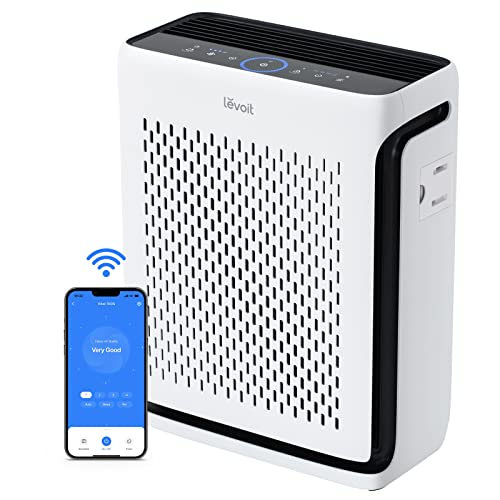
For most bedrooms and offices, the Levoit Core 300S is a sensible compact choice; the Winix 5500-2 is a strong value for medium rooms; the Blueair Blue Pure 211i Max suits large, frequently occupied spaces; and the Coway Airmega 400S is better for open-plan areas where high airflow matters more than a small footprint. If long filter life and a highly durable metal cabinet are priorities, the Austin Air HealthMate is a different, higher-cost option.
Our top picks


As an Amazon Associate we earn from qualifying purchases at no extra cost to you. Ratings are shown as listed on Amazon.
Best HEPA air purifiers by room and situation
| Situation | Recommended model | Why it fits | Important compromise |
|---|---|---|---|
| Small bedroom, nursery, or office | Levoit Core 300S | About 141 CFM smoke CADR, compact body, low sleep-mode noise | Not designed for fast cleaning of large open rooms |
| Medium bedroom or living room on a budget | Winix 5500-2 | About 232 CFM smoke CADR, washable prefilter, widely available replacement filters | Its optional ionizer should be disabled if you want filtration without ionization |
| Large living room or high-use common area | Blueair Blue Pure 211i Max | About 435 CFM CADR and a quiet low-speed setting for its output | Larger replacement filters and a relatively large footprint |
| Open-plan home or several connected rooms | Coway Airmega 400S | About 328 CFM smoke CADR, dual-sided intake, two large filter cartridges | Costs more and works best where air can circulate freely |
| Heavy, continuous use and rugged construction | Austin Air HealthMate | Large multi-stage filter, steel cabinet, roughly 400 CFM airflow | Heavy, less refined controls, and higher purchase and filter costs |
What the numbers actually tell you
HEPA filtration describes the filter’s ability to capture very small airborne particles under a defined test method. It does not, by itself, tell you how quickly the purifier cleans a room. For that, look at CADR, or clean-air delivery rate. A purifier with a very efficient filter but weak airflow can deliver less clean air per hour than a larger purifier with a similar filter.
Smoke CADR is usually the most useful of the commonly published CADR figures because it represents smaller particles than dust or pollen. Manufacturer room-size claims can use different air-change assumptions, so compare CADR when models are close in size.
A practical room-size calculation
To estimate air changes per hour (ACH), use:
ACH = CADR × 60 ÷ room volume
For a 12-by-15-foot bedroom with an 8-foot ceiling, the volume is 1,440 cubic feet. A purifier rated at 141 CFM gives approximately:
141 × 60 ÷ 1,440 = 5.9 air changes per hour
That is a theoretical maximum at the tested airflow. Real-world results will be lower when the purifier is in a corner, the filter is dirty, doors are open, or the selected speed is quiet mode. If the room is twice as large, the same purifier provides roughly half the ACH.
Head-to-head comparison of leading choices
| Model | Published particle-performance figure | Suggested room size | Noise and controls | Filter and ownership notes |
|---|---|---|---|---|
| Levoit Core 300S | About 141 CFM smoke CADR | About 219 sq. ft. at a high air-change assumption | Sleep mode rated around 22 dB; app and automatic mode | Replaceable cylindrical filter; commonly about $25–$50 per replacement, depending on version and seller |
| Winix 5500-2 | About 232 CFM smoke CADR | About 360 sq. ft. | Multiple fan speeds, sleep mode, air-quality sensor | Washable mesh prefilter; carbon filter and HEPA-style replacement set commonly about $30–$60 |
| Blueair Blue Pure 211i Max | About 435 CFM smoke CADR | About 635 sq. ft. | Approximately 23 dB at low speed; app, scheduling, and automatic mode | Large combined filter; typical replacement range about $50–$90 |
| Coway Airmega 400S | About 328 CFM smoke CADR | About 1,560 sq. ft. at a lower air-change assumption | Automatic mode, timer, app, and filter indicator | Uses two large replacement filters; commonly about $70–$130 per set |
| Austin Air HealthMate | Roughly 400 CFM airflow; CADR comparisons are not always published in the same format | Up to about 1,500 sq. ft., depending on conditions | Simple multi-speed control; generally louder and less feature-rich | Large combined filter often lasts about 3–5 years according to the manufacturer; replacements commonly cost about $200–$300 |
Published figures can vary by testing standard, product revision, and operating speed. Treat the table as a comparison guide rather than a guarantee for every room. Models with “HEPA-type,” “HEPA-like,” or proprietary particle filters should not automatically be treated as equivalent to a purifier that clearly identifies a tested HEPA filter or publishes an applicable efficiency standard.
Which purifier is best for your priorities?
Choose the Levoit Core 300S for small rooms
Its compact size and low sleep-mode noise make it easy to place near a bed or desk. It is a good fit when the door is usually closed and the room is no more than a modest bedroom or office. It becomes a poor value if you expect one unit to clean a large living area, because it must run at a high setting for longer and still produces less clean air than a larger model.
Choose the Winix 5500-2 for value and simple maintenance
The washable prefilter catches hair and larger dust before they reach the main filter. This can help preserve airflow, but it does not eliminate filter replacement. Let the prefilter dry completely before reinstalling it. The unit includes an ionization feature; disable it if you prefer a mechanical-filtration-only setup.
Choose the Blueair 211i Max when airflow matters most
Its high CADR is useful for a large living room, workshop-adjacent space, or area where doors open frequently. The tradeoff is physical size and the cost of its large replacement filter. A high-output purifier can also be more noticeable at the speed required for rapid cleaning, even when its lowest setting is quiet.
Choose the Coway Airmega 400S for open-plan coverage
Its dual-filter design and large intake area suit rooms where air can move around the unit. Put it in a central, unobstructed position rather than against a wall or inside furniture. Its very large manufacturer coverage figure assumes a lower number of air changes than the smaller-room claims printed for many compact models, so do not compare square-foot figures without checking the underlying ACH assumption.
Choose the Austin Air HealthMate for long ownership cycles
The steel housing and large filter appeal to people who want a durable, uncomplicated appliance. It is heavy—roughly 45–50 pounds—and has fewer smart features than newer competitors. Its replacement filter costs more, but replacing it less frequently may make the long-term cost competitive for continuous use. Check the filter condition sooner if it operates around smoke, construction dust, or heavy household debris.
Energy use: a small calculation that changes the choice
Suppose a purifier draws 45 watts and runs continuously. At an electricity rate of $0.16 per kilowatt-hour:
0.045 kW × 24 hours × 365 days × $0.16 = about $63 per year
A 10-watt sleep setting would cost about $14 per year at the same rate, while a 70-watt high setting would cost about $98 per year. Automatic mode can reduce energy use, but sensor-controlled operation is not always aggressive enough for rapid particle removal. If cleaning speed matters, run a suitable high speed for a defined period, then reduce it once the room is cleaner.
Filter replacement and setup practices that matter
- Remove all plastic packaging from a new filter before installation. Leaving the wrapping on can severely restrict airflow.
- Keep intake and exhaust openings clear by at least several inches; more clearance is helpful for large units.
- Vacuum or wash only the part the manual identifies as washable. Do not wash a HEPA or combined filter unless the manufacturer explicitly permits it.
- Reset the filter indicator after replacement, but do not rely on the indicator alone. Dust loading, odors, reduced airflow, and persistent fan noise can justify an earlier inspection.
- Use the highest practical speed after cooking, cleaning, or opening windows to outdoor pollution, then return to a quieter setting.
- Do not use an ozone-generating device as an alternative to particle filtration. Ozone can irritate the respiratory system and is not a substitute for removing particles.
Bottom line
For a small enclosed room, buy for quiet operation and adequate CADR rather than oversized coverage claims. For a living room, prioritize smoke CADR and affordable filters. For open-plan spaces, choose a larger unit and position it where air can circulate. The best HEPA air purifiers are not necessarily the ones with the biggest advertised square-foot number; they are the models whose verified filtration, real airflow, noise, running cost, and maintenance requirements match the room you will use every day.
This article provides general product information, not medical advice. Anyone with significant respiratory concerns, allergies, or other health questions should discuss indoor-air strategies with a qualified healthcare professional.





Write Your Review
No reviews yet. Be the first to share your experience!