

Key takeaways
- Electronic muffs that amplify range commands, slim cups that clear a rifle stock, and a passive NRR 31 pair: the best shooting ear muffs compared.
As an Amazon Associate we earn from qualifying purchases.
Affiliate Disclosure: This article contains affiliate links. If you buy through a link on this page, we may earn a commission at no extra cost to you.
A single unsuppressed gunshot at the muzzle runs well past the level where permanent hearing damage can happen in one exposure, and the damage is cumulative and painless enough that most shooters notice it years too late. Ear muffs are the simplest fix, but picking a pair is not just a matter of grabbing the biggest number on the box. The Noise Reduction Rating is a laboratory figure, electronic muffs handle a shot differently from passive ones, and the cup that protects best on an indoor range may be the cup that knocks against your rifle stock in the field.
The five picks below cover the realistic spread: slim electronic muffs that amplify range commands and game movement while clamping down on gunfire, a gel-padded electronic option for long sessions, and a maximum-attenuation passive muff for loud indoor ranges and magnum rifles. Each one is sold on Amazon, and each section sticks to what the manufacturer actually publishes about that model.
1. Howard Leight Impact Sport (R-01526) — the slim-cup standard for hunters
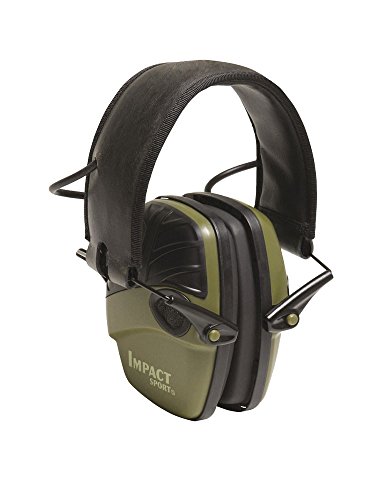
The Impact Sport is the muff that defined the slim electronic category, and the cut of the earcup is the reason. The bottom of each cup is cut away so the stock of a rifle or shotgun can come up into a natural cheek weld without shoving the muff off your ear and breaking the seal. A broken seal is lost protection, so for long-gun shooters that shape matters more than a few extra points of rating.
Electronically, two directional microphones amplify low-level sound up to four times — range commands, conversation, footsteps and game movement in the woods — and the circuit shuts amplification off when impulse noise reaches 82 dB, leaving the passive shell to do the work. Howard Leight rates it at NRR 22 with the electronics on or off. Power comes from two AAA batteries for roughly 350 hours of use, with an automatic shut-off after four hours so a forgotten muff in the range bag does not drain itself. A 3.5 mm input and included cord let you plug in a phone or a scanner, and the whole unit folds flat. The honest trade-off: NRR 22 is modest for indoor ranges and compensated rifles, where doubling up with plugs underneath is the sensible move.
Specs
- Brand: Howard Leight (Honeywell)
- Model: Impact Sport, R-01526
- Type: Electronic, sound amplification
- NRR: 22 dB
- Amplification: Up to 4x, shuts off at 82 dB impulse noise
- Microphones: 2 directional
- Battery: 2 AAA (included), about 350 hours, 4-hour auto shut-off
- Audio input: 3.5 mm jack with cord included
- Design: Low-profile cutaway earcups, folding headband
2. Walker’s Razor Slim Electronic Muff — fast compression, flatter profile

Walker’s built the Razor Slim around one number: a sound-activated compression circuit with a reaction time of 0.02 seconds. That is the interval between the muzzle blast arriving and the electronics squeezing it down to a safe level, and a fast circuit means less of the shot’s crack leaks through before the muff responds. Walker’s uses compression rather than simple clipping, so softer sounds around the shot are squeezed instead of chopped off entirely, which keeps speech more natural between shots.
The rating is NRR 23, a point above the Howard Leight, and the cups are among the flattest in the class — Walker’s calls them ultra low-profile, with a rubberized coating that shrugs off knocks in a range bag. Two omnidirectional microphones feed the amplification, tuned toward natural sound clarity rather than sheer volume. There is a 3.5 mm audio input jack for external devices, a recessed volume control that is hard to bump accidentally, and power comes from two AAA batteries. Like most slim muffs, the clamping force is firm; that is what keeps the seal on a moving head, but shooters who wear them for a full day may notice it by the afternoon.
Specs
- Brand: Walker’s
- Model: Razor Slim Electronic Muff (GWP-RSEM)
- Type: Electronic, sound-activated compression
- NRR: 23 dB
- Reaction time: 0.02 seconds
- Microphones: 2 omnidirectional
- Battery: 2 AAA
- Audio input: 3.5 mm jack
- Design: Ultra low-profile rubberized earcups, compact folding frame
3. 3M Peltor Sport Tactical 100 (TAC100-OTH) — cleaner sound for the range
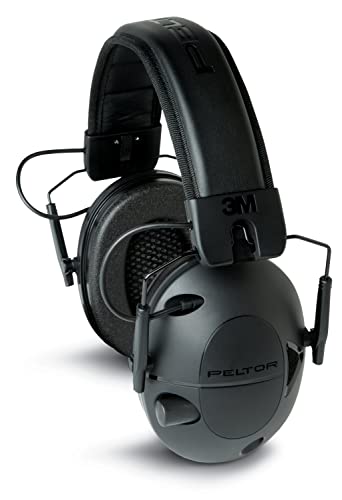
The Sport Tactical 100 is 3M’s answer to the same slim electronic brief, with the emphasis shifted toward sound quality. Its variable suppression time lets you adjust how long the electronics hold a loud sound down, which tames the echo and flutter that indoor ranges produce, and 3M’s adaptive frequency response filters steady background noise — ventilation systems, distant lanes — so voices come through with less hiss behind them. The microphones are recessed into the cups, which cuts wind noise outdoors.
The rating is NRR 22, the cups are low-profile enough to clear a shotgun or rifle stock, and the padded, adjustable headband is built for long strings of fire. It runs on two AAA batteries and includes a 3.5 mm input for a phone or radio. Where it differs from the two muffs above is feel rather than figures: the electronic processing is more refined, and the trade-off is that it gives up a point of rated reduction to the Walker’s while costing its owner nothing in stock clearance. For an indoor-range regular who shoots beside other lanes all morning, that cleaner audio is the deciding factor.
Specs
- Brand: 3M Peltor
- Model: Sport Tactical 100, TAC100-OTH
- Type: Electronic, sound amplification with variable suppression time
- NRR: 22 dB
- Frequency response: Adaptive, filters background noise
- Battery: 2 AAA
- Audio input: 3.5 mm jack
- Design: Low-profile earcups, padded adjustable headband, recessed microphones
4. Walker’s Razor Slim X-TRM — gel pads for long sessions

The X-TRM takes the Razor Slim platform and fixes the complaint that follows most slim muffs through a long day: ear fatigue. The ear cushions are gel cooling pads, which sit softer against the head, seal well around the temples of shooting glasses, and do not turn clammy in summer heat the way standard foam does. A moisture-wicking headband handles the rest of a hot range day.
Underneath, the electronics match the standard Razor Slim brief — sound-enhancing amplification with fast compression, an NRR of 23, and two AAA batteries, which Walker’s includes in the box. The cups stay slim enough for rifle and shotgun work. The honest note is that gel pads are a wear item like any cushion, and the benefit here is comfort across hours, not extra protection: the rating is the same NRR 23 as the regular Razor Slim. If your sessions are short, the standard model covers you. If you instruct, shoot matches, or spend full days on a line, the pads are the difference between a muff you keep on and a muff you keep lifting off — and a lifted muff protects nothing.
Specs
- Brand: Walker’s
- Model: Razor Slim X-TRM
- Type: Electronic, sound-enhancing with compression
- NRR: 23 dB
- Ear cushions: Gel cooling pads
- Headband: Moisture-wicking
- Battery: 2 AAA (included)
- Design: Slim low-profile earcups for long-gun clearance
5. 3M Peltor X5A — maximum passive protection, no batteries

The X5A sits at the opposite end of the design space: no microphones, no batteries, no circuits — just the highest attenuation 3M builds into a passive muff, rated NRR 31. The cups are deep and heavily lined, the headband is electrically insulated (dielectric), and the ear cushions and foam liners are replaceable through 3M’s HYX5 hygiene kit, so a worn seal can be renewed instead of replacing the whole muff.
That rating makes it the right pick for the loudest environments in this roundup: indoor ranges, magnum rifles, muzzle brakes, and shooters who double up with foam plugs underneath for the strongest combination available. What you give up is everything electronic — no amplification of range commands, no awareness of game sounds in the field — and size. These are bulky cups, and they will interfere with a rifle or shotgun stock; for long guns they are the wrong tool. For a pistol range, a sight-in bench with a braked rifle, or a new shooter who simply wants the most reduction on the shelf, the X5A is the honest answer.
Specs
- Brand: 3M Peltor
- Model: X5A, X Series
- Type: Passive
- NRR: 31 dB
- Headband: Over-the-head, electrically insulated (dielectric)
- Cushions: Replaceable via 3M HYX5 hygiene kit
- Power: None required
- Design: Deep high-attenuation earcups, tilting pivot points for seal
How to Choose
Start with what NRR actually means. The Noise Reduction Rating is measured in a laboratory on trained subjects with a perfect fit. Real ears, real heads and a hurried fit deliver less — safety guidance commonly derates a muff’s labeled figure substantially before estimating field performance. Read NRR as a comparison between models, not a promise: an NRR 31 muff attenuates more than an NRR 22 muff on the same head, and neither delivers its full number if the seal is broken by glasses arms, a hat brim, or long hair tucked underneath.
Electronic or passive? Electronic muffs amplify quiet sound — range commands, a spotter’s call, deer moving in dry leaves — and compress or shut off amplification when a shot fires. That awareness is why hunters and range shooters default to them. Passive muffs are simpler, need no batteries, and reach the highest ratings, but they muffle everything equally, voices included. Many experienced shooters own one of each.
Compression versus clipping. Two electronic designs exist. Clipping circuits simply switch amplification off above a threshold, which can chop speech into fragments around gunfire. Compression circuits reduce the loud sound’s level while keeping quieter sound running, which sounds more natural. Reaction time matters too: the faster the circuit responds to the shot, the less of the initial crack reaches your ear.
Mind the stock. Slim, low-profile cups exist for one reason: a deep cup collides with a rifle or shotgun stock at the moment of the shot and levers the muff off the ear. Long-gun shooters should start with the slim electronic picks. Deep passive cups belong on pistol ranges and benches.
Doubling up is legitimate. For indoor ranges and braked or magnum rifles, foam plugs under muffs add meaningful extra protection, and electronic muffs still let you hear commands through the combination. If a venue is loud enough that you are shouting between strings, double up.
Fit is the rating. Whatever you buy, seat the cups fully around the ears, route glasses arms over the cushions where possible, and replace flattened cushions — on the X5A they are a spare part, not a new muff.
FAQ
Is NRR 22 enough for shooting?
For outdoor rifle and shotgun shooting, an NRR 22–23 electronic muff is the common choice and keeps most shooters comfortable. Indoors, with muzzle brakes, or with magnum calibers, step up to a higher-rated muff like the NRR 31 X5A or wear plugs under your muffs.
Do electronic muffs protect as well as passive ones when the batteries die?
Yes. The passive shell and cushions provide the rated reduction on their own; the batteries only power the microphones and amplification. A dead electronic muff is a passive muff, not an unprotected ear.
Why do my muffs fail with shooting glasses?
Glasses arms pass under the cushion and open a small channel that leaks sound. Thin-armed glasses, gel cushions like the X-TRM’s, and seating the arms above the cushion all reduce the leak. The seal, not the electronics, is what you are fixing.
Can I hear game and range commands through electronic muffs?
That is their purpose. Directional microphones amplify low-level sound — the Impact Sport up to four times — and voices and movement stay audible while gunfire is compressed. Volume is adjustable on all three electronic picks here.
How long do the batteries last?
The Impact Sport is rated for roughly 350 hours on two AAA batteries and shuts itself off after four hours to save them. The Walker’s and Peltor electronic models also run on two AAAs. The passive X5A needs no power at all.
Conclusion
Match the muff to the shooting you actually do. Hunters and long-gun shooters should start with a slim electronic muff — the Howard Leight Impact Sport for its stock-friendly cut and long battery life, or the Walker’s Razor Slim for a point more rated reduction and the fastest compression circuit here. Range regulars who value clean audio pick the Peltor Sport Tactical 100, all-day shooters pick the gel-padded X-TRM, and anyone facing indoor lanes or braked magnums should reach for the passive NRR 31 X5A, with plugs underneath when it gets truly loud. Whichever you choose, wear it for every shot: hearing loss from gunfire does not announce itself until it is permanent.
More from Amazon
Programs that pair well with the guide above. Offers and eligibility are set by Amazon and may change.
Free shipping on eligible items, Prime Video and more. Eligible new members can start with a free trial.
Start a Prime free trialA Prime membership for ages 18-24 with a trial period. Eligibility is set by Amazon.
See Prime for Young AdultsAudiobooks and podcasts to listen to on the go. Eligible new members can start with a free trial.
Try Audible freeAd-free music streaming. Eligible new subscribers can start with a free trial.
Try Music Unlimited freeAs an Amazon Associate we earn from qualifying purchases.










Write Your Review
No reviews yet. Be the first to share your experience!