

Key takeaways
- Inspect the rails, rungs, locks, rope, feet, and labels before each use.
- Choose firm, level ground and clear stones, hoses, toys, and other trip hazards.
- Keep the ladder at approximately a 75-degree angle using the 4-to-1 rule.
- Extend the ladder at least 3 feet above a roof edge or landing when it is being used for access.
- Face the ladder while climbing and keep both hands available by using a tool belt or hoisting tools separately.
- Keep your belt buckle between the rails; climb down and reposition rather than reaching sideways.
- Keep ladders away from overhead electrical lines and stop work in wind, rain, or lightning.
The best extension ladder for most homeowners is a 24-foot, non-conductive fiberglass ladder with a 300-pound duty rating, comfortable D-shaped or padded rungs, reliable over-center locks, and a closed length short enough for safe indoor storage.
That recommendation is not right for every job, however. A 16-foot ladder is easier to carry and store for one-story maintenance, while a 28- to 32-foot ladder may be necessary for high gables or two-story work. The right choice depends on reach height, transport weight, surface stability, and how often you will use it—not simply the maximum number printed on the label.
Our top picks

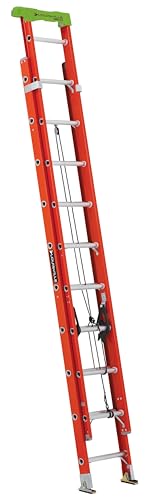


As an Amazon Associate we earn from qualifying purchases at no extra cost to you. Ratings are shown as listed on Amazon.
Best extension ladders by situation
| Situation | Best choice | Why | Important trade-off |
|---|---|---|---|
| Occasional gutter cleaning on a one-story house | 16- or 20-foot aluminum ladder | Lower cost, lighter weight, and easier handling | Aluminum conducts electricity and can feel less rigid |
| General two-story home maintenance | 24-foot fiberglass ladder | Good balance of reach, stability, and electrical non-conductivity | Usually heavier and more expensive than aluminum |
| High gables, tall trees, or substantial outdoor work | 28- or 32-foot fiberglass ladder | Provides more usable reach without standing on the top sections | Longer closed length, greater weight, and more difficult setup |
| Frequent transport between jobs or campsites | Lightweight aluminum extension ladder | Easier to load onto a vehicle and reposition | Requires strict separation from electrical hazards |
| Limited garage or shed space | Shorter two-section model or compact telescoping ladder | Stores in less vertical and horizontal space | Telescoping mechanisms need especially careful inspection and cleaning |
Reach height is not the ladder length
A 24-foot extension ladder does not safely provide 24 feet of working height. Extension ladders must usually extend at least 3 feet above a roof edge or landing, and the user should not stand on the highest marked steps. The practical working height is therefore lower than the product name suggests.
For a ladder leaning against a wall, use the 4-to-1 setup rule: place the feet approximately 1 foot away from the wall for every 4 feet of ladder height to the upper support point. If the ladder reaches 20 feet at the wall, the feet should be about 5 feet out. This improves the angle and reduces the chance of the ladder sliding backward or tipping.
Measure the actual height of the gutter, roof edge, or work area before buying. A 20-foot ladder may be suitable for a typical one-story gutter, but a 24-foot model is often the more useful general-purpose size for a two-story home.
Head-to-head: aluminum versus fiberglass
Aluminum
Aluminum ladders are generally the lightest and least expensive option. A 16- to 24-foot model may weigh roughly 25 to 45 pounds, depending on its duty rating and construction. That difference matters when one person must carry the ladder across a yard, rotate it upright, or place it on a vehicle.
The major limitation is electrical conductivity. Aluminum should not be used near overhead power lines, service drops, or any situation where the ladder could contact energized equipment. Aluminum rails can also dent if dropped, and a bent rail or damaged rung is a reason to remove the ladder from service.
Fiberglass
Fiberglass is the safer material around potential electrical hazards, although no ladder should be treated as electrically safe unless the manufacturer specifically states its rating and the work area has been assessed. Fiberglass models are commonly heavier: a 24-foot ladder may weigh approximately 45 to 65 pounds, with larger models exceeding that range.
Fiberglass rails can develop surface splinters, fading, or damage from sunlight and weather. Inspect the rails and do not use a ladder with cracks, exposed fibers, crushed sections, or missing labels. Fiberglass is often the better long-term choice for a homeowner who performs varied outdoor maintenance and wants one primary ladder.
Comparison of useful ladder specifications
| Ladder size | Typical closed length | Typical weight range | Practical use |
|---|---|---|---|
| 16 ft | 7 to 8 ft | 20 to 35 lb | Low roofs, one-story gutters, pruning, painting |
| 20 ft | 8 to 10 ft | 25 to 45 lb | Most one-story exterior work and some lower two-story tasks |
| 24 ft | 10 to 12 ft | 35 to 65 lb | General two-story maintenance and roof-edge access |
| 28 ft | 12 to 14 ft | 45 to 75 lb | High gables, tall buildings, and more demanding outdoor work |
| 32 ft | 13 to 16 ft | 55 to 90 lb | High-reach work where a shorter ladder cannot meet the setup requirement |
These are typical market ranges rather than specifications for every model. Check the manufacturer’s label for the exact closed length, weight, maximum standing level, and duty rating before ordering. A ladder rated Type IA or IAA, commonly 300 or 375 pounds, provides more capacity than a basic 200- or 250-pound household model. The rating includes the user, clothing, tools, and materials.
Rung comfort, locks, and stability
Rung design becomes important during work lasting more than a few minutes. Deep, serrated D-shaped rungs provide better foot contact than narrow round rungs. A slight angle or padded surface can reduce pressure on the soles, but comfort does not make prolonged ladder work safe; move the ladder instead of leaning far to one side.
Look for positive rung locks that engage automatically or visibly snap over the rung. Both locks should sit at the same height before climbing. Avoid using a ladder when a lock is bent, fails to engage fully, or can be lifted without releasing the mechanism. A rope and pulley make taller ladders easier to extend, but inspect the rope for fraying and replace it with the manufacturer’s specified part when necessary.
Stability begins at the feet. Wide, replaceable shoes with slip-resistant tread are preferable to narrow plastic caps. Some professional ladders offer levelers for uneven ground, but levelers do not turn loose soil, wet grass, or sloped rock into a safe base. Never place a ladder on boxes, buckets, loose boards, or other objects to gain height.
Setup checklist for safer outdoor work
- Inspect the rails, rungs, locks, rope, feet, and labels before each use.
- Choose firm, level ground and clear stones, hoses, toys, and other trip hazards.
- Keep the ladder at approximately a 75-degree angle using the 4-to-1 rule.
- Extend the ladder at least 3 feet above a roof edge or landing when it is being used for access.
- Face the ladder while climbing and keep both hands available by using a tool belt or hoisting tools separately.
- Keep your belt buckle between the rails; climb down and reposition rather than reaching sideways.
- Keep ladders away from overhead electrical lines and stop work in wind, rain, or lightning.
Ownership realities and storage
The parts that usually wear first are the rope, pulley, rung-lock springs, feet, and end caps. Dirt in the lock channels can prevent full engagement, so brush the mechanism and wipe the rails after dusty or muddy work. Do not lubricate a lock unless the manufacturer permits it; oily parts can attract grit and interfere with operation.
Store an extension ladder horizontally on two or more evenly spaced supports, with the sections fully retracted and secured against rolling. Keep it out of direct sunlight and away from heat, chemicals, and damp ground. Vertical storage can save floor space, but the ladder must be restrained at the top and bottom so it cannot fall. Do not hang heavy equipment from the rungs or leave the ladder extended in a driveway or yard.
For a simple ownership calculation, a $180 ladder used 18 times over six years costs $10 per use before replacement parts. A cheaper 20-foot ladder that cannot safely reach your gutters may be poor value, while an oversized 32-foot model can be wasteful if it is too heavy to set up. For most households, a well-rated 24-foot fiberglass ladder is the best compromise; choose a lighter 16- or 20-foot aluminum model when portability and low-height work matter more, and step up to 28 feet or more only when the required reach justifies the added handling difficulty.





Write Your Review
No reviews yet. Be the first to share your experience!