

Key takeaways
- Best for a rental, occasional use, or a tight budget: a top-loading bottle-fed cooler with hot and cold taps.
- Best for a family or small office: a bottom-loading bottle-fed unit, especially when lifting a full 3- or 5-gallon jug is inconvenient.
- Best for frequent drinking and low ongoing waste: a bottleless countertop or floor-standing cooler connected to a cold-water line.
- Best for limited floor space: a bottleless countertop dispenser or a slim top-loading unit, provided you have suitable counter and overhead clearance.
- Best for camping cabins, workshops, or unreliable plumbing: a bottle-fed model, since it continues working without a permanent water connection.
The best water cooler dispenser depends on one practical choice: pick a bottle-fed model for the simplest, lowest-installation setup, or choose a bottleless dispenser for frequent use, better long-term convenience, and no jug storage.
Our top picks

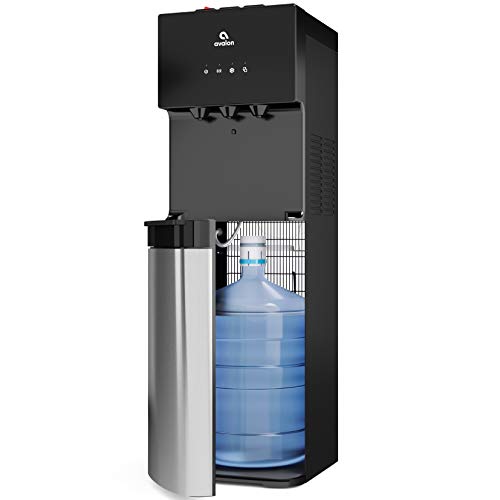


As an Amazon Associate we earn from qualifying purchases at no extra cost to you. Ratings are shown as listed on Amazon.
Quick picks by situation
- Best for a rental, occasional use, or a tight budget: a top-loading bottle-fed cooler with hot and cold taps.
- Best for a family or small office: a bottom-loading bottle-fed unit, especially when lifting a full 3- or 5-gallon jug is inconvenient.
- Best for frequent drinking and low ongoing waste: a bottleless countertop or floor-standing cooler connected to a cold-water line.
- Best for limited floor space: a bottleless countertop dispenser or a slim top-loading unit, provided you have suitable counter and overhead clearance.
- Best for camping cabins, workshops, or unreliable plumbing: a bottle-fed model, since it continues working without a permanent water connection.
Bottle-fed versus bottleless: the real difference
Bottle-fed dispensers draw water from an inverted jug or a bottom-mounted bottle. They are usually easier to install and move, but you must buy, transport, store, and clean the containers. A top loader is normally cheaper and has fewer pumps to fail. A bottom loader is easier to refill because the bottle remains on the floor, although its pump can add noise and eventually need replacement.
Bottleless dispensers connect to a cold-water supply and typically filter the water before sending it to a chilled reservoir. They avoid jug handling and are economical for offices or households that use several gallons every day. Installation is more involved: you need a nearby water line, a shutoff valve, sufficient pressure, and often an electrical outlet. A bottleless model is not automatically better water; its performance depends on the filter type, replacement schedule, and quality of the incoming supply.
Comparison of the best water cooler dispensers by specification
| Dispenser type | Typical cooling speed | Cold reservoir | Typical noise | Approximate footprint | Maintenance pattern |
|---|---|---|---|---|---|
| Top-loading bottle-fed | About 0.5–1.0 gallon per hour | 0.6–1.0 gallon | 45–55 dB | 11–13 in wide, 11–13 in deep, 38–45 in high | Jug replacement plus cleaning every 1–3 months |
| Bottom-loading bottle-fed | About 0.5–1.2 gallons per hour | 0.6–1.0 gallon | 50–60 dB when the pump runs | 11–13 in wide, 13–16 in deep, 40–45 in high | Jug replacement, pump inspection, and regular sanitizing |
| Bottleless countertop | About 0.5–1.5 gallons per hour | 0.4–0.8 gallon | 40–50 dB | 10–16 in wide, 12–18 in deep, 15–20 in high | Filter replacement every 6–12 months, sanitizing, leak checks |
| Bottleless floor-standing | About 0.8–2.0 gallons per hour | 0.8–1.5 gallons | 45–55 dB | 11–14 in wide, 13–17 in deep, 40–48 in high | Filter replacement every 6–12 months and periodic service |
These are typical ranges rather than guarantees. Compressor size, room temperature, ventilation, and whether the machine is being used continuously can change actual performance. Thermoelectric countertop units are often quieter, but they generally cool more slowly and may produce warmer water in a hot room.
Cooling speed and recovery: what matters at busy times
A dispenser’s cold reservoir determines how many glasses it can serve immediately. A unit with a 0.8-gallon cold tank can provide roughly ten 10-ounce servings before its stored supply is depleted. If its cooling rate is 0.8 gallon per hour, recovering that amount from room temperature could take close to an hour under ideal conditions.
For a household of two or three people, this is rarely a problem. In an office where ten people fill 16-ounce bottles during a short morning break, it can be. Look for a larger reservoir and a stated cooling rate of at least 1 gallon per hour, while remembering that a large tank does not mean the compressor can chill water quickly forever.
Cold-water temperature claims also need context. Many dispensers advertise water around 40–50°F, but the output usually becomes warmer after repeated servings. Leave several inches around the ventilation area, and do not place the cooler beside an oven, radiator, or sunny window.
Filtration: choose the filter for your water problem
Bottle-fed dispensers typically filter little or nothing because the water is already supplied in a sealed container. Check the jug supplier’s treatment and storage practices instead. Some bottleless models use sediment and carbon filters, which can reduce particles, chlorine taste, and odor. More advanced systems may add reverse osmosis, ultraviolet treatment, or specialized media.
Carbon filtration is often sufficient for improving municipal tap-water taste. Reverse osmosis can remove more dissolved substances, but it usually wastes some water, needs more frequent maintenance, and may require a storage tank. Neither filtration type makes an unknown water source automatically safe. If your water quality is uncertain, use current local water reports or ask a qualified water professional which treatment is appropriate.
Filter capacity is commonly listed by gallons or months. A six-month rating does not mean six months under every workload: an office that uses 10 gallons per day reaches a 1,500-gallon filter rating in about 150 working days, or roughly seven months at five days per week. Heavy sediment can shorten that interval.
Countertop or floor-standing?
Countertop models
Countertop dispensers save floor space and are convenient in a kitchenette, RV, or small apartment. Measure both the appliance and the space above it. A top-loading countertop unit may need 18–24 inches of unobstructed clearance to lift out the bottle, which can make an apparently suitable shelf unusable. A bottleless countertop model avoids that lifting clearance but still needs room for filter changes and tubing.
Floor-standing models
Floor-standing units offer larger reservoirs, taller filling height, and easier access for large bottles. They are the better fit for offices and families using several gallons daily. Allow at least 2–4 inches behind and on the sides for ventilation, plus enough space to remove a jug, open a front panel, or reach the drain plug.
Decision matrix for choosing the right type
| Your situation | Recommended choice | Why | Trade-off |
|---|---|---|---|
| Under about 10 glasses per day | Top-loading bottle-fed | Low purchase complexity and adequate recovery | Heavy bottles and visible jug storage |
| 10–30 glasses per day | Bottom-loading bottle-fed or larger bottleless unit | Better convenience and reservoir capacity | More noise, cost, or installation work |
| More than 30 glasses per day | Floor-standing bottleless | No repeated jug deliveries and faster recovery options | Filter and plumbing maintenance |
| No nearby water connection | Bottle-fed | Works almost anywhere with a power outlet | Ongoing jug purchases and handling |
| Bedroom, study, or quiet office | Low-noise countertop model | Smaller compressor or thermoelectric system reduces disturbance | Usually slower cooling and a smaller tank |
Ownership costs and maintenance people overlook
Compare total use rather than only the purchase price. For example, suppose a household drinks three 5-gallon jugs per month. At a general delivered-water range of $8–$15 per jug, water costs about $24–$45 monthly before deposits or delivery charges. A bottleless unit may instead use replacement filters costing roughly $50–$150 per year, plus installation and the tap-water charge. The cheaper option depends on local jug prices, water quality, and how long you keep the dispenser.
The parts most likely to cause trouble are not usually the outer cabinet. Bottle-fed pumps, dispensing switches, silicone tubing, drip trays, and compressor start components can wear first. On bottleless models, clogged filters reduce flow and can make the pump work harder. A slow leak at a push-fit connection is another common problem after installation.
- Sanitize the reservoir and taps according to the manufacturer’s instructions, commonly every one to three months.
- Replace filters on time rather than waiting for a bad taste or severely reduced flow.
- Wash the drip tray frequently; it can develop odors even when the water system is clean.
- Keep bottles upright and capped before loading them.
- After moving a compressor-based dispenser, let it stand upright for several hours before switching it on.
- For bottleless installation, use an accessible shutoff valve and inspect every connection for several hours after setup.
Bottom line
Choose a top-loading bottle-fed dispenser when simplicity and low initial cost matter most. Choose a bottom-loading model when you want bottle-fed convenience without lifting heavy jugs. Choose a bottleless floor-standing dispenser for a busy household or office that has suitable plumbing, and choose a countertop bottleless unit when floor area is the limiting factor. Whichever design you select, compare the cold recovery rate, reservoir size, filter or jug costs, noise, service access, and required clearance—not just the advertised temperature.





Write Your Review
No reviews yet. Be the first to share your experience!