

Key takeaways
- Five long-stem compost thermometers compared on stem length, dial sealing, range and accuracy, plus a plain guide to what your pile's readings mean.
As an Amazon Associate we earn from qualifying purchases.
A compost pile can look perfect from the outside and be doing almost nothing in the middle. Temperature is the one signal that tells you what the microbes are actually up to, and a long-stem dial thermometer is the simplest way to read it: push the probe into the core, wait for the needle to settle, and you know whether the pile is working, stalling, or cooking too hard.
One honest warning before the picks. A thermometer tells you temperature and nothing else. It cannot tell you whether the pile is balanced. A pile can sit at a satisfying 145°F and still be wrong: soaked and airless inside, heavy on greens and short on browns, quietly going anaerobic while the dial says everything is fine. Treat the reading as one instrument on the dashboard, not the whole diagnosis.
Stem length decides what you are measuring. The sensing element sits in the bottom two inches of the stem, so a short probe reads the cool outer layer and reports a number unrelated to the core. Match the stem to the pile: the center of a three-foot cube sits roughly eighteen inches from any face, which is why twenty-inch stems are the default here.
The failure modes of these tools are boring and predictable. Dials fog when steam gets past an unsealed lens, and stems bend when someone forces a probe into dense, woody material or levers it sideways to pull it out. Every pick below uses a sealed dial and a stainless stem, but no stem survives being used as a pry bar. Push straight, pull straight.
Affiliate Disclosure: This article contains affiliate links. If you buy through a link on this page, the site may earn a commission at no additional charge to you. Product specifications are taken from the manufacturers’ own listings.
1. REOTEMP FG20P Backyard Compost Thermometer, 20 Inch
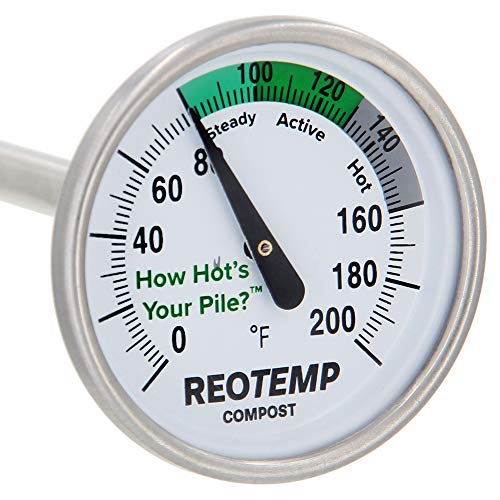
The FG20P is the reference design in this category and the sensible default for a standard backyard pile or bin. Its twenty-inch stem reaches the core of a three-foot pile, the quarter-inch stem is thick enough to push through layered material without flexing much, and the hermetically sealed dial can be left in the pile between checks without fogging. The dial prints three activity zones, Steady, Active and Hot, so a reading makes sense at a glance.
REOTEMP specifies accuracy at plus or minus one percent of full scale, which on a 0 to 200°F range means the needle can sit a couple of degrees off the true value. That is fine for compost work, where the zone matters more than the exact degree, and the calibration screw on the back of the dial housing lets you reset it against ice water if it drifts.
The compromises are real. The dial is Fahrenheit only, so anyone working in Celsius does the conversion at the fence, every time. The dial face is also small for reading at arm’s length in flat light, and the stem will still bend if forced into a frozen or densely packed pile.
Specs
- Stem length: 20 inches
- Stem diameter: 1/4 inch
- Dial size: approximately 1.8 inches, hermetically sealed
- Temperature range and markings: 0 to 200°F, Fahrenheit only, with printed Steady, Active and Hot zones
- Material: stainless steel stem and dial housing
- Accuracy claim: plus or minus 1 percent of full scale, per REOTEMP, with a recalibration screw
- Type: analog bimetal dial, no battery
2. Greenco Compost Soil Thermometer (YGP-20), 20 Inch

The Greenco is the dual-scale alternative to the REOTEMP above. Its two-inch dial carries Fahrenheit and Celsius on the same face, marked in two-degree increments across a 40 to 180°F range, which suits gardeners who keep notes in Celsius. The dial is color-coded, the lens is PC-coated and sealed against moisture with an IP55 water-resistant build, and the stem joins the dial with a reinforced welded bolt, addressing the joint where cheap probes work loose.
Greenco uses 304 stainless steel for the stem, but at five millimeters it is noticeably slimmer than the REOTEMP’s quarter inch. In loose, well-built piles that makes no difference. In dense material full of stalks and twigs, a slimmer stem is more likely to bend if you push carelessly.
The other honest gap is accuracy. Greenco describes the thermometer as high accuracy but publishes no numeric tolerance, so there is no stated figure to hold it to. An ice-water check when it arrives, and once a season after that, is the practical answer. The maker states a lifetime warranty.
Specs
- Stem length: 20 inches
- Stem diameter: 5 mm (0.2 inch)
- Dial size: 2 inches, PC-coated lens, hermetically sealed, IP55 water resistant
- Temperature range and markings: 40 to 180°F and -17.8 to 82.2°C, dual scale, 2-degree increments, color-coded zones
- Material: 304 stainless steel
- Accuracy claim: described by the maker as high accuracy; no numeric tolerance published
- Type: analog bimetal dial, no battery
3. REOTEMP FG16P Backyard Compost Thermometer, 16 Inch
The FG16P is the FG20P’s shorter sibling: same quarter-inch stainless stem, same sealed three-zone dial, same included digital composting guide, four inches less reach. That shorter stem is a feature in the right setting. In a tumbler, a small enclosed bin, or a modest pile, a twenty-inch probe is clumsy and overshoots the core.
The limit is just as clear. Put this thermometer in a full-size heap and it reads the outer third of the pile, where temperatures lag the core by a wide margin, which leads to turning too late or feeding a pile that was already hot enough. Buy the stem that matches the pile you actually have. Accuracy is specified the same way as the larger model, at plus or minus one percent of full scale, with the same recalibration screw.
Specs
- Stem length: 16 inches
- Stem diameter: 1/4 inch
- Dial size: approximately 1.8 inches, hermetically sealed
- Temperature range and markings: 0 to 200°F, Fahrenheit only, with printed Steady, Active and Hot zones
- Material: stainless steel stem and dial housing
- Accuracy claim: plus or minus 1 percent of full scale, per REOTEMP, with a recalibration screw
- Type: analog bimetal dial, no battery
4. REOTEMP Backyard Pro Compost Thermometer (BP-F43), 36 Inch

Everything about the Backyard Pro is scaled up for large heaps, windrows, and farm-scale piles. The thirty-six-inch stem reaches the core of a pile five to six feet wide, and at five-sixteenths of an inch the stem is substantially heavier than the backyard models, so it pushes through coarse, stalky material without the flex that bends thinner probes. The dial grows to two and a half inches, sealed behind a glass lens that will not yellow the way plastic lenses do over seasons outdoors.
The dial prints three activity zones, Ready, Active and Hot, across a 0 to 200°F scale, and accuracy is specified at plus or minus one percent of full scale. Like the smaller REOTEMP models it has an adjustable calibration screw, so an ice-water check takes a minute. A digital composting guide is included, and the maker lists a one-year limited warranty.
For a small bin this thermometer is simply too much tool: awkward in a tumbler, hard to store, and easy to bend because the long stem offers so much leverage when it snags. It earns its place only where the pile is big enough to need the reach.
Specs
- Stem length: 36 inches
- Stem diameter: 5/16 inch
- Dial size: 2.5 inches, hermetically sealed, glass lens
- Temperature range and markings: 0 to 200°F, Fahrenheit only, with printed Ready, Active and Hot zones
- Material: stainless steel throughout
- Accuracy claim: plus or minus 1 percent of full scale, per REOTEMP, with an adjustable calibration screw
- Type: analog bimetal dial, no battery
5. General Tools PT2020G-220 Analog Soil and Composting Thermometer, 20 Inch

General Tools comes at this category from the instrument trade rather than the garden trade, and the PT2020G-220 shows it. The twenty-inch probe carries a dual-scale dial reading 0 to 220°F and -18 to 104°C, the widest range in this roundup, usable for soil checks in spring and for the hottest piles in summer. It is a plain numbered dial rather than a zoned compost dial, so you read a number and interpret it yourself using the guide below.
That plainness cuts both ways. There are no printed zones to lean on, and General Tools publishes no numeric accuracy tolerance for this model, so the ice-water check matters here too. The wider scale also spreads the composting band, roughly 80 to 160°F, across a smaller arc of the dial, so small changes are harder to see at a glance. For gardeners who keep a notebook and think in numbers rather than zones, that trade suits fine.
Specs
- Stem length: 20 inches
- Dial size: large analog dial; diameter not published by the maker
- Temperature range and markings: 0 to 220°F and -18 to 104°C, dual scale, numbered dial without printed compost zones
- Material: stainless steel probe
- Accuracy claim: no numeric tolerance published by the maker
- Type: analog bimetal dial, no battery
How to Read Your Pile: What the Numbers Ask You to Do
Below 80°F. The pile is dormant, stalled, or too small to heat. Check moisture first: a squeezed handful should feel like a wrung-out sponge. Then check the mix, since a pile short on greens has nothing to burn, and the size, since a pile under roughly three feet in each dimension loses heat faster than microbes can make it.
80 to 100°F, the Steady band. Mesophilic bacteria are working slowly. This is legitimate cold composting and it will finish eventually, but it will not kill weed seeds or pathogens. If you want speed, add greens and confirm the pile is damp throughout.
100 to 130°F, the Active band. The healthy working range for most backyard piles. Turn every week or two, and expect the temperature to sag after each turning and climb again.
131 to 150°F, the Hot band. This range does the sanitizing work. Sustained time here, with turnings that cycle the cooler outer material through the core, is what reduces pathogens and weed seeds instead of just warming them. Hold the pile in this band for several days at a time.
150 to 160°F and above. The pile is running too hot. The organisms doing the work begin to die off past this band, and decomposition slows instead of speeding up. Turn the pile to release heat, fold in carbon-rich browns, and check moisture. If it keeps climbing past 160°F, turn it again and spread it out: an overheated pile kills its own workforce and stalls. Hotter is not better; the 131 to 150°F band is the goal.
Technique and Care
Take readings the same way each time so they are comparable. Push the probe slowly into the core, using a stick to open a path in dense material, and remember that the sensing element is in the bottom two inches of the stem: the reading describes that spot, not the whole pile. Leave the dial in place until the needle fully settles, which can take a minute or more, and read at two or three spots before concluding anything. Avoid the bottom few inches, which sit in the cold, wet layer.
Check calibration with ice water: a slurry of crushed ice and water sits at 32°F, and the needle should settle there. The REOTEMP models adjust with the small screw on the back of the dial housing. Wipe the stem clean after use, store the thermometer out of the weather, and never use the stem to pry, lever, or stir.
Frequently Asked Questions
How long a stem do I need? Long enough for the tip to reach the pile’s center. Sixteen inches suits tumblers and small bins, twenty inches suits the standard three-foot pile, and thirty-six inches is for heaps five feet wide and up. A stem that only reaches the outer layer reports the edge temperature, which always lags the core.
Why not a digital probe? Digital readouts settle faster, but electronics and the steam of an active pile are poor company, and a digital probe is a tool you insert, read, and remove rather than leave in place. Analog bimetal dials need no battery, tolerate being left in the pile between checks, and are readable at a glance. Every thermometer here is analog for those reasons.
My pile is hot but smells like ammonia. What is wrong? The temperature is fine and the balance is not, which is exactly the gap a thermometer cannot see. An ammonia smell means too much nitrogen-rich green material: turn the pile and fold in browns such as dry leaves or straw. A sour, swampy smell points the other way, to a pile that is too wet and compacted; turn it, add dry coarse browns, and rebuild it looser.
More from Amazon
Programs that pair well with the guide above. Offers and eligibility are set by Amazon and may change.
Free shipping on eligible items, Prime Video and more. Eligible new members can start with a free trial.
Start a Prime free trialA Prime membership for ages 18-24 with a trial period. Eligibility is set by Amazon.
See Prime for Young AdultsAudiobooks and podcasts to listen to on the go. Eligible new members can start with a free trial.
Try Audible freeAd-free music streaming. Eligible new subscribers can start with a free trial.
Try Music Unlimited freeAs an Amazon Associate we earn from qualifying purchases.










Write Your Review
No reviews yet. Be the first to share your experience!