

Key takeaways
- Compare the best manual lawn aerators, from hollow-tine core tools that pull plugs to rolling spike drums and aerator shoes, with full specs and limits.
As an Amazon Associate we earn from qualifying purchases.
A lawn can be watered and fed on schedule and still look thin, and the usual reason is not a lack of nutrients — it is compaction. Foot traffic, mower passes, kids, dogs and the general settling of a yard squeeze the soil until air, water and roots can barely move through it. Aeration opens that soil back up, and for a garden, a yard or the grass patch at a camp plot, a manual aerator is often the right scale of tool: no engine to store, no rental to return, and enough muscle for the ground a household actually walks on.
This guide covers manual lawn aerators only — step-on coring tools, a push rolling aerator, and wearable aerator shoes. Powered walk-behind machines and tow-behind units that hitch to a tractor are a different class of equipment and are not covered here. What follows is an honest split between the tools that genuinely relieve compaction and the tools that merely poke holes, because the difference decides whether the job is worth doing at all.
Affiliate Disclosure: This article contains affiliate links. If you buy through a link on this page, the site may earn a commission at no extra cost to you. Product picks are based on specifications and listing details, not on commissions.
Core vs Spike: The One Decision That Matters
Every manual aerator in this guide works in one of two ways, and they are not interchangeable.
Core (plug) aerators use hollow tines that cut into the soil and pull out a small cylinder of earth, leaving an open hole and a plug lying on the surface. Removing soil is what actually relieves compaction: the hole gives the surrounding ground room to expand, lets water and air reach the root zone, and gives seed a protected pocket to germinate in. The plugs left behind look messy for a week or two, then break down and return their soil — and the beneficial microbes in it — to the lawn. For genuinely compacted ground, this is the method turf professionals recommend, and three of the five tools below work this way.
Spike aerators use solid spikes that punch holes by pushing soil aside. That is fast and easy, and on loose or sandy soil a spike pass before overseeding can help seed make contact with the ground. But be clear about the trade-off: a solid spike does not remove anything, so it compresses the soil immediately around each hole. On clay or already-compacted ground, repeated spiking can make the compaction worse rather than better. The rolling aerator and the aerator shoes in this guide are spike tools, and they are included for what they genuinely do well — quick passes over large or small areas on soil that is not heavily compacted — not as substitutes for coring.
When and How to Aerate by Hand
Timing and soil condition matter more than the tool. Aerate when the grass is actively growing — early fall is ideal for cool-season lawns, late spring for warm-season lawns — so the turf can recover and fill the holes quickly. Avoid aerating a stressed, dormant or drought-baked lawn.
Soil must be moist for any of these tools to work. Water the lawn deeply a day or two beforehand, or work a day after steady rain. The target is soil that a screwdriver slides into easily: dry ground will bounce hollow tines off the surface and bend spikes, while saturated, muddy ground smears holes shut and clogs coring tubes. If plugs stop ejecting from a coring tool, the soil is either too wet or the tines need clearing with the tool unclogged by hand.
Work in a pattern with holes spaced roughly 3 to 4 inches apart in the worst areas — paths, gate entries, the worn ring around a fire pit or tent pad — and a single pass elsewhere. Leave the pulled plugs where they fall; mowing over them once they dry helps them crumble back into the lawn. Overseeding immediately after coring is the classic pairing, because seed that drops into the holes is sheltered from birds and stays in contact with moist soil.
What to Check Before Buying
- Tine type first. Hollow tines relieve compaction; solid spikes do not. Choose the type before comparing anything else.
- Tine count and plug depth. Step-on corers pull two or three plugs per step, roughly 3 to 3.5 inches deep. More tines cover ground faster but take more leg force per step.
- Working width. A step-on tool covers a few inches per press, which suits patches and small lawns. A rolling drum covers an 18-inch swath per pass and suits a full yard.
- Handle length. Most step-on corers stand about 37 inches tall, keeping your back straight while your leg does the work. Rolling aerators use longer handles, around 50 inches, for pushing posture.
- Weight and build. Powder-coated or alloy steel frames shrug off wet soil and storage in a shed. Heavier rolling drums penetrate better; lighter hand tools are easier to carry between patches.
- Clogging behavior. Open or slot-style hollow tines eject plugs more reliably in sticky soil. Any corer works better with a cleaning tool or an old screwdriver kept nearby.
1. Yard Butler ID-6C Manual Lawn Coring Aerator

The Yard Butler ID-6C is the reference design for a manual coring aerator: two hollow steel tines on a foot bar, a 37-inch powder-coated steel handle, and cushioned grips. You set the tines on the turf, step on the bar, and the tubes cut two plugs about 3.5 inches long and a half inch across. The next step pushes the previous plugs out of the top of the tubes, so the tool clears itself as you walk a pattern across the lawn.
That self-ejecting action is the practical detail that separates it from cheaper corers, because hollow tines that pack solid with clay turn the job into a cycle of stepping and unclogging. The powder-coated steel frame is built for decades of shed storage and wet soil, and at under 4 pounds the tool is easy to carry out to a worn patch by the gate or the bare ring where a tent usually sits. The honest limitation is coverage: two plugs per step is a narrow pattern, so a large, uniformly compacted lawn is slow work. For small yards, garden-side turf and targeted repair of compacted spots, it is the benchmark the other corers here are measured against.
Specs
- Type: Core (hollow-tine), step-on
- Tines: 2 hollow steel tines, pulls plugs about 3.5 in long
- Working width: 2 plugs per step across an 8.75 in foot bar
- Handle: 37 in powder-coated steel with cushioned grips
- Weight: 3.72 lb
2. Garden Weasel Core Aerator 91818

The Garden Weasel 91818 takes the same two-tube coring layout and stretches the plugs: its two steel aeration tubes are 4 inches long and produce cores up to 3.5 inches, among the deepest a manual step-on tool reaches. Depth is the point of coring — a plug pulled from below the thatch layer opens a channel that water actually travels down — so the longer tubes suit lawns where compaction runs deeper than the surface, such as the strip along a driveway or a well-used garden path.
An extra-wide, centered steel footplate with slip-resistant treads spreads your weight evenly over both tubes, which keeps the tool from tilting and tearing the turf on the way out. The 37-inch powder-coated carbon steel handle carries a 6-inch textured rubber grip, the whole tool runs 40 inches overall, and at about 3.3 pounds it is light enough to work a long border without a break. The MIG-welded joints and powder coat are aimed at rust resistance for a tool that lives in a shed and works in wet soil. Like every two-tine corer, it rewards moist soil and patience over force: rock it slightly on the way out and the plugs release cleanly.
Specs
- Type: Core (hollow-tine), step-on
- Tines: 2 steel tubes, 4 in long, pull cores up to 3.5 in
- Working width: 2 plugs per step, extra-wide centered footplate
- Handle: 37 in powder-coated carbon steel, 6 in rubber grip; 40 in overall
- Weight: 3.29 lb
3. Walensee Lawn Coring Aerator

The Walensee coring aerator is the straightforward value entry in the coring group: an alloy steel step-on tool with two hollow tines, a T-bar top with cushioned handle grips, and a foot bar for driving the tines with body weight. It follows the same working pattern as the two corers above — step, pull, step again — and the listing’s own instructions repeat the advice that matters most with this class of tool: water the lawn thoroughly first, work every 6 to 12 inches, and keep the ejector tubes clean so plugs keep moving.
The frame dimensions run about 37 inches tall with a 9.5-inch-wide head, so it stores flat against a shed wall and covers the same two-plug pattern per step. Alloy steel construction keeps it rigid under a full body-weight press, which is where lighter frames flex and waste effort. Expect the usual coring caveats rather than any unique flaw: in sticky wet clay the tubes will need clearing more often than slotted self-eject designs, and two plugs at a time is a patch-and-small-lawn pace, not a full-yard pace. For a household that aerates once a year and wants real plugs pulled without renting a machine, it covers the job description honestly.
Specs
- Type: Core (hollow-tine), step-on
- Tines: 2 hollow alloy-steel tines
- Working width: 2 plugs per step, 9.5 in head width
- Handle: T-bar with cushioned grips; about 37 in overall
- Weight: Not published in the listing
4. VEVOR Rolling Lawn Aerator, 18-Inch

The VEVOR rolling aerator is the coverage pick: an 18-inch drum carrying 27 iron spikes, pushed ahead of you on a 51.6-inch handle like a mower. Each spike is 2 inches long, so a pass punches a grid of shallow holes across a full swath instead of two plugs per step. A full small lawn that would take an afternoon with a step-on corer takes a fraction of the time, which is exactly the situation a rolling spike tool exists for — prepping a loose or sandy lawn for overseeding, or giving a healthy lawn a light seasonal pass.
Read the limits plainly, though. These are solid spikes: they displace soil rather than removing it, the holes reach only about 2 inches deep, and on compacted clay this tool will not fix the underlying problem and can firm up the soil around each hole. The drum can be filled to add weight for better penetration on firmer ground, the three-section handle detaches for storage and adjusts to the user’s height, and the spikes come pre-installed. At just under 10 pounds it is easy to carry to the yard and hang up afterward. Used on the right soil, it is the fastest manual option here; used on hard clay, it is the wrong tool and the corers above are the answer.
Specs
- Type: Spike, rolling drum (push)
- Spikes: 27 iron spikes, 2 in long
- Working width: 18 in
- Handle: 51.6 in adjustable steel handle, 3 detachable sections
- Weight: 9.92 lb; drum can be filled to add working weight
5. Ohuhu Lawn Aerator Shoes
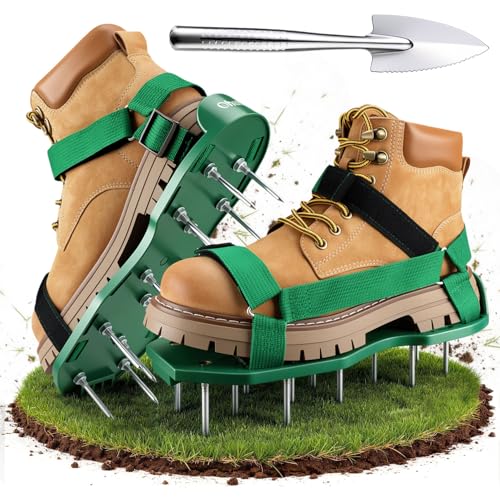
Aerator shoes are the smallest-scale option in the guide: a pair of spiked soles that strap over your own shoes, so the aeration happens as you walk. The Ohuhu set carries 13 steel spikes per shoe, each 2 inches long, mounted in a heavy-duty plastic sole with anti-slip pads, and fastens with adjustable hook-and-loop straps instead of a stack of buckles. They arrive pre-assembled — strap them on and walk — and the set includes a small stainless steel shovel for cleaning soil out of the soles.
The honest framing matters most with this pick. Shoes are spike tools, so they push soil aside rather than removing plugs, and the holes are only as deep as your body weight drives them. Coverage is one footstep at a time, which makes them genuinely slow: a full lawn in aerator shoes is an endurance event, and they are at their best on tiny patches — a balcony-side strip of turf, the worn square where a camp chair sits, a small garden lawn — or for punching seed holes before overseeding a bare spot. Keep them off paving and decking, which the spikes will scar, and walk carefully on slopes. For the right small job they are simple and effective; for a compacted yard, choose a corer.
Specs
- Type: Spike, wearable strap-on sandals
- Spikes: 13 steel spikes per shoe, 2 in long
- Sole: Heavy-duty plastic with anti-slip pads
- Fit: One size, adjustable hook-and-loop straps, pre-assembled
- Extras: Stainless steel cleaning shovel included
- Weight: Not published in the listing
Which Manual Aerator Fits Your Lawn
Match the tool to the soil, not to the size of the job alone. If the ground is compacted — water pooling on the surface, grass thin despite feeding, a screwdriver hard to push in — choose a coring tool: the Yard Butler ID-6C for the classic self-ejecting design, the Garden Weasel 91818 for the deepest plugs, or the Walensee for the same job on a tighter outlay. If the soil is loose or sandy and the goal is seed-to-soil contact over a whole yard, the VEVOR rolling aerator covers ground fastest. If the area is a few square feet of worn turf, the Ohuhu shoes turn a walk across it into the whole job.
Whichever type you choose, the working rules stay the same: aerate moist soil during active growth, leave coring plugs to break down on the surface, and overseed straight after coring so the seed lands in the holes. Done once a year on those terms, a manual aerator keeps a garden lawn, a yard or a camp plot’s grass breathing without an engine ever entering the picture.
More from Amazon
Programs that pair well with the guide above. Offers and eligibility are set by Amazon and may change.
Free shipping on eligible items, Prime Video and more. Eligible new members can start with a free trial.
Start a Prime free trialA Prime membership for ages 18-24 with a trial period. Eligibility is set by Amazon.
See Prime for Young AdultsAudiobooks and podcasts to listen to on the go. Eligible new members can start with a free trial.
Try Audible freeAd-free music streaming. Eligible new subscribers can start with a free trial.
Try Music Unlimited freeAs an Amazon Associate we earn from qualifying purchases.










Write Your Review
No reviews yet. Be the first to share your experience!