

Key takeaways
- Compare the best jigging rods for vertical jigging and slow pitch, matched by jig weight and technique, from graphite spinning rods to E-glass sticks.
As an Amazon Associate we earn from qualifying purchases.
Affiliate Disclosure: This article contains affiliate links. If you buy through a link on this page, we may earn a commission at no extra cost to you.
Jigging looks simple from the dock: drop a metal jig straight down, work it back up, repeat. The rods are anything but simple. A jigging rod is built to do two contradictory jobs — animate a heavy chunk of metal hundreds of times a day, and then absorb the shock when something large eats it on the drop. How it does those jobs depends entirely on which jigging you mean, because vertical speed jigging and slow pitch jigging are different techniques that happen to share a metal lure.
The first split is conventional versus spinning, and it is really a split between fisheries. Conventional jigging outfits dominate deep water: the reel sits on top, line peels off under your thumb on the drop, and the tackle is built around heavy jigs, heavy braid and fish that need to be stopped before they reach structure. Spinning jigging gear owns the shallower game — reefs, wrecks and ledges where jigs run lighter, casts at surface activity matter, and a bail flipped open drops a jig faster than any freespool. Neither is better. They fish different water.
The second split is speed versus slow pitch, covered in detail below. The five rods here span both worlds: a travel spinning rod, a long conventional all-rounder, a short deep-water power stick, an E-glass durability pick, and a dedicated slow pitch spinning rod.
1. Shimano Grappler Type J S60-4/3

The Grappler Type J is Shimano’s jigging-specific family, and the S60-4/3 is its travel-friendly spinning model: 6 feet long, built in three pieces, and designed around jigs in the 180 to 250 g window. That three-piece build is the headline for anglers who fly or drive long distances to fish. It breaks down short enough for a rod tube that fits where a one-piece 6-footer will not, and the ferrule design keeps the bend closer to a one-piece curve than travel rods used to manage.
The blank uses Shimano’s Spiral X and Hi-Power X construction, two layers of carbon tape wrapped in opposing directions to resist twisting and ovalizing under load. Twist resistance is not a spec-sheet flourish in jigging. A blank that twists under a surging fish wastes lifting power and stresses guide alignment; a blank that stays straight puts the load into the fibers that were designed to carry it.
As a spinning rod in this weight class, it suits the mid-depth game: reefs and wrecks in moderate water, jigs heavy enough to stay vertical in current, and fish you fight with the rod rather than winch with the reel. Anglers who jig truly deep water all day will usually end up on conventional tackle, but for the spinning side of the fishery this is the most technically advanced blank in the roundup.
Specs
- Model: Grappler Type J S60-4/3
- Type: Spinning, 3-piece travel construction
- Length: 6’0″
- Power: 4 on Shimano’s Type J scale
- Blank: Spiral X and Hi-Power X carbon construction
- Jig weight: Designed for jigs in the 180–250 g range
- Best for: Mid-depth reef and wreck jigging; travel
2. Daiwa Harrier X HRX70MB

At 7 feet, the Harrier X HRX70MB is the longest rod in this roundup, and length changes what a jigging rod can do. The extra blank gives more lift on the upstroke, moves more line with each pump, and helps when you need to pitch a jig away from the boat to reach the edge of a wreck or a school marked off to one side. Daiwa builds the Harrier X series for the full spread of metal jig work — flutter jigs, knife jigs and traditional lead-head jigging — with a series jig range of 50 to 250 g.
The blank pairs HVF Nanoplus carbon with X45 bias construction, which wraps fibers at 45 degrees to fight the twisting and blank distortion that heavy jigging loads produce. Hardware is chosen for abuse: Fuji Tangle-Free K-Series guides with FazLite rings, and two-foot guide frames along the full blank instead of the lighter single-foot guides that bend and crack under repeated high-load cycles. The Fuji ESC reel seat locks a conventional reel down tight, and the rubber gimbal at the butt works in a rod holder, a fighting belt, or against your hip.
This is the conventional pick for anglers who want one rod that covers the middle of the jigging world — moderate depths, mid-weight jigs, bottom fish and pelagics in the same trip. Deep-water specialists fishing the heaviest jigs will want the shorter, heavier sticks below; the Harrier X trades some of that stump-pulling power for reach and versatility.
Specs
- Model: HRX70MB
- Type: Casting (conventional), 1-piece
- Length: 7’0″
- Power: Medium
- Blank: HVF Nanoplus carbon with X45 bias construction
- Guides: Fuji Tangle-Free K-Series, FazLite rings, two-foot frames
- Reel seat: Fuji ESC
- Butt: EVA grip with rubber gimbal
- Series jig range: 50–250 g
3. St. Croix Mojo Jig MJJC58HMF

The Mojo Jig casting rod in the 5’8″ heavy configuration is the deep-water specialist of this list, and its length is the point. At 5 feet 8 inches there is almost no wasted blank: the rod is a lever built to pump heavy jigs straight up from deep water and to lift against fish that use depth as their defense. St. Croix builds the blank from SCII carbon with its IPC mandrel tooling, FRS resin and ART reinforcement, in a moderate-fast action that loads deep enough to cushion braid’s lack of stretch without going soft.
Component choices follow the same heavy-duty logic. Sea Guide guides with SS304 stainless frames and aluminum oxide rings are built for braid under load. The Fuji PSS-SD palming reel seat is shaped to sit in your hand through hours of pumping — on a conventional jigging rod, your palm is part of the handle system, and a seat that fits the hand is a fatigue feature, not a luxury. Heavy Mojo Jig models add a Fuji gimbal butt for belts and holders.
Be clear about what this rod is not. It is a boat tool, full stop. Five-foot-eight rods cannot cast, cannot mend line, and cannot keep a jig working through a surf zone or off a pier. From shore it is useless, and St. Croix never intended otherwise. On a boat over deep structure, that same shortness is exactly the advantage: less rod to fight, more lift per stroke, and a blank that keeps a jig dancing at depths where longer, softer rods go vague.
Specs
- Model: MJJC58HMF
- Type: Casting (conventional), 1-piece
- Length: 5’8″
- Power / Action: Heavy / moderate-fast
- Blank: SCII carbon with IPC tooling, FRS resin and ART reinforcement
- Guides: Sea Guide, SS304 stainless frames, aluminum oxide rings
- Reel seat: Fuji PSS-SD palming seat
- Butt: Fuji gimbal butt cap
- Warranty: 5-year
4. Okuma Cedros CJ-C-661MHa
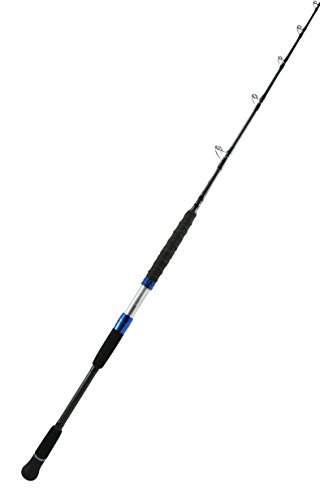
Every other rod here is carbon. The Cedros jigging rod is E-glass, and that is a deliberate engineering choice, not a budget shortcut. Glass is heavier and less sensitive than graphite, but it bends deeper, absorbs shock spikes that non-stretch braid transmits straight to the hook hold, and tolerates the knocks, gunnel bangs and high-sticking moments that eventually snap a high-modulus blank. For anglers who jig hard and treat gear roughly — or who fish around structure where a hooked fish has to be bullied — that forgiveness is worth real money in unbroken rods.
Okuma rates the Cedros family around specific jig weights, because a jig rod’s action is tuned to a load: the blank should recover at the speed that makes the jig dart, and it can only do that inside its weight window. The 6’6″ medium-heavy casting model sits in the middle of the range. Hardware is the other reason this rod has a following: ALPS high-rise 316 stainless guide frames with zirconium inserts, the high frames keeping line off the blank and foregrip under load, and an ALPS pyramid-shaped machined aluminum reel seat that locks a conventional reel down with zero flex. The split-grip layout uses a ribbed EVA foregrip and a contoured butt grip for leverage.
The trade-off is feel. You will not sense a jig ticking bottom in deep water the way you will on the Grappler, and a full day of speed jigging with glass is a workout. What you get back is pulling power and a rod that shrugs off the abuse jigging dishes out, backed by a limited lifetime warranty.
Specs
- Model: CJ-C-661MHa
- Type: Casting (conventional), 1-piece
- Length: 6’6″
- Power: Medium Heavy
- Blank: E-glass construction
- Guides: ALPS high-rise 316 stainless steel frames, zirconium inserts
- Reel seat: ALPS pyramid-shaped machined aluminum, anodized
- Grip: Split design, ribbed EVA foregrip, contoured EVA butt
- Warranty: Limited lifetime
5. Okuma Tesoro TSR-S-681ML-SP
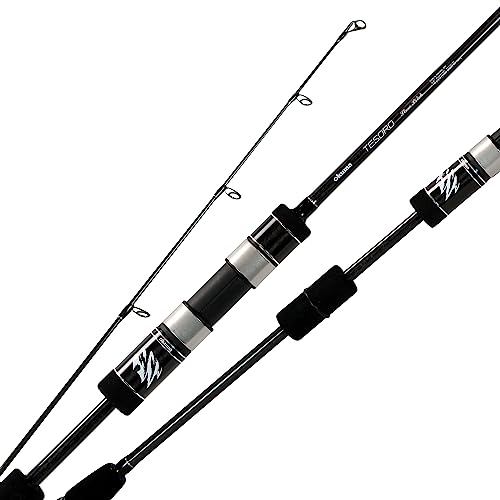
The Tesoro SP is the slow pitch rod of the roundup, and slow pitch is where jigging rod design inverts. A speed jigging rod is stiff and fast so it can rip a jig upward. A slow pitch rod is soft and parabolic — it bends deep into the blank, and the angler does not lift the jig so much as load the rod and let the blank’s slow recoil flick the jig sideways, where it flutters and falls like wounded prey. The rod is the action; the reel mostly collects line. The TSR-S-681ML-SP is a 6’8″ medium-light spinning model built for exactly that, on a lightweight 24/30-ton carbon blank with Okuma’s UXR resin system.
This technique specificity cuts both ways, and it is the most important honesty in this article. Fish a slow pitch rod with a fast, aggressive speed-jigging stroke and it feels dead — the blank folds instead of driving the jig, and the lure barely moves. Fish a stiff speed jigging rod with slow pitch technique and the opposite failure happens: the jig gets yanked upward in a straight line instead of pitched sideways, and the fluttering fall that triggers strikes never happens. These are not interchangeable tools with different labels. They are different instruments.
Within its technique, the Tesoro’s longer, softer build suits shallower slow pitch work — the spinning format drops jigs fast, handles light braid well, and the parabolic bend keeps small assist hooks pinned in fish that shake hard at the surface. If your jigging is deep and conventional, this is not your rod. If you have watched slow pitch anglers outfish the speed jiggers on pressured reef fish, this is the format that does it.
Specs
- Model: TSR-S-681ML-SP
- Type: Spinning, dedicated slow pitch model
- Length: 6’8″
- Power: Medium Light
- Blank: 24/30-ton carbon with UXR resin reinforcement
- Action: Parabolic slow pitch bend
- Best for: Slow pitch jigging over reefs and ledges in moderate depths
How to Choose the Right Jigging Rod
Start with the jig weight, because it is the one real spec. Line class and power labels vary between brands, but the jig weight range printed on the blank is an engineering statement: it is the load the blank was designed to load and recover against. Fish a 60 g jig on a rod built for 200 g and the blank barely flexes, so the jig gets dragged rather than worked — no dart, no flutter, no action. Fish a 200 g jig on a rod built for 60 g and the blank folds and stays folded; you cannot lift the jig, let alone animate it. Weigh your jigs, match the rod’s printed range to the weights you actually fish, and let that decide before brand or power labels enter the conversation.
Match the format to the water. Conventional outfits are the deep-water default: precise drops, high line capacity, and the leverage to work heavy jigs all day over wrecks and ledges. Spinning outfits shine shallower, where jigs run lighter, drops need to be instant, and the occasional cast at breaking fish matters. Many serious jig anglers own both and choose by depth and jig weight, not by loyalty.
Do not cross the speed and slow pitch streams. As the Tesoro section explains, the two techniques need opposite blanks — fast and stiff versus soft and parabolic. A combination rod that claims both will do neither well. Decide which technique you will actually fish most, and buy the rod that does that one properly. If you are new, speed jigging with a mid-weight conventional or spinning setup is the more forgiving place to start; slow pitch rewards anglers who already read depth, current and bottom structure well.
Respect what length means. Under 6 feet, a jigging rod is a pure boat tool: maximum lift, minimum leverage against you, and no casting ability whatsoever. That is a feature over deep water and a disqualification everywhere else. Rods from 6’6″ to 7 feet give up a little deep-water efficiency for versatility — better jig control in current, some casting ability, and a fighting chance from a pier. Buy the short rod only if a boat is your platform.
Interrogate the hardware, because jigging destroys it. No technique loads guides and reel seats like jigging: hundreds of high-load pumps a day, braid sawing under tension, fish surging against a locked drag. Look for two-foot guide frames on conventional rods, inserts that tolerate braid, and machined or positively locking reel seats. On conventional rods you will also see spiral-wrapped guide trains, where the guides rotate around the blank from top to underside along its length. The idea is simple: a conventional reel sits on top, so line under load wants to twist the blank and press against its side; spiraling the guides underneath lets the line pull from below like a spinning rod, which removes the twist and keeps the line off the blank. It looks odd and works exactly as advertised.
Frequently Asked Questions
Should I choose a conventional or spinning jigging rod?
Choose by depth and jig weight. Conventional outfits handle deep water and heavy jigs with better drop control and lifting leverage. Spinning outfits are faster to drop, easier to cast, and better matched to lighter jigs in shallower water. Anglers who jig a wide range of depths often end up with one of each.
Can one rod handle both speed jigging and slow pitch?
Not well. Speed jigging needs a fast, stiff blank that rips a jig upward; slow pitch needs a soft, parabolic blank that loads and recoils slowly. Each technique feels wrong on the other’s rod — dead on one, harsh and lifeless on the other. Pick the technique you fish most and buy for it.
Why does jig weight matter more than the rod’s power label?
Power labels are not standardized between brands, so one maker’s medium-heavy is another’s heavy. The jig weight range printed on the blank is the load the rod was engineered around. Fish inside that range and the blank loads and recovers correctly; fish outside it and the jig stops working properly no matter what the label says.
Can I use a jigging rod from shore?
Mostly, no. Vertical jigging rods are short boat tools designed to work a jig straight down and lift fish vertically. From shore you need casting distance and line control that a 5’8″ or 6′ rod cannot give. The longer rods in this roundup can pitch jigs from piers at a pinch, but a dedicated shore rod is a different tool.
Conclusion
Match the rod to the jig weight and the technique, and the rest follows. The Shimano Grappler Type J is the pick for spinning anglers who travel and fish mid-depth structure. The Daiwa Harrier X covers the broad middle of conventional jigging with reach and strong hardware. The St. Croix Mojo Jig is the short, heavy lever for deep water from a boat. The Okuma Cedros trades sensitivity for E-glass toughness and shock absorption. And the Okuma Tesoro SP is the dedicated slow pitch instrument — superb inside its technique, wrong outside it. Buy the one that matches how you actually fish, and check the jig weights printed on your jigs before you check anything else.
More from Amazon
Programs that pair well with the guide above. Offers and eligibility are set by Amazon and may change.
Free shipping on eligible items, Prime Video and more. Eligible new members can start with a free trial.
Start a Prime free trialA Prime membership for ages 18-24 with a trial period. Eligibility is set by Amazon.
See Prime for Young AdultsAudiobooks and podcasts to listen to on the go. Eligible new members can start with a free trial.
Try Audible freeAd-free music streaming. Eligible new subscribers can start with a free trial.
Try Music Unlimited freeAs an Amazon Associate we earn from qualifying purchases.










Write Your Review
No reviews yet. Be the first to share your experience!