

Key takeaways
- Compare the best fish grips for safe handling and quick photos, from the stainless BogaGrip to floating and digital scale models for catch and release.
As an Amazon Associate we earn from qualifying purchases.
Affiliate Disclosure: This article contains affiliate links. If you buy through a link on this page, we may earn a commission at no extra cost to you.
A fish grip has one job: give you control of a fish at boatside while your fingers stay clear of teeth, gill plates and treble hooks. Used well, it shortens the time a fish spends out of the water, keeps your hands out of a pike’s mouth, and holds the fish steady for a fast photo before release. Used badly, it becomes a handle for hoisting a fish vertically by its jaw, which is exactly what damages the fish you planned to let go.
The honest starting point is that a grip is a control tool, not a carrying handle and not a scale you should bet a tournament result on. For small panfish and gentle species, wet hands are still the kindest tool you own. Grips earn their place with toothy fish, thrashing fish, and fish wearing a mouthful of treble hooks. The five picks below cover the main designs: a machined stainless benchmark, a floating plastic grip, two grip-and-scale combos, and a compact aluminum grabber.
1. Eastaboga BogaGrip

The BogaGrip is the tool every other lip grip gets compared to, and it has held that position for decades. Eastaboga machines it in the USA from 300-series stainless steel with acetal plastic components, and the design is deliberately simple: a trigger sleeve slides along the tube to open the jaws, and the jaws lock progressively tighter as the fish’s weight pulls against them. The tube rotates freely, so a fish that rolls at boatside twists the grip instead of wrenching your wrist or tearing its own jaw.
The built-in spring scale is the other half of its reputation. Unlike the novelty scales on budget grips, the BogaGrip scale is calibrated against certified weights and the tool can be sent to the IGFA for certification, which is why it shows up on so many guide boats. That said, treat any grip scale as an estimate until it has been checked: springs drift with age, corrosion and hard use, and a club tournament will still want a certified scale at weigh-in.
The trade-offs are weight and flotation. The mid-size model is a full pound of steel, and it does not float. Dropped over the side without a leash or an attached float, it sinks instantly and it is gone. Rig a wrist lanyard or a small float before it ever leaves the boat bag.
Specs
- Construction: 300-series stainless steel with acetal plastic components
- Scale: Built-in mechanical spring scale, 30 lb capacity in 1/2 lb increments (Model 130)
- Length: 10.75 inches
- Weight: 1 lb
- Operation: One-hand trigger sleeve, locking jaws, free-rotating tube
- Origin: Made in the USA
- Flotation: Does not float; lanyard or float strongly advised
2. Rapala Floating Fish Gripper 9-Inch (RFFG9)

Rapala’s floating gripper takes the opposite approach to the BogaGrip: molded construction, a squeeze-style quick-release mechanism you can work with one hand, and a body that floats if it goes overboard. For kayak anglers and waders, that last point is not a gimmick. Gear dropped from a kayak is usually gone for good, and a grip that bobs on the surface in a bright finish is one you actually get back.
The jaws hold with a positive lock and release with a quick squeeze, which keeps unhooking fast and keeps the fish low over the water rather than lifted high for a struggle. A wrist lanyard is included for the moments when your hands are full of rod, net and fish at once.
Be honest about the limits of molded grips, though. Under the load of a heavy, violent fish, plastic-bodied grippers can flex in a way machined metal does not, and flex at the wrong second is how fish get dropped on the deck or lost at the boat. For bass, trout, panfish and moderate inshore species, this grip is well matched. For big pike, muskies or heavy saltwater fish, step up to metal.
Specs
- Model: RFFG9
- Length: 9 inches
- Weight: 0.32 lb
- Operation: One-hand quick-release squeeze mechanism with locking jaws
- Flotation: Floats if dropped overboard
- Extras: Wrist lanyard included
- Best for: Kayak, wade and bank fishing; light to medium species
3. Piscifun Fish Gripper with Digital Scale
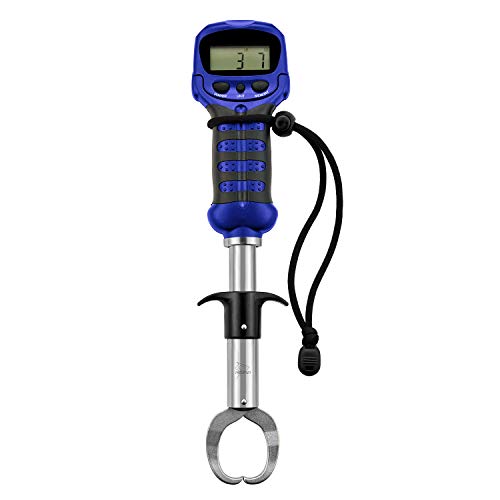
Piscifun’s digital gripper pairs stainless jaws with a battery-powered scale in the handle, and it is the convenience pick of this list. The readout is large and backlit, the handle rotates 360 degrees so you can read the display without twisting the fish, and the memory function stores up to ten weights so a day of catches does not need a notebook. Units switch between kilograms, pounds and ounces at a button press.
The jaws are 304 stainless steel with a wide opening for thick-lipped fish, the body is water-resistant rather than submersible, and an adjustable wrist strap guards against drops. It runs on two AAA batteries and shuts itself off to save them.
The honest caveat applies to every digital grip scale: accuracy depends on a still fish, a vertical hold, fresh batteries and a sensor that has not been knocked around in a tackle bag for two seasons. Readings are fine for personal bests and bragging rights. They are not a substitute for a certified scale when money or a record is on the line, and the electronics are the first thing saltwater spray will eventually kill. Rinse it, dry it, and store it out of the bag’s bottom.
Specs
- Model: Piscifun-TL020
- Scale: Digital, 60 lb (27 kg) capacity, memory for 10 weights
- Jaw material: 304 stainless steel
- Handle: 360-degree rotating, non-slip, with adjustable wrist strap
- Power: 2 AAA batteries, auto shut-off, low-battery indicator
- Dimensions: 13.3 x 3.3 x 1.7 inches
- Weight: 0.26 kg
- Water resistance: Water-resistant body (not rated for submersion)
4. ARCPRO 2-in-1 Fish Gripper with Scale

The ARCPRO gripper is an aluminum alloy T-style tool with a mechanical scale built into the handle, rated to 40 lb. The one-finger trigger operation opens and closes the jaws without a full-hand squeeze, which matters when your other hand is holding a rod or a net, and the handle swivels 360 degrees so a rolling fish spins the tool instead of your wrist.
Aluminum construction keeps it light enough to clip to a belt or vest, and the corrosion-resistant finish is intended for both saltwater and freshwater use. As with every mechanical grip scale, the spring readout is a guide rather than a measurement: check it against a known weight a couple of times a season, because springs stretch and readings wander. A quick-release jaw and an adjustable lanyard round out a tool aimed at anglers who want grip and scale in one piece of kit without electronics to feed.
Specs
- Model: X500
- Construction: Aluminum alloy
- Scale: Built-in mechanical scale, 40 lb capacity
- Operation: One-finger trigger, quick-release jaws
- Handle: 360-degree swivel, corrosion-resistant finish
- Use: Saltwater and freshwater
- Extras: Adjustable wrist lanyard
5. GOMEXUS Fish Lip Gripper

Gomexus built its name on machined aluminum reel parts, and this compact gripper follows the same formula: CNC-style aluminum construction, a small footprint, and a lanyard to keep it attached to you. It is the minimalist option here, with no scale and no electronics, just a lightweight grabber meant for trout, panfish, bass and smaller inshore fish handled from a kayak, a dock or the bank.
That simplicity is the appeal for anglers who weigh fish on a separate scale or do not weigh them at all. There is nothing to calibrate, nothing to feed batteries, and little to corrode. The limitation is size: a mini gripper is the wrong tool for a heavy fish or a wide, thick jaw, and it gives you less leverage when a fish surges. Match it to smaller species and it disappears into a vest pocket until needed.
Specs
- Construction: Aluminum
- Part number: KY100BKSR
- Design: Compact mini gripper for one-hand use
- Scale: None
- Extras: Lanyard included
- Best for: Trout, panfish, bass and light inshore fish; kayak and bank fishing
How to Choose the Right Fish Grip
Start with how you actually handle fish. If you release most of what you catch, the grip’s real value is keeping the fish in or near the water while you work the hook out. Clamp the lower jaw, keep the fish horizontal, and slide your free hand under its belly before any lift. A big fish hanging vertically from a jaw clamp carries its whole weight on jaw and spine structures that did not evolve for it, and that is how released fish get injured by the tool meant to protect them. For photos, support the fish with both hands, grip in one and belly in the other, and keep it low over the water so a flop ends in the lake, not on the deck.
Match the material to the fish. Molded and plastic grips like the Rapala are light, cheap to replace and float, and they are the right call for kayak and wade fishing for bass, trout and panfish. Their weakness is flex under a heavy, twisting load. Machined stainless like the BogaGrip does not flex, shrugs off saltwater for years, and costs accordingly. Aluminum sits between the two: light, rigid enough for most freshwater work, and happier with a freshwater rinse after salt use.
Treat built-in scales as estimates. Spring scales drift as springs age, and digital scales drift when sensors get knocked, wet or fed weak batteries. Check any grip scale against a known weight at home a few times a season. The BogaGrip is the exception that proves the rule: it can be professionally certified, which is exactly why serious record hunters use it. For a tournament weigh-in, assume the officials’ certified scale is the only number that counts.
Decide whether flotation matters before you drop something. Kayak anglers, waders and anyone fishing over deep water should put flotation or a lanyard at the top of the list. Metal grips sink the instant they leave your hand. A floating plastic grip or a foam float clipped to a lanyard turns a lost tool into a minor splash.
Think about teeth and hooks, not just size. The clearest case for a grip is a fish with teeth or a mouth full of trebles: pike, walleye, bluefish, mackerel and any crankbait-caught fish that thrashes at boatside. That is where fingers get hooked and bitten. For a single-hooked bluegill, your wet hand is faster and gentler than any tool in this roundup.
Frequently Asked Questions
Is it safe to lift a fish by a lip grip?
Only briefly, and only for smaller fish. For anything heavy, clamp the jaw for control and support the belly with your other hand so the fish stays horizontal. Never carry a fish around by the grip, and never hang a fish you plan to release vertically while you dig for a camera.
Are grip scales accurate enough for tournaments?
Generally, no. Most built-in scales are estimates that drift over time, and tournaments require certified scales. The BogaGrip can be sent in for IGFA certification, which is the exception; everything else should be treated as a personal-best tracker.
Plastic or metal grip: which should I buy?
Plastic if you fish from a kayak or on foot and your species run small to medium, because it floats and travels light. Metal if you handle strong or heavy fish, fish saltwater often, or want one tool to last for years. Aluminum splits the difference for freshwater anglers.
Do I still need pliers if I carry a grip?
Yes. A grip controls the fish; it does not remove hooks. Pair it with the hook remover or pliers you already carry, and keep the fish in the water while you use them whenever you can.
Conclusion
For most anglers, the Rapala Floating Fish Gripper is the sensible default: light, one-handed and retrievable when dropped. The BogaGrip is the buy-once answer for serious saltwater and record-minded fishing, provided you leash it. The Piscifun digital and ARCPRO grips add weighing convenience for anglers who like a number with their photo, and the Gomexus is the compact grabber for light tackle work. Whichever you choose, use it to control the fish at the surface, support the belly for the photo, and let it go quickly.
More from Amazon
Programs that pair well with the guide above. Offers and eligibility are set by Amazon and may change.
Free shipping on eligible items, Prime Video and more. Eligible new members can start with a free trial.
Start a Prime free trialA Prime membership for ages 18-24 with a trial period. Eligibility is set by Amazon.
See Prime for Young AdultsAudiobooks and podcasts to listen to on the go. Eligible new members can start with a free trial.
Try Audible freeAd-free music streaming. Eligible new subscribers can start with a free trial.
Try Music Unlimited freeAs an Amazon Associate we earn from qualifying purchases.










Write Your Review
No reviews yet. Be the first to share your experience!