

Key takeaways
- Compare the best rod holders for bank fishing and boat rails on locking strength, spike depth, clamp fit and rod angle for catfish, bass and shore fishing.
As an Amazon Associate we earn from qualifying purchases.
A rod holder has one job that actually matters: keeping your rod where you left it when a fish hits hard. Everything else — materials, finishes, adjustment knobs — is secondary. A catfish that slams a baited rod does not pull gently. It yanks, and if the holder is loose in the ground or the rod sits in an open cradle with nothing retaining it, the whole outfit can be in the water before you cross the ten feet from your camp chair. Anglers lose more rods to lazy holders than to broken line, and it is almost always preventable.
That is why this guide judges holders first on security. A locking ring that closes over the rod butt matters more than whether the body is nylon, ABS, or stainless. On the bank, the equivalent of a lock is spike depth: a ground spike pushed four inches into soft soil is a rod donation waiting to happen, while the same spike driven to the hilt in firm ground will hold against a serious strike.
The five holders below split between the bank and the boat, and each is assessed on how well it holds a rod under load. Where a design has a real weakness — spikes that refuse rocky ground, clamps with a maximum opening you have to respect — it is stated plainly.
Affiliate Disclosure: This article contains affiliate links. If you buy through a link on this page, we may earn a commission at no additional cost to you. That income helps keep the site running, and it does not change which products we include or what we say about them.
Scotty #230 Powerlock Rod Holder with 241 Side/Deck Mount

The Scotty Powerlock is the boat holder the others get compared to, and the reason is the locking ring. The rod sits in an open cradle, and a sliding collar closes over the butt section so the rod physically cannot lift out when a fish strikes or a trolling lure digs in. That single feature separates it from every open-tube holder that relies on gravity and optimism. The body is fiber-reinforced nylon, which cannot rust, does not corrode in brackish water, and flexes slightly instead of cracking under a shock load.
The #230 package includes Scotty’s 241 side/deck mount, so it bolts to a gunwale, a transom, or a flat deck surface out of the box, and the holder adjusts through a full circle horizontally with vertical tilt as well. That covers both trolling — rod tip low and angled out from the boat — and still-fishing at anchor with the tip up where you can see it.
The honest limitations are about mounting, not holding. The 241 mount needs a flat surface and screws; if your boat has no suitable flat spot, you will need a Scotty rail or clamp mount instead, bought separately. The cradle is also sized for standard spinning and casting outfits, so very large saltwater rods can be a tight fit. For freshwater boat and dock use, it is the most secure holder in this guide.
Specs
- Mount: 241 side/deck mount included; holder rotates 360 degrees horizontally with vertical tilt adjustment
- Retention: sliding locking ring closes over the rod butt
- Material: fiber-reinforced nylon
- Fits: spinning, casting, and baitcasting rods with standard-diameter butts
PLUSINNO Fishing Boat Rod Holder with Large Clamp (2 Pack)

PLUSINNO’s clamp-on holder is the answer for boats you do not want to drill into — rental boats, borrowed jon boats, canoes, and kayaks. The clamp opens to a maximum of 1.97 inches, and the double V-shaped jaws grip both round and square tubes, which covers most boat rails and dock posts. The holder rotates 360 degrees, folds flat when removed, and the pack includes two, so a pair of rods can fish both sides of the boat.
The body is ABS with stainless steel hardware on the clamp, a sensible split: the stainless parts do the gripping and take the weather, while the ABS body keeps weight down. There is no locking ring over the rod butt, so this is a holder for attended fishing — rods you are watching, with drags set so a hard strike pulls line instead of pulling the outfit overboard. Set up that way, it is secure; with a locked-down drag and nobody paying attention, no open holder is.
Measure before you buy. The 1.97-inch maximum opening is a hard limit, not a suggestion: a thick pontoon rail or a padded gunwale cap can exceed it, and a clamp forced past its range grips weakly exactly when you need it to grip hard. Within range, this is the most flexible no-drill option here, and the clamp also works on a cooler handle or a bank-side bucket when the shoreline gives you nothing to mount to.
Specs
- Mount: clamp-on, maximum opening 1.97 inches; double V jaws fit round and square tubes
- Adjustment: 360-degree rotation; folds flat for storage
- Material: ABS body with stainless steel clamp hardware
- Pack: 2 holders
Brocraft Square Rail Mount Rod Holder for Pontoon Boats (2 Pack)

Pontoon boats are where generic rail clamps go to fail. Pontoon rails are square — most often 1-1/4 inch square tube — and a clamp designed for round rails contacts a square tube on two thin edges, rocks under load, and works loose. Brocraft’s holder is built for that rail: the mount fits 1-1/4 inch square tube directly, and it also handles round rails from 7/8 inch to 1 inch, so the same pair can move between a pontoon and a smaller boat.
The construction is fiberglass-injected nylon with stainless steel fasteners included in the box, and the mount is compatible with Scotty and Brocraft adapters, which matters if you already own holders on the Scotty pattern and want to swap heads rather than start over. You get two holders per pack, enough to fish a pair of rods off the pontoon’s rear rail while anchored over a catfish hole — the situation where a holder earns its keep, because pontoon rails sit high and a rod pulled off one is gone for good.
The caveat is fit range, again. Round rails outside the 7/8-to-1-inch window will not clamp properly, and this package is rail mount only. Within its stated range, though, it solves the square-rail problem properly instead of asking a round clamp to improvise, and that is the whole point of buying it.
Specs
- Mount: rail clamp fits 1-1/4 inch square tube and 7/8 to 1 inch round rails
- Material: fiberglass-injected nylon with stainless steel fasteners included
- Compatibility: works with Scotty and Brocraft holder adapters
- Pack: 2 holders
GOLDEAL Rod Holders for Bank Fishing (2 Pack)
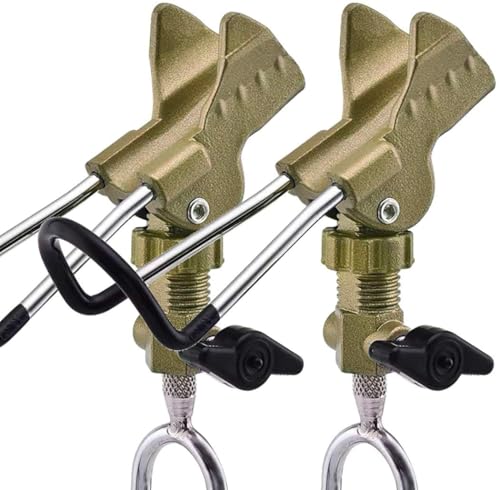
On the bank, there is no rail and no deck, so the holder is a spike — and the GOLDEAL pair is the straightforward version of that idea in the right material. Each holder is stainless steel, with a pointed ground spike, a cradle that adjusts 360 degrees, and a folding design that packs flat in a tackle bag. Stainless is the correct call for something driven into wet mud and left there: it will not rust out over a season the way painted mild steel does.
The cradle holds the rod at whatever angle you set, which lets you fish the two bank positions that matter. Low and nearly parallel to the water suits circle hooks, which set themselves as the fish moves off and loads the rod. Higher, with the tip up, suits bite-watching and keeps line out of shoreline brush. A two-pack means you can run one of each, or spread two baits at different distances — how most bank catfishing actually works.
Now the honest part, because it applies to every spike holder ever made: a spike is only as good as the ground. In soft soil and sand, drive it deep — most of the spike buried — and it will hold against hard strikes. In rocky or root-bound banks, a spike may only go in two inches no matter how hard you push, and a holder sitting that shallow can lever out when a fish hits. Carry a small mallet in the camp kit; it doubles the ground a spike can handle. Where the bank is solid rock or concrete, no spike works at all — switch to a clamp holder on a bucket, a cooler, or a chair frame instead.
Specs
- Mount: ground spike for soil and sand banks
- Adjustment: 360-degree cradle adjustment; folds flat
- Material: stainless steel
- Pack: 2 holders, about 420 g total
Fishin’ Stix Trident Telescoping Fishing Rod Holder

The Fishin’ Stix Trident solves the two bank problems the simple spike does not: height and soft ground. The holder telescopes from 12 inches out to 30 inches, so on a steep or brushy bank you can raise the rod until the line clears the snags at the water’s edge, and in sand — surf fishing, reservoir beaches — the longer shaft plants deep enough to stay planted. The shaft is tubular steel with a non-slip nylon cradle, and the design is built to hold against the hard-running catfish and surf species that snap flimsy stakes.
Telescoping is also this holder’s trade-off. A two-piece shaft has a joint, and a joint is where grit gets in and where flex concentrates; rinse the shaft after sandy sessions and extend it fully rather than fishing it at a half-locked middle length. The cradle is open, with no retaining ring, so the same attended-fishing rule applies as with the PLUSINNO clamp: set the drag to give line on the strike, especially at taller settings, where a yank has more leverage against the stake.
Specs
- Mount: ground stake for sand and soil; telescoping shaft extends from 12 to 30 inches
- Construction: tubular steel shaft with non-slip nylon cradle
- Rated capacity: built for hard strikes from large fish, per the maker
- Use: surf, beach, and bank fishing for catfish, bass, and similar species
How to Choose the Right Rod Holder
Start with where the rod will sit, because that decides the mount before anything else. A boat with a flat gunwale or deck takes a bolted mount like the Scotty, the most secure arrangement of all. A boat you cannot or will not drill takes a clamp, and then the only question that matters is whether your rail falls inside the clamp’s opening range — measure the rail and note its shape, round or square, before ordering. Pontoon owners should start with square-rail mounts: adapting a round clamp to a square rail is the most common cause of holders that slowly rotate and dump rods. On the bank, the ground decides — soil and sand are spike country, rock and concrete are not.
Second, think about retention. A locking ring, like the Scotty’s, physically prevents a rod from leaving the holder — what you want for trolling, for unattended rods, and for any drag set tight. Open cradles are fine for attended fishing with the drag set to slip on a strike; that drag setting is not optional, it is the retention system. Whichever style you choose, test it the way a fish will: rod in, then pull up and forward hard. If it moves, the fish will move it more.
Third, set the rod angle for the fishing, not for looks. Circle hooks work by letting the fish load the rod until the hook turns into the jaw corner, and that happens best with the rod low, pointed near the bait, so the fish pulls against a smooth, steady bend. J-hooks and bite alarms want the opposite: tip up, line visible, slack managed so you can see or hear the take. A holder that adjusts through a wide range lets you do both; a fixed-angle holder forces one style on you.
Finally, a word about the PVC pipe holder, because it genuinely works: a length of pipe on a stake is light and fine for panfish and light lines. Its limits are real, though — no retention, no angle adjustment, and PVC that goes brittle in cold weather. The ready-made holders in this guide exist to fix exactly those things, and where a strike is a genuine yank, the fix is worth having.
Frequently Asked Questions
Can a fish really pull a rod out of a holder?
Yes, and it happens every season. A hard strike pulls up and forward, which is exactly the direction an open cradle releases. Locking-ring holders prevent it mechanically; with open holders, the defense is a drag set to slip before the rod can be dragged, plus a spike driven deep or a clamp fully tightened on a rail it actually fits.
Why did my bank spike pull out of the ground?
Almost always depth. A spike buried only a few inches has almost no leverage resistance, and soft soil makes it worse. Drive the spike as deep as it will go, angle it slightly away from the water so the pull drives it deeper rather than levering it out, and use a mallet on firm ground. On rock or riprap, switch to a clamp holder on a bucket or cooler instead.
Will a round-rail clamp work on my pontoon’s square rails?
Poorly. A round clamp touches a square tube on two edges, so it rocks under load and loosens. Use a mount made for 1-1/4 inch square tube, like the Brocraft above, or a dual-shape jaw designed for both profiles, like the PLUSINNO clamp. Matching the clamp to the rail shape is the single biggest factor in whether a rail holder stays put.
What rod angle is best for catfishing from the bank?
For circle hooks, keep the rod low and pointed close to the bait so the fish loads the rod steadily and the hook sets itself — resist the urge to grab the rod at the first twitch. For traditional hooks, a higher tip keeps you in contact and lets you see the bite. Either way, the holder has to hold that angle under load, which is a spike-depth and clamp-fit question, not a materials question.
Conclusion
Buy the holder for the mount first and the security second, and you will not lose rods. Boat anglers with a drill available should start with the Scotty Powerlock and its locking ring; no-drill setups are covered by the PLUSINNO clamp, and pontoon owners should go straight to the Brocraft square-rail mount. On the bank, the GOLDEAL pair handles ordinary soil banks, while the telescoping Fishin’ Stix Trident is the one to carry for sand, surf, and snaggy banks. Whichever you pick, drive it deep, clamp it on a rail it fits, set the drag to slip, and do the pull test before the fish does it for you.
More from Amazon
Programs that pair well with the guide above. Offers and eligibility are set by Amazon and may change.
Free shipping on eligible items, Prime Video and more. Eligible new members can start with a free trial.
Start a Prime free trialA Prime membership for ages 18-24 with a trial period. Eligibility is set by Amazon.
See Prime for Young AdultsAudiobooks and podcasts to listen to on the go. Eligible new members can start with a free trial.
Try Audible freeAd-free music streaming. Eligible new subscribers can start with a free trial.
Try Music Unlimited freeAs an Amazon Associate we earn from qualifying purchases.

Write Your Review
No reviews yet. Be the first to share your experience!